

Hits That Took Over The '80s Thanks To College Radio
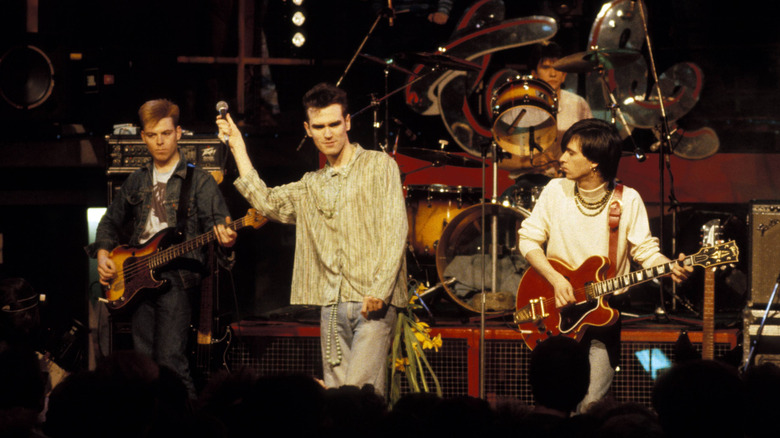
Before the age of alternative rock, there was the era of college radio, a span in the '80s that introduced the world to some of the biggest future rockers in the world. This wasn't a format that played tunes by rockers chasing college degrees; it was a haven for indie bands and smaller-label acts that appealed to a demographic craving something between totally underground and obnoxiously mainstream. It gave listeners longing for unique sounds a way to find exciting new bands that didn't get the spotlight, and usually didn't want it. Regardless, there were certain songs that shone all on their own, capitalizing on the college radio airwaves and taking over the '80s by offering the coming Gen X alt-rock crowd some counterculture relief from the commercialized mainstream music that was too uncool for school.
While the college radio scene was the place to find music you couldn't hear on bigger stations around the country, acts like R.E.M. found footing with "Radio Free Europe," a perfect first try that offered high-minded references written in washy, watercolor imagery with an infectious beat and memorable melody. On the other end of the spectrum, Violent Femmes staked their claim on the college radio front with the unkillable "Blister in the Sun," a frenzied post-punk bouncer that cropped up again and again. These and more became the soundtrack of the matriculating crowd that had outgrown disco and weren't about to embrace hair metal — in other words, the college students of the '80s.
Radio Free Europe — R.E.M.
The golden sons of Athens, Georgia, R.E.M. hit the scene in 1980 and showed the music world the right way to jangle, though their idiosyncratic blend of folk and rock had a hard time finding a spot in the general populace. Thanks to college radio stations launching a little free-speech protest tune called "Radio Free Europe," the band received airplay with the co-eds looking for something unique to play on their Walkmans and hi-fi systems (this was pre-CD times, remember). This was R.E.M.'s debut single, an auspicious introduction to a band that would soon become one of the biggest Grammy-snubbed acts in the world. It would be re-recorded for the band's debut album, "Murmur," in 1983. But in 1981, they were still serving indie-style, socially conscious impressionism in a pre-shoegaze mumble that Michael Stipe helped originate.
Thanks to their underground campus introduction, R.E.M. didn't stay in the slipstream for long. By the mid-'80s, traditional and alt-rock radio picked up what the band was putting down and started spinning their tunes for a broader audience. With "Radio Free Europe" sending its college radio transmission as an early signal for things to come, the band went on to become one of the biggest acts of the late-'80s and early-'90s. The song was even re-released in 2025 to protest free-speech clampdowns in democracies around the world, showing R.E.M.'s college-radio-ready prescience from decades earlier.
Blister in the Sun — Violent Femmes
The high-energy sizzle of "Blister in the Sun" set Violent Femmes on a collision course with everlasting college radio fame in 1983. After appearing on the band's debut album, it became a single promoting the 1997 dark comedy "Grosse Pointe Blank" and found new life as a nostalgic hit. A live version from the Femmes' album, "Viva Wisconsin," released in 1999, showed that this college classic had no intention of going gently into that good night. With its mix of surf-punk-ish guitars and sassy, spirited delivery, it transitioned easily into an alt-rock favorite and demonstrated its shapeshifting ability to fit into musical era after musical era.
The skate and surf punk scenes had a ready backing track for their hang-tens and ollies, thanks to the Femmes' tricky percussive guitar-and-drum interplay. Controversy unrolled over the rumored illicit nature of the lyrics, though as vague as they are (aside from the lines "I'm so strung out / I'm high as a kite," which definitely point to substance use), they could have been about a day of sheer happiness and self-confidence if listeners wanted them to be. The song became so ubiquitous that it was even covered by drag idol Trixie Mattel and used in a Wendy's commercial, which led to a lawsuit over royalty sharing among band members in 2007.
How Soon Is Now? — The Smiths
When the head of your record company refers to your song as the '80s version of "Stairway to Heaven," like Sire's Seymour Stein said about The Smiths' college classic "How Soon Is Now?," you know you have a lasting tune on your hands. Surly Morrissey is at his complainy-pants best in this cinematic potboiler of a single; Johnny Marr's guitar work shimmers and broods in equal measure, a billowing sonic curtain that casts mesmerizing shadows you can lose your soul in. "You shut your mouth, how can you say / I go about things the wrong way?" Morrissey asks in his warbly, mournful baritone, "I am human and I need to be loved / Just like everyone else does." If you're looking for patient zero in the emo pandemic that followed, you've found him.
Obviously, the song was too heavy to fit alongside Whitney Houston and Phil Collins when it was released in 1985. But it was custom-made for college radio and became an enduring milestone for how emotionally expansive rock subgenres could be. Decades down the line, when American Idol Kelly Clarkson covered the song for her "Kelly-oke" segment, "How Soon Is Now?" proved to be a flexible tune that could transcend the shackles of mere alt rock if given enough time. Being a ubiquitous college radio favorite in the neon decade couldn't pigeonhole it forever, even if it did take nearly 40 years to break through to the so-called heights.
Just Like Heaven — The Cure
Who would have thought a goth powerhouse like The Cure could have conquered both college radio and mainstream music with a joyous tune celebrating the sweetness of love? "Just Like Heaven" may have started out spinning on college stations in 1987, but it sparked a happy sensation on alternative rock radio and made a cannonball-sized splash in the Billboard Hot 100. It landed at No. 40 in January 1988, a Top 40 first for the band and the start of a run that would keep the band hopping through the mid-'90s.
Listeners couldn't get enough of Robert Smith's brittle warble rejoicing in his dear one's sweetness, and other bands couldn't wait to create their own sparkly cover versions. It was a vibrant surprise that enjoyed numerous needle-drop exposures in films and TV episodes, propelled by the love the Gen X college crowd maintained for the tune. The song even inspired the title of a 2005 rom-com starring Reese Witherspoon — about as un-college radio as possible. But when it touched down on university playlists back in the late-'80s, it was one of the trickiest twists to be pulled by an otherwise somber band known more for its spookiness than its charm and cheer.
Here Comes Your Man — The Pixies
The undeniable cheeriness of The Pixies' "Here Comes Your Man" gave 1989 college radio a pop of pep that showed brooding and contemplation weren't all there was to the underground music circuit. Vocalists Black Francis and Kim Deal offered a sarcastic alt-Sonny and Cher vibe as their lyrics subverted the notion of romance with sly snark. The verses read like literary '60s folk-beat poetry of the highest order: "I know the nervous walkin' / I know the dirty beard hangs / Out by the boxcar waitin' / Take me away to nowhere plains." With a twangier arrangement, it could even come across as a classic country railroad tune. But the melody's sunny brightness makes it an undeniable college pop tune that hits the singable chorus of "Here comes your man" with all the peppiness the band can muster.
It became a No. 3 hit on the alternative airplay chart, setting the bouncy guitar tones and gleefully punkish vocals on a trajectory toward college radio classic status. That's pretty solid movement for a simple tune Francis wrote as a teenager. He was even inspired by college radio elder statesmen R.E.M. to include the word "boxcar," turning the scene into a self-referential community of musicians doing their own thing and getting it heard by the campus masses.