

The 5 Best Creedence Clearwater Revival Songs That Aren't Fortunate Son
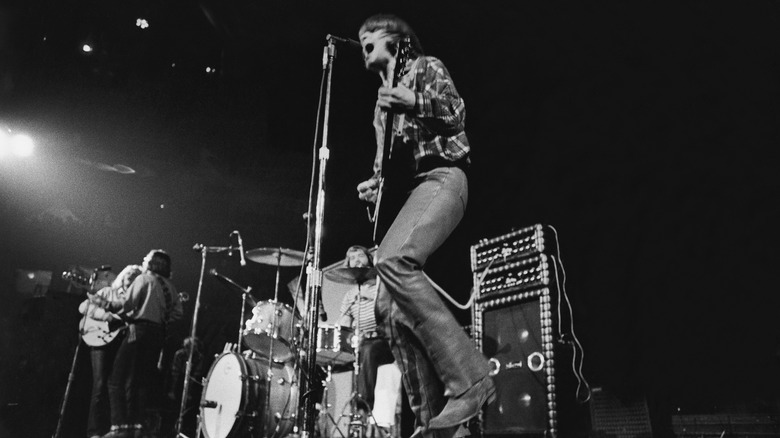
While "Fortunate Son" is, without a doubt, the signature Creedence Clearwater Revival hit, the band has a lot more to offer. Whether you were down on the corner or up around the bend the first time you saw the rain, there's more than enough CCR classics to make Mary proud. Sure, "Fortunate Son" became so synonymous with the Vietnam war that it's been featured in everything from "Forrest Gump" to the video game "Bioshock: Infinite," but that cultural ubiquity is only part of the band's story.
With that in mind, here's a look at the best CCR tracks that aren't scorching anthems to the hypocrisy of patriotic displays from draft-dodging rich kids. The rugged everyman relatability of John Fogerty and company is on display throughout this list of working-class anthems. So, let's take a look at the prodigious hits of the band that put out three hit albums in one year (remember when bands did that?).
Proud Mary
John Fogerty may have written it after getting an honorable discharge from the army reserves, but the meaning behind the 1969 song "Proud Mary" is universal. As the Fogerty himself tells the story, he opened an official-looking envelope, read the joyous news therein, turned cartwheels in the front yard, and went inside to write Creedence Clearwater Revival's breakout hit. The result was a song that listeners from all walks of life can relate to: the simple joy of disconnecting from the modern world and drifting away on steady currents. The track went on to astronomical success, hitting No. 2 on the Billboard Hot 100 and no less than Bob Dylan declaring it to be his favorite song of the year.
But the legacy of "Proud Mary" doesn't end with it being CCR's first success story. The song went on to find a second life as an R&B and soul standard with hit cover versions released by musical group Ike & Tina Turner and artist Solomon Burke. Those are the most well-known renditions, but the track has been redone by everyone from Checkmates, Ltd. to Tom Jones to Brush Arbor. Even Star Trek's Leonard Nimoy recorded his own rendition, helping to ensure that the track would live long and prosper for generations to come.
Bad Moon Rising
You might not realize that a 1941 supernatural classic inspired one of Creedence Clearwater Revival's best charting singles, but that was the case with "Bad Moon Rising." According to John Fogerty, he had been mulling over the phrase "there's a bad moon on the rise" as a potential hook when he recalled the 1941 dark fantasy film "The Devil and Daniel Webster" about a wayward soul who makes a deal with the devil. For Fogerty, the ominous implications were less a literal retelling of the story than a metaphor for the social unrest of the United States in 1969.
"Bad Moon Rising" was another solid hit for the seemingly unstoppable band and went to No. 2 on the Billboard Hot 100, one of five Creedence Clearwater Revival songs to hold the position. Not bad for a song whose hook is commonly misheard as "there's a bathroom on the right."
Down on the Corner
Although the omnipresent "Fortunate Son" made Creedence Clearwater Revival a go-to protest band for the Vietnam era, much of their work was devoted to what would appear to be apolitical, slice-of-life meditations on the affairs of the common folk. "Down on the Corner" is one such instance: Fogerty sets aside the proletarian rage of the working class and turns his attention to a cheerful celebration of a local band of street buskers drawing a crowd of appreciative onlookers.
From an arrangement standpoint, "Down on the Corner" actually does a great deal to evoke the atmosphere it aims to describe. The bassline is aggressively simplistic, as are the chordal vamps. It feels tailored specifically to conjure up images of the kind of easily structured jam that emerges when local musicians begin laying it down together. We're left wishing we could go join the crowd dancing along to "Willy and the Poor Boys." "Down on the Corner" hit No. 3 on the Billboard Hot 100 with "Fortunate Son" as a B-side. We'll let it slide this time.
Have You Ever Seen the Rain?
John Fogerty has an undeniable gift for making profound statements out of the gentle minutiae of everyday life. In the case of "Have You Ever Seen the Rain?" a series of ruminations on the significance of rainfall on a sunny day are meant to foreshadow the frontman's own burgeoning awareness that Creedence Clearwater Revival would not be together much longer. Fogerty doesn't sound enraged at the mounting tension between himself and his bandmates, just resigned to their fate and embracing it with gentle, reflective good humor.
Sadly, the track proved to be a portend of things to come. Tensions had mounted within the band regarding Fogerty's tight grip on the creative reigns, but he had a very solid justification: Strict adherence to his vision had made the band astronomically successful. Nevertheless, the frontman yielded to his band's demands and agreed to an even partnership. The new dynamic initially proved fruitful with "Have You Ever Seen the Rain?" becoming another stellar hit, but it was not to last. Tom Forgerty, rhythm guitarist and brother to John, soon parted ways with the band and the remaining members released 1972's "Mardi Gras," a widely ballyhooed shortfall of an album that led to the group's demise.
Up Around the Bend
The lyrics to "Up Around the Bend" are more than a little ambiguous. Apparently there's a nice place to hang out just around the next curve in the road and ... that's it. For what it's worth, they're apparently open to philosophical dialogues about the nature of perpetual motion. But not every Creedence Clearwater Revival song has to make a major statement. Fogerty was all too aware that good times and good time rock 'n' roll were at the heart of CCR. What "Up Around the Bend" lacks in lyrical depth it makes up for in infectious songcraft and righteous delivery. The arpeggiated opening guitar riff segues into Fogerty's euphoric, wailing rasp of a vocal. It simply hits a hard rocking sweet spot in the laid-back blue-collar mind. That good cheer seems to radiate across the band as there's an added sense of determination in the up-tempo groove.
Altogether, this serves as a solid reminder that the flower power generation wasn't all about Vietnam protests and outrunning tear gas: There was a genuine appreciation for taking time out to relax and enjoy life. The song went to No. 4 on the Billboard Hot 100 in April of 1970, a positive start to a decade that would soon see the group come to an end. Their tumultuous falling out would underscore the fact that 1969 was the best year of Creedence Clearwater Revival's career, but at least there were some more solid classics shortly thereafter.