

5 Creedence Clearwater Revival Songs That Prove 1969 Was The Best Year Of Their Career
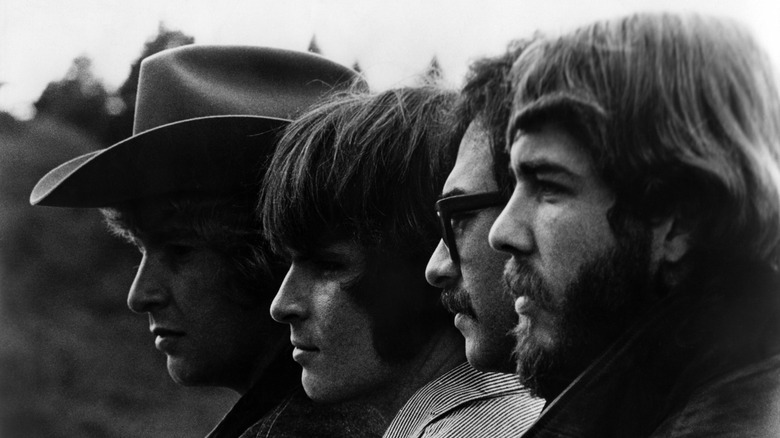
Does anyone have more perfectly singable songs than Creedence Clearwater Revival? Thanks to John Fogerty's natural songwriting talents, the quartet and their "swamp rock," as it was dubbed, overwhelmed the musical world of the late '60s and built a legacy practically overnight. A compilation album like 1976's "Chronicle — The 20 Greatest Hits," a vinyl that every classic rock fan should already own, tells the whole story. But 1969 was the band's best year of their career.
All of Creedence Clearwater Revival's seven albums fall within a mere four years, from 1968 to their official breakup in 1972, which makes choosing their best year easier. It also makes it tougher because most of their catalog is comparably excellent (maybe excluding their last album, 1972's "Mardis Gras"). Their hits are spread across their albums, too, though three of their five songs to reach No. 2 come from 1969 (with no No. 1s — a surprising record). That was a wildly prolific year for Creedence Clearwater Revival when they released three entire albums: "Green River," "Bayou Country," and "Willy and the Poor Boys."
Those three albums pretty much cinch our case for 1969 being their best year. Our five songs from that year exemplify Creedence Clearwater Revival's finest characteristics: effortless songwriting, universal accessibility, and refined simplicity. Even whittling our list down to five songs is tough, non-singles included. In no particular order, here we go.
Proud Mary
We might as well start with a whopper of a classic rock song that we'll be blasting on repeat 'til the day we die: "Proud Mary" from Creedence Clearwater Revival's second album, 1969's "Bayou Country." This is a fitting first choice, as the name of the song is the very first thing that John Fogerty wrote in his songwriting notebook after being discharged from active duty in the U.S. Army in 1967 and returning home to El Cerrito near San Francisco. It wound up being Creedence Clearwater Revival's first No. 2 in 1969. Bear in mind that we're focusing on Fogerty winning back the rights to his music in 2023 following a 50-year court battle, making Creedence Clearwater Revival's music his music.
Fogerty didn't write "Proud Mary" then, though. Speaking from the amazing Red Rocks Amphitheatre in Colorado in 2024 on his YouTube channel, Fogerty said that he went back to his then-untitled song in 1968 and finished it in about an hour, lyrics and all. He knew it was "the best song I'd ever written," "a classic," and especially loved the now iconic "Rollin', rollin', rollin' on the river" lyrics. As for the title, he looked back to that notebook he'd bought the year prior and saw, "Proud Mary." The rest is history.
All this is to say: "Proud Mary" feels so effortless and spontaneous because that's how it was written. The music was winding around Fogerty's skull long before he wrote it, intermingling with his post-Army-discharge feelings, waiting for the chance to be spun. It's practically effervescent, on top of being not only unbelievably tightly written and singable, which made it perfect for Tina Turner and Ike Turner to cover (netting them their only Grammy).
Green River
Go ahead and give "Green River" a listen, even if you've heard it a thousand times before. Focus just on the carefree, jaunty music and ask yourself what it feels like. The log where catfish bite, perhaps? Your rope still hangin' to a tree? Kickin' your feet way down the shallow water? Even if you've never experienced that kind of free, outdoorsy kind of childhood — full of mud, bare feet, and playing around by ponds and in the grass — "Green River" can transport you there. No matter that it's a mere two-and-a-half minutes long, John Fogerty accomplishes exactly what he set out to do with "Green River" from Creedence Clearwater Revival's 1969 album of the same name, which is translate experiences from his own childhood to the band's audience.
As Fogerty said in a 2012 Rolling Stone interview, "Green River" is about Putah Creek about 20 minutes west of Sacramento along I-80. His family visited it when he was a child, when he mentally dubbed it "Green River." The Creedence Clearwater Revival song of the same name is composed of exactly what its lyrics describe: Little snippets of memories assembled into a song about being able to return to an idyllic, unspoiled place. As the song's lyrics culminate, "You're gonna find the world is smolderin' / And if you get lost, come on home to Green River."
Like a lot of other Creedence Clearwater Revival's songs, you might not even know the lyrics to "Green River" or know its personal backstory. But the music communicates them implicitly right down to its loose and twangy guitars, lounging mid-tempo rhythm, and simple fills that sound like sparkling childhood feelings. It makes listeners wish for green rivers of their own.
Down on the Corner
Released on 1969's "Willy and the Poor Boys," "Down on the Corner" is another one of these spontaneous creations that flowed from the pen of John Fogerty. Yet again sparked by some real-world event — some little nugget that he experienced — he said on the "Zach Sang Show" that "Down on the Corner" came from seeing some Disney ad for what was apparently called a "Super Pooh Package" (speaking of Winnie the Pooh). Fogerty looked at it, tilted his head a bit, and heard "Willy and the Poor Boys" in the name. Hence the record title, its lead track, and its chorus, "Down on the corner, out in the street / Willy and the Poor Boys are playin' / Bring a nickel, tap your feet."
Like a lot of Creedence Clearwater Revival's songs, the music for "Down on the Corner" is exceedingly simple, but not in an undercooked or lazy way. Like "Green River," "Down on the Corner's" music fits its story to a T. We could use the word "jaunty" again to describe the song's main bass riff (you'd recognize it on the spot), which sounds exactly like the four kids described in the song — Willy, Rooster, Poor Boy, and Blinky — playing their makeshift instruments on a street corner. The song is a bit clanky and clangy, and it's as unfazed as you'd imagine those kids would be.
As Fogerty said on the "Zach Sang Show," "Down on the Corner's" music just came to him. He was singing the song's verse melody and just heard its bassline — simple as that. Such songwriting only adds to the whimsy and timelessness of the track, as well as the case for 1969 being Creedence Clearwater Revival's best year.
Bad Moon Rising
"Bad Moon Rising" from 1969's "Green River" comes equipped with quite the backstory. As John Fogerty explained on his YouTube channel, the song's name comes from astrologically minded individuals of the late '60s, when people would walk up to each other and ask, "What's your sign?" Rather than such-and-such sun sign, moon sign, or a sign like Aries rising, Fogerty went with "bad moon rising." Why? He has no idea, nor does he know what it means. He just liked the sound of it, which came from the same songwriting notebook that contained the title, "Proud Mary." Astrology, plus inspiration from a 1941 horror film featuring a Faustian bargain, plus the music, all came together into "Bad Moon Rising," a tune that defined rock history in 1969.
Unlike the other tracks in this article, Fogerty didn't personally experience "Bad Moon Rising's" apocalyptic "earthquakes and lightnin'," "hurricanes a-blowing," "rivers overflowing," and "voice of rage and ruin," all of which sound better suited to death metal than the light bounce of "Bad Moon Rising." But maybe that's why the song works — because it sounds like a lighthearted romp at the end of the world.
The song does contain a bit of darkness, though. As Fogerty said on his YouTube channel, it's the first track he wrote with a deeper guitar tuning where every string was tuned down a step, like how guitar pioneer Lead Belly used to tune his 12-string down two steps or more. Even if the effect isn't obvious, this kind of tuning impacts the music's overall timbre. "Bad Moon Rising" isn't as spooky as Creedence Clearwater Revival's cover of "I Put a Spell on You," but Fogerty did record it on an all-black guitar. So, you know, horns up.
Fortunate Son
Forget for a moment that you know Creedence Clearwater Revival's "Fortunate Son." Way before "Forrest Gump" and quadrillion other movies and TV shows overused the song and eroded its impact, it was just a song that summarized John Fogerty's feelings about all the political, social, economic, etc., upheaval of the '60s. Those feelings had been brewing since the 2nd grade, he said on his YouTube channel, when he first saw some wealthy politicians on TV riding down the street in a procession of black limos. It took all the way until Creedence Clearwater Revival were recording 1969's "Willy and the Poor Boys" for his feelings to cohere in a rapid, 20-minute songwriting session that produced "Fortunate Son."
No matter all the catchy, memorable track titles throughout Creedence Clearwater Revival's catalog and equally memorable lyrics and melodic hooks, "Fortunate Son" just might sit at the top. Little fragments of lines like "Some folks are born made to wave the flag," "Some folks are born silver spoon in hand," "I ain't no millionaire's son," "I ain't no senator's son," and so forth echo so strongly in the hearts and minds of many members of the public that "Fortunate Son" has become a go-to musical touchstone about class disparity and socioeconomic inequality. The song's rolling, opening bassline and rowdy, impossible-to-forget riff are precisely as growling, defiant, and bold as the song needs to be.
It's odd to think that "Fortunate Son," now Creedence Clearwater Revival's second-most streamed song on Spotify at nearly 2 billion listens, isn't one of the band's five No. 2 hits (it peaked at No. 3). But it goes a long way in making the case for 1969 being the band's best year.