

5 Guitar Solos You Won't Believe Were Played By The Same Guitarist
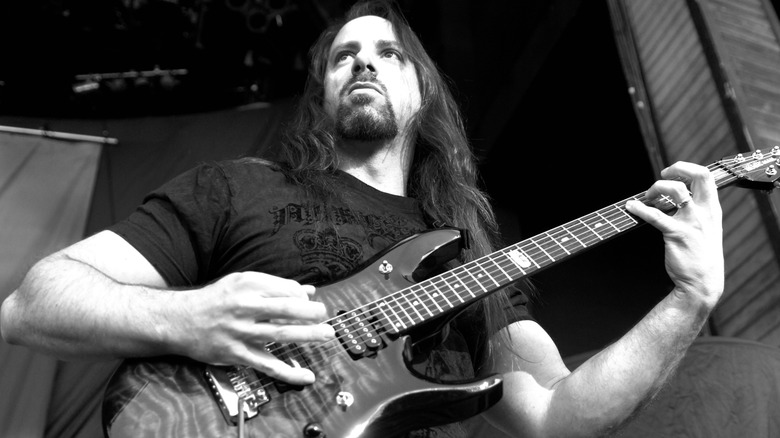
Dream Theater has enjoyed the kind of success few progressive metal bands ever achieve. There are prog bands that went mainstream with a pop hit, and then there's Dream Theater, who just somehow went mainstream. The group's extraordinary success, with album sales surpassing 15 million and a Grammy win, has been built not on sing-along radio pop songs but on mind-blowing instrumental prowess. At the forefront of that decades-long career of top-shelf musicality has been the band's longtime guitarist, John Petrucci.
While it's easy (and correct) to place John Petrucci among shredders like Steve Vai, Joe Satriani, and the leading lights of the Shrapnel Records catalog, that association doesn't fully encompass his stylistic range. So, with that in mind, we wanted to take a look at the solos that showcase not just a fleet-fingered metal maestro but a learned musician whose talents extend far and wide in the most unexpected of ways. From smooth jazz to flamenco and gospel, John Petrucci's stylistic skill is as boundless as his imagination.
Pull Me Under
The idea that an intricate, virtuosic prog metal epic inspired by "Hamlet" would be a hit single is a long shot in any year, but it seems all the more unlikely that it would happen in 1992, the year grunge ruled the music universe. Nevertheless, that's exactly what happened with "Pull Me Under," the lead single from Dream Theater's major label debut LP "Images and Words." In a lottery-winning level of good fortune, the band's demo came to the attention of Atco Records A&R rep Derek Shulman, who, in addition to having a knack for finding extraordinary hair metal bands, had been the lead singer for prog rock legends Gentle Giant — truly a match made in heaven for a group such as Dream Theater.
The song's success made "Images and Words" a gold-selling record, but the track serves as an excellent entry point into the range on offer in Petrucci's playing. Many of the elements most commonly associated with "shred" soloing are there: alternate picking delivered at dizzying speed, equally captivating legato runs, and wicked whammy bar dynamics. But underneath the showmanship is a well-structured solo with plenty of melodic payoff in its own right. Petrucci doesn't jump into the knuckle-busting madness straight away, and his solo lines build slowly, establishing a precise connection to the song's underlying harmonic context before the chops take over.
Thus, it is not just the chops but the melodic coherence informing them that sets John Petrucci — and Dream Theater as a whole — apart from the milieu of shredders showing off the results of endless hours of practice. We aren't just hearing technical skill but a penchant for composition on a grand scale. Those furious passages fly by, and our imaginations are filled with images and words all the while.
Hollow Years
"Falling Into Infinity" sees John Petrucci exploring new sonic territory, albeit under a certain degree of duress. By 1996, Dream Theater were two albums into their major label contract, and the suits at the top wanted more hits. Bowing to the pressure to produce more listener-friendly fare, the quintet released an album that relegates both their progressive and heavy metal vocabularies to background roles in favor of the closest thing such a band could deliver in terms of pop songs. While still enjoyable, it lacks the sense of free-flowing imagination that made the earlier albums so captivating.
That enforced atmosphere of restraint takes Petrucci in some unusual directions. He's still able to break out the shredding here and there, but it's tracks like "Hollow Years" that see Petrucci's inventive nature and diverse palette emerging in subtler, more enigmatic ways. The song is largely an acoustic ballad exploring themes of internal despair and interpersonal disillusionment, and that context motivates Petrucci's sparse, reflective lead work. It's the kind of smooth, adult contemporary playing that listeners might normally expect from Earl Klugh rather than the reigning king of cerebral metal guitar.
There's enough prog metal fan service on "Falling Into Infinity" to prevent Dream Theater from becoming one of those bands that lost the plot chasing a new sound. But the record isn't about those morsels of virtuosity. It's the band making the best of a newly attached management leash and finding satisfying moments in the restraint.
Solitary Shell
The title track of 2002's "Six Degrees of Inner Turbulence" is, like so much in the Dream Theater canon, a sprawling epic. Clocking in at a whopping 42 minutes, the song is structured as six interrelated vignettes telling the different life stories of patients at a mental health facility. In the midst of material covering post-traumatic stress disorder, bipolar mania, and postpartum depression, among other issues is "Solitary Shell," a look at a character with autism.
Petrucci and company approach each condition with a distinct musical style: PTSD is dramatized with speed metal, postpartum depression is a tender piano ballad, and autism is handled with up-tempo acoustic smooth jazz. That might seem like an odd choice, but it works in light of lyrics describing a blissfully detached introvert at peace in his isolation.
With that context in mind, Petrucci's solo, which echoes the folksy Americana stylings of contemporary jazz players like Pat Metheny and Bill Frisell, fits the context beautifully. It takes the carefree reverie of adult contemporary radio and uses it as an ironic means of articulating a state of being that seems paradoxically unproblematic to the person with the condition. From a phrasing standpoint, it's proof that the prog metal master would be equally at home playing with Spyro Gyra.
Furia Taurina
John Petrucci has never been shy about acknowledging electric/acoustic jazz fusion pioneer Al Di Meola as one of his major influences. On "An Evening with John Petrucci & Jordan Rudess," he wears it on his sleeve along with a plethora of other influences from Di Meola's Latin and Spanish-influenced world. The album, a recording of a one-off duo concert with Dream Theater keyboardist Jordan Rudess, opens with flamenco-infused solo guitar on "Furia Taurina" that recalls Di Meola's work with John McLaughlin and Paco de Lucia on "Friday Night in San Francisco."
While the techniques for picking through Latin jazz guitar passages are physically similar to furious speed metal runs, there is, nevertheless, a profound difference in the left-hand vibrato and modal phrasing that gives it that culturally authentic flair. Petrucci demonstrates that amidst all the practice necessary to maintain electric shred chops, he has time to hone an entirely different vocabulary of phrasing, vibrato, and melodic expression.
State of Grace
There are those rockers who partied way too hard and there are those who would rather take the time to reflect. In the case of "State of Grace," that contemplation takes the form of a gospel-infused piano duet with keyboardist Jordan Rudess. Recorded in 1998 as part of the self-titled debut album from Liquid Tension Experiment, Petrucci sets aside dazzling chops altogether for a hypnotic, meditative work that recalls both vintage gospel and contemporary Christian styles.
Liquid Tension Experiment was founded by Dream Theater drummer Mike Portnoy as an instrumental supergroup for the Magna Carta label. To that end, he enlisted King Crimson/Peter Gabriel bassist Tony Levin, fellow Dream Theater fixture Petrucci, and Jordan Rudess, then keyboardist for the Dixie Dregs but who would join Dream Theater soon after. The project as a whole is a delirious dreamscape of surrealistic shredding, ingenious improvisation, and aggressively avant-garde arrangements.
That context makes "State of Grace" all the more effective: this is a group of musicians' musicians who know when to step back from the freewheeling fretwork and let the human spirit take over. Petrucci certainly channels his inner David Gilmour throughout the performance in terms of sustain and vibrato, but by and large he lets go of rock star grandiosity and just does the Lord's work.