

The 5 Greatest Self-Taught Bassists Of All Time
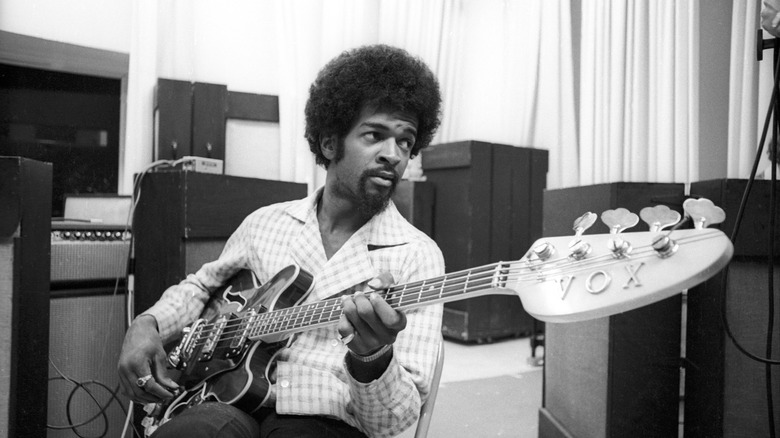
It may be true that the bass guitar is one of the easiest entry points to joining a band, but while almost anyone can learn the basics relatively quickly, playing it with style, finesse, and character takes a great deal of skill. Here, we're taking a look at the five greatest self-taught bassists, who managed to master their chosen instrument with little to no formal training.
Indeed, these bassists relied primarily on instinct to learn their instruments — Paul McCartney, who makes the list, has admitted, for example, that he never learned to read music despite his amazing six-decade career. And in several cases, not only did they become technically skilled, they also pioneered their own innovations, developing playing techniques that created entire new genres and changed the way bassists played thereafter. These five musicians are proof that you don't need to study music formally to become truly world class.
Jaco Pastorius
Considered by many critics to be the most technically adept electric bass player to ever have lived, Pennsylvania-born musician Jaco Pastorius learned his instrument almost entirely by ear. His father, Jack, was a distinguished drummer, and it seemed that Pastorius was going to follow in his father's footsteps and spend his musical life behind the kit.
However, music wasn't Pastorius' only childhood passion. He was fiercely competitive and loved games and sports, especially football. And it was while playing that he suffered a wrist injury that impacted his ability to hit the skins. He continued playing as part of a soul band called Las Olas Brass, but lost his place to another drummer. At the same time, there was a vacancy in the band for a bass player, so rather than quit the band altogether, Pastorius switched roles.
It turned out to be one of the most fortuitous changes of personnel in musical history, with Pastorius proving himself to be an innovative and expressive bassist who began to push his newly chosen instrument to its limits. Most notably, he innovated widely on the fretless electric bass, that allowed him to achieve many of the soundings that until then had only been possible on a traditional double bass. His solo career, work with jazz-fusion band Weather Report and others, and session work for artists as acclaimed as Joni Mitchell — he performed on her 1976 "Hejira" album — led many fans and critics to consider him the greatest bassist of all time. Pastorius died tragically in 1987, cutting short a glittering career.
James Jamerson
One figure that even Jaco Pastorius looked up to was the legendary Motown bassist James Jamerson. As a member of the record label's stalwart session band, the Funk Brothers, Jamerson performed on countless classics of the 1960s, helping to define the sound of soul throughout the era with a lively and infectious low-end that made people want to dance.
Before Jamerson, basslines in pop music were comparatively amelodic, blending in with the percussion to add rhythm. But Jamerson helped bring a new dynamism to the instrument, transforming it into a source of memorable melodies. Jamerson began mastering his chosen instrument as a teenager, beginning on a double bass and playing in both his high school band and at local jam sessions. Notably, he decided against a music scholarship, instead learning organically by playing with musicians in Detroit, where he relocated after his childhood in South Carolina. While much of his playing was rooted in jazz, he also became familiar with blues after joining Washboard Willie and the Supersuds of Rhythm, which led to him becoming a session musician.
With the Funk Brothers, he continued to work largely on instinct. Discussing his legendary partnership with drummer Benny Benjamin, Jamerson explained: "We didn't need sheet music. I started to play, he started the beat, we'd look at each other and know whether we needed a triplet, quarter triplet, or double time or whatever. We could feel the groove together" (via Classic Motown). Strikingly, he achieved all this by plucking the strings with just his index finger, an unusual technique among professional bassists.
Paul McCartney
Paul McCartney has had one of the most distinguished careers in the history of pop music. As a member of the Beatles, he was also part of the most celebrated rock band of all time, which created an immaculate discography of timeless tracks and redefined pop music in terms of its scope and ambition. McCartney is celebrated as an incredible songwriter, with an instinctive aptitude for melody as well as an exceptional ability to blend traditional forms of music with the avant-garde.
McCartney was primarily a guitarist and pianist in his youth, but found himself becoming the Beatles' bass player to replace previous bassist Stuart Sutcliffe, who left in 1961. However, the deeply competitive musician soon made the instrument his own, creating a lively, restless style of playing that adds a huge amount of energy and interest to their recordings throughout their discography.
Though a multi-instrumentalist, McCartney has stayed closely associated with the bass, having played the instrument for his later band Wings and typically using one for the majority of his live shows. Throughout his career, he has proven adept at incorporating different styles into his bass playing, such as funk, which underpins his overlooked, bass-driven 1978 track "Arrow Through Me." McCartney is critically acclaimed, but underrated as a bass player.
Bootsy Collins
Bootsy Collins has been a bass icon for more than five decades, having risen to prominence alongside the Godfather of Funk, James Brown, in the early 1970s as a member of his band the J.B.'s. Collins' bass playing — which involves locking into the drums at the start of the bar and creating space for syncopation and fills — is foundational to funk, and he later became a leading light of George Clinton's afrofuturist Parliament-Funkadelic movement, known as P-Funk, later in the same decade and performing on several classic funk albums. In the years since, he has performed with a wide array of musicians, as well as forging a career with his own group, Bootsy's Rubber Band.
Raised in Cincinnati, Ohio, Collins was inspired to pursue music after witnessing his older brother, guitarist Catfish Collins, practicing in the family home. He was also inspired by local jazz musicians he witnessed in the city. "Musicians were just cool, man," he told Red Bull Music Academy in 2011. And Collins himself has gone on to be one of the coolest, pioneering a style of playing that has been widely imitated, but rarely bettered by funk practitioners. "I had no training at all, man," he told Downbeat magazine. "None. It was all for the funk of it. Whatever I heard in my head, that's what came out." An enviable skill for any musician.
Larry Graham
Los Angeles musician Larry Graham is credited with being the primary creator of the slap-bass technique on the electric bass, influencing everybody from Bootsy Collins himself to the Red Hot Chili Peppers' Flea. Having inherited his first guitar from his father when he gave up playing, Graham taught himself to play the instrument and performed in a trio with his mother on piano and a friend on drums, during which time he also acquired a bass. But when the friend left, he found himself having to find a way of adding percussion to the duo's performances, turning to the bass instead of guitar. Still a teenager, he began plucking and slapping the strings to imitate the rhythm of the drums and began to develop his innovative style of playing.
His boisterous performances soon brought him to the attention of other musicians, and he joined Sly and the Family Stone in 1968, performing on early classics such as "Dance to the Music," the lyrics of which make special reference to the song's low end, supplied by Graham. Since then, Graham has remained prolific, becoming a regular fixture on the Billboard R&B chart with his own group Graham Central Station, helming the '90s group Psychedelic Psoul, featuring on the 1987 duet "If You Need My Love Tonight" alongside Aretha Franklin, and working as a songwriter and session musician for artists including Prince.