

The Folk Classic With No Known Author That Bob Dylan Made His Own
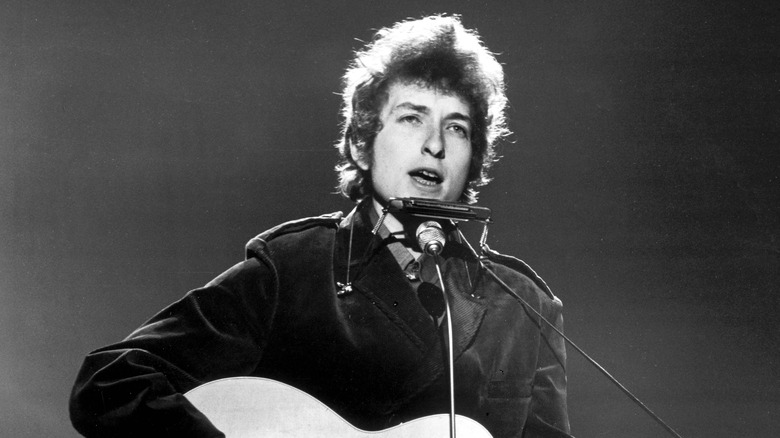
There are a few hit songs without any credited authors, some of which have been covered by different artists throughout the years. A good example is "The Demon Lover," a mysterious ballad that's said to have originated in 17th-century England before possessing the rest of the world. Also known as "The House Carpenter" (among other titles), Bob Dylan recorded his own version in the '60s, with the track later appearing on "The Bootleg Series, Vol. 1–3: Rare & Unreleased 1961-1991."
Dylan's rendition, "House Carpenter," is a fast-paced acoustic number that chronicles the story of a woman who leaves her husband and family to be with an old flame — a sailor who was lost at sea. However, there's a twist — and it's a twisted one at that — as the lover turns out to be a demon in disguise, and he leads her to her death. It's one of the many near-perfect songs in Dylan's oeuvre, and despite being a cover, the track is very much in line with his folk sensibilities.
"House Carpenter" is also one of Dylan's more haunting tracks. The premise of a wife leaving her family to suffer a grisly fate is inherently horrifying, and Dylan's stripped-back style only enhances the story. It might not be one of those creepy songs that listeners can't hear more than once, but it's pretty eerie all the same. That said, the lyrics can also be interpreted as a cautionary tale.
The deeper meaning of House Carpenter
"The House Carpenter" has been around for centuries, and scholars have long debated the song's deeper themes. The track is also known as "A Warning for Married Women," and it has been interpreted as an old, cautionary tale for women thinking about breaking their marriage vows. "House Carpenter" has also been interpreted as an anti-adultery track, as bad things happen to the protagonist after she leaves her husband.
The song can also be interpreted as a cautionary tale about embracing our most selfish impulses, with or without demonic prompting. The lyrics reveal that the woman is tempted away from her house carpenter husband and kids because her old flame comes promising wealth. She ultimately suffers for her decision, which seems like a pretty direct message about temptation having consequences.
Regardless of its meaning, Bob Dylan's version of "The House Carpenter" is one of many that have kept the ballad alive for hundreds of years. Is it the best one? That's subjective, but he made the song his own, and that's why it warrants every Dylan fan's attention.