

5 Nearly Perfect Bob Dylan Songs That Should Be Required Listening For Younger Generations
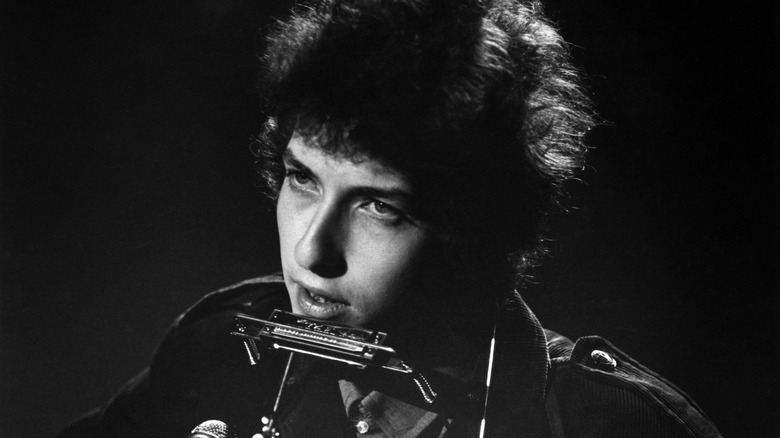
Bob Dylan's extensive catalog may seem a daunting task for any unfamiliar young listener, and though there are excellent enough points of entry for whatever stylistic preference a fan may have, these five tracks transcend all genre and preference as some of the strongest songs that the music legend ever recorded. The man known for his vast discography full of both famous and underrated songs — that we bet you haven't heard — boasts a number of songs that could be considered for such a music education requirement, but diving into each of Dylan's distinct eras with their own styles of masterpieces best showcases the singular talent he was.
In this list, we'll supply five of Dylan's very best musical compositions from five different eras of his career, starting with his freewheelin' folk of the early 1960s and ending with his award-winning resurgence in the late '90s. Though obvious tunes such as "Like a Rolling Stone" and "Don't Think Twice, It's Alright" are also fundamental tracks into understanding both Dylan and the '60s, the five compositions of this list separate themselves with a bit less star power (though some were certainly hits). Whether you're interested in a traditional folk song, an excellent pop tune, or a folk rock odyssey, we've got it all in this list of mandatory listens for any burgeoning rock 'n' roll fan.
Tangled Up in Blue
The entirety of the album "Blood On The Tracks" would fit right into mandatory listening for any youth going back to classic rock 'n' roll, but its opening track, on its own, is an essential song to get into Dylan. "Tangled Up in Blue" was released in January of 1975 along with the rest of the record, and it's an enthralling odyssey full of stories of love, adventure, and more, paired with a charming sound. The song was one of Dylan's most successful, peaking at No. 31 on the U.S. charts.
Dylan's songwriting is near its mountainous peak on this song, which blends different perspectives of one story, or a handful of short stories, in its seven verses. Its narrative is charming and compelling, the details are vivid and full of symbolism, and it's an all around fun listen aside from any artistic merit that it certainly has. "Tangled Up in Blue" fills its nearly six-minute runtime with hardly any breaks or filler, and a structure of melody in each verse, ending with the titular refrain, that perfectly suits the accompanying lyrics. The song blends many of Dylan's most prevalent themes into one excellent track, and it's as good a place as any to begin a journey into his music.
Desolation Row
This 11-and-a-half-minute folk song was the final impression on the mostly electric "Highway 61 Revisited," an album that both changed Dylan's career as well as rock 'n' roll music altogether. Though the album is best remembered for hits such as "Like a Rolling Stone," the gorgeous poetry of "Desolation Row" is one of the finest artistic statements Dylan ever made, and a definitive track in understanding Dylan's music.
The lyrics are rich with fascinating detail and symbolism, bouncing between literary giants like T.S. Eliot and Ezra Pound, fictional characters like Ophelia and Cinderella, and much more. It's as dense as a Dylan song comes, filled with an undeniably sincere sentiment in painting this fictional place that reflects so much of his, and the greater, reality. It carries a weight — with lyrics like its opening, "They're selling postcards of the hanging" — that blends with more comical themes, which are each made stronger by their own contrast. "Desolation Row" is open to many interpretations, as great lyrical works often are, and it's among the best representations of the lyricist that history has made Dylan out to be. Its driving guitar melody is simple and inviting, and it's a captivating and moving way to spend a dozen minutes.
One of Us Must Know (Sooner or Later)
Bob Dylan's 1966 album "Blonde On Blonde" blends Southern blues styles, both goofy and poetic lyrics, and much of the most abstract writing and titling that Dylan ever used, but it's also full of some of his most influential pop music, on par with that of bands like the Beatles. Hits like "I Want You" and "Just Like a Woman" are great examples of this, but the song that is the most essential to this era of Dylan is the infinitely listenable "One of Us Must Know (Sooner or Later)."
Built on jazzy pianos and blues-influenced swirling synths, the song is musically dense, rising to a climactic chorus in its classic Dylan breakup song style: "But, sooner or later, one of us must know / That you just doin' what you're supposed to do / Sooner or later, one of us must know / That I really did try to get close to you." Vocally, it's a bright and passionate performance, and among the best of the many peaks of "Blonde On Blonde," which is one of a handful of albums that helped define folk rock. This is an essential era of Dylan altogether, but the excellent tune of "One of Us Must Know (Sooner or Later)" makes it a can't-miss song for anyone exploring Bob Dylan for the first time.
Not Dark Yet
After a largely disappointing '80s, Bob Dylan returned to the limelight with "Time Out of Mind" in 1997, which is usually regarded as his comeback album — though he had been making solid tunes in the interim. The album ended up winning a Grammy Award for album of the year in 1998, and though this makes obvious the entire work is excellent, it's headlined by the stellar single "Not Dark Yet."
Though Dylan's croak — the bane of some music fans who write it off as a bad voice — is as nasally as ever, it matches the almost mystical charm of this track, which exists in a pensive near-purgatory. Lyrically, "Not Dark Yet" is a meditation on life and death, with unique Dylan twists of focus, and it's simultaneously empowering and melancholy-inducing: "Every nerve in my body is so vacant and numb / I can't even remember what it was I came here to get away from / Don't even hear a murmur of a prayer / It's not dark yet, but it's gettin' there." Stylistically, it's much different than the rest of this list, but "Not Dark Yet" is a window into another era of Dylan's career where he's at the top of his game.
Girl From the North Country
"Girl From the North Country" is a folk classic about a real person built upon traditional English songs, primarily the ballad "Scarborough Fair," but was made singular by Dylan as one of many headlining tunes of "The Freewheelin' Bob Dylan" in 1963. This original version is a gentle and airy tune, mirroring the beauty of the Northern country landscape Dylan sings of. It's a song of sentimental longing for a lover who once was, featuring another of Dylan's top qualities as a lyricist, his sincerity in love. "Please see if her hair hangs long," he pleads, "If it rolls and flows all down her breast / Please see for me if her hair's hangin' long / For that's the way I remember her best."
A few years later, Dylan re-recorded the song as a duet with Johnny Cash for his 1969 album "Nashville Skyline," which has now become one of his most popular tracks, with over 200 million streams accumulated on Spotify alone. "Girl From the North Country" takes on a more relaxed and uplifting sound in this rendition, where Dylan's pretty croon melds with Cash's deep drawl in one of the best duets of the 1960s.