

5 Everyday Places That Became Classic Rock Album Cover Landmarks
We may receive a commission on purchases made from links.
In the classic rock era, the album cover was almost as important as the music on the LP inside of its thin cardboard sleeve. The art and photography used on the outside teased and tantalized the far-out rock 'n' roll that awaited the record store browser or consumer, and it was a physical object they could hold in their hands and examine while the music mentally transported them. Some of the greatest album covers of all time were packaged LPs issued in the 1960s and 1970s, and they were often little more than a perfectly timed, planned, or executed photograph. Sometimes, these photographs captured a totally ordinary spot in the real world.
Here are five extremely well-known classic rock sleeves depicting everyday places that subsequently became landmarks and rock 'n' roll tourism destinations. These settings are forever tied to the histories of Led Zeppelin, Bob Dylan, David Bowie, the Beatles, and Pink Floyd. Whether you're a hardcore fan or a casual listener, the real locations behind these legendary album artworks are worth a visit.
Physical Graffiti – Led Zeppelin
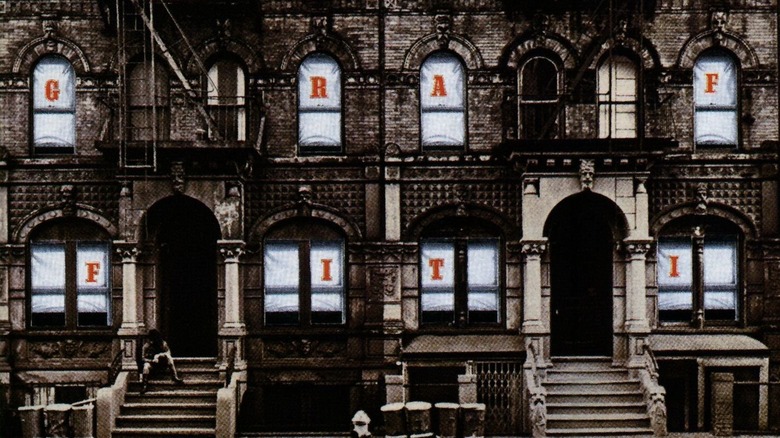
Released in 1975, "Physical Graffiti" is Led Zeppelin's second-best-selling album ever, moving 16 million units in the U.S. (versus 24 million for "Led Zeppelin IV"). The sleeve surrounding the vinyl that resides in so many record collections is both simple and complicated — an aging, big-city, multi-story building adorned with numerous intricate doorways, windows, and architectural flourishes. One of the best classic rock album covers of the '70s, "Physical Graffiti" is meant to evoke the imagery and feelings associated with low-cost urban apartment living. "I had come up a concept for the band based on the tenement, people living there and moving in and out," cover designer Peter Corriston told the New York Times.
Requiring a structure that would also boast clear symmetry and would work as a square image, Corriston wandered New York City for weeks in search of the right of the candidate, eventually discovering a complex in the eastern part of the Greenwich Village neighborhood. The two buildings are located at 96 and 98 St. Marks Place, just off of Avenue A. When Corriston took the photo, the place stood five stories high, but he had to take one floor out of the frame to meet space constraints for the final artwork. The mundane and unassuming building featured on the "Physical Graffiti" album is also covered in pop culture references.
The Freewheelin' Bob Dylan – Bob Dylan
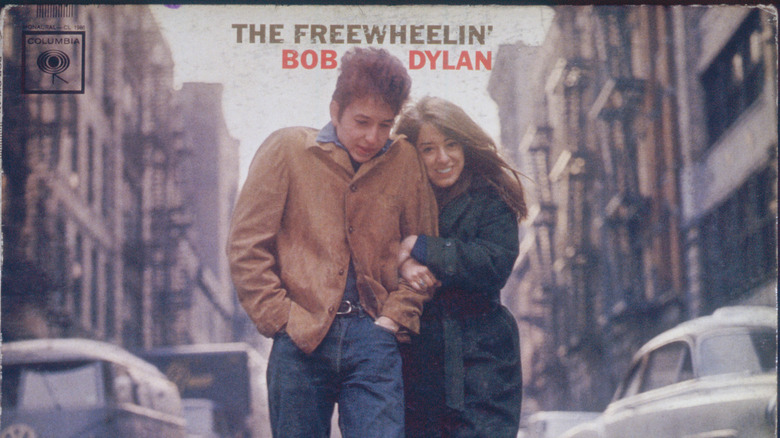
Bob Dylan's second album, "The Freewheelin' Bob Dylan," is the one that made the folk-rock troubadour a popular figure and superstar. It was Dylan's first LP to chart, and it was a Top 30 smash, containing classics like "Blowin' in the Wind," "Don't Think Twice, It's All Right," and "A Hard Rain's A-Gonna Fall." While the music is stark, the cover is warm, friendly, and even a little romantic. It depicts a pensive Dylan and a smiling Suze Rotolo, his partner at the time, walking arm in arm. The pair are captured shivering and snuggling together for warmth as they walk through a cityscape with snow and ice on the ground.
Dylan and Rotolo are mid-stride in the middle of a New York city street, with parked cars on both sides. That shot was secured by photographer Don Hunstein, who caught the couple as they traversed Jones Street in the Greenwich Village part of New York City. The couple lived just down the way in an apartment at 161 West Fourth Street.
The Rise and Fall of Ziggy Stardust and the Spiders from Mars – David Bowie
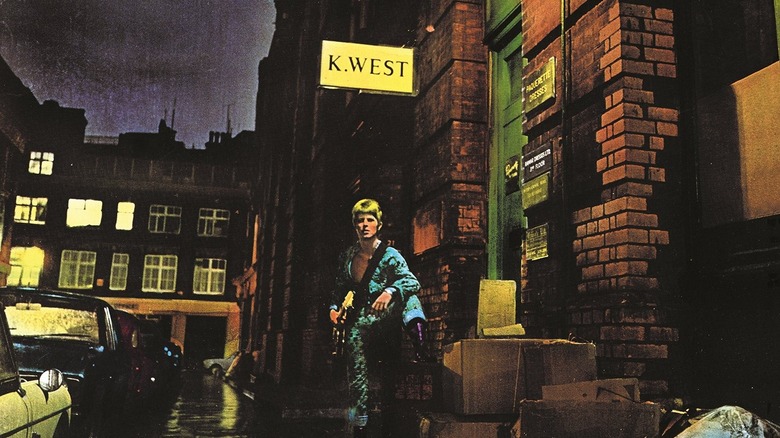
David Bowie officially committed to his persona of Ziggy Stardust — rock 'n' roll space alien, libertine, and messianic figure — with the 1972 glam rock concept album "The Rise and Fall of Ziggy Stardust and the Spiders of Mars." As such, the LP cover had to get across a lot of ideas, including Bowie's want to resemble some hybrid of a bug and the futuristic, mascara-wearing thug portrayed by Malcolm McDowell in the 1971 film "A Clockwork Orange," newly arrived and lost on Earth.
Bowie agreed to a photoshoot in January 1972 at the Regent Street adjacent studio of London photographer Brian Ward. During the session, Ward wanted to get some shots outdoors in the waning afternoon sunlight, but a flu-stricken Bowie didn't want to traipse around much in the rain or the cold. He posed nearby the studio in front of a furrier business at 23 Heddon Street, labeled "K. West." The sign came down in 1982, but a plaque marks and celebrates the site of the famous album cover's origin.
Abbey Road – The Beatles
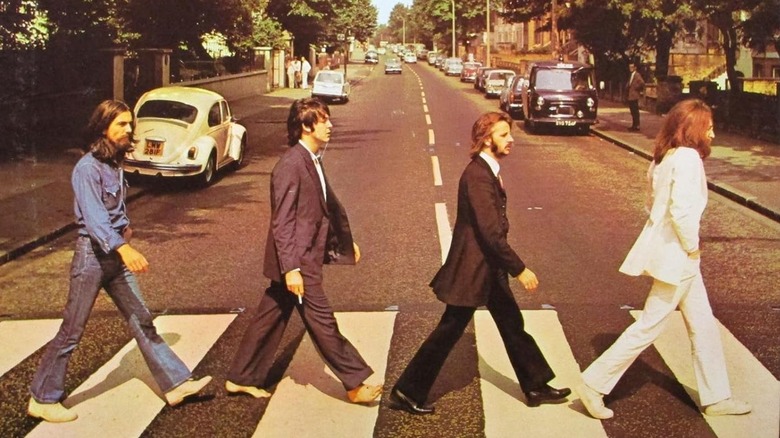
"Abbey Road" is among the most famous and instantly recognizable sleeves of all time. The classic rock vinyl cover has details you never noticed, like how the 1969 release by the Beatles doesn't include the name of the LP or the band on the front — the Fab Four were so popular they didn't need to do that. The cover comprises one whole image, that of the Beatles moving across a crosswalk (or a zebra crossing) in single file — John Lennon in a suit leads the way, followed by a similarly suited Ringo Star, a suit-wearing but shoeless Paul McCartney, and George Harrison in a denim shirt and jeans.
Countless tourists, visitors, and other musicians have since recreated the straightforward but iconic photograph at the real spot the Beatles posed for the picture, which member Paul McCartney conceived. John Kosh, creative director at the Beatles' Apple Records, organized the shoot. On August 8, 1969, the Beatles completed initial recording on "Abbey Road," exited their studios at No. 3 Abbey Road in London, and walked down to and across the crosswalk that was right there. Photographer Iain Macmillan snapped about six pictures while police blocked off traffic.
Animals – Pink Floyd
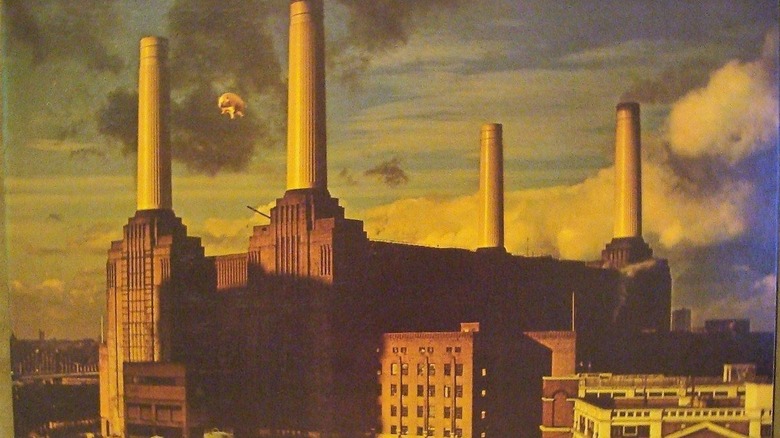
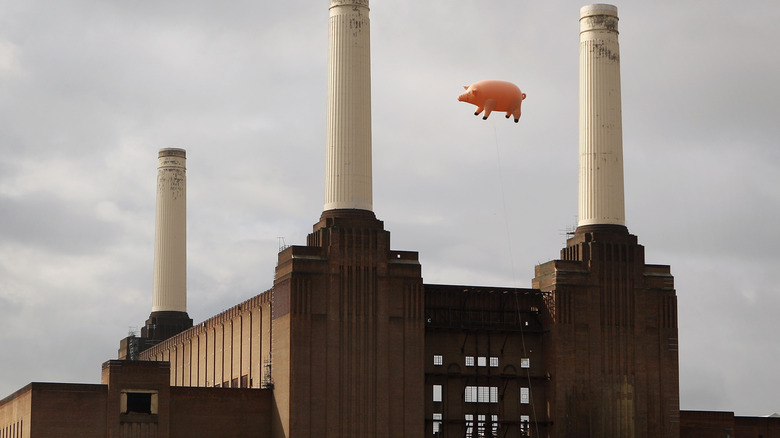
In 1977, Pink Floyd unleashed "Animals," another of its dour and experimental concept albums. Concerning the degraded and increasingly bleak social and political state of affairs in the 1970s, "Animals" was primarily written by bassist Roger Waters, who also came up with the idea for the cover. The sleeve shows off a looming industrial stronghold amid city buildings, with a coal-burning power station chugging black smoke into the air from its tall chimneys. Meanwhile, an inflatable pig floats through the sky.
Pink Floyd enlisted its favored design firm, Hipgnosis, to bring Waters' concept to life. Although the designers suggested they just take a photo of a power plant and edit in a separate photo of an airborne pig, the bassist demanded that the image be real and captured all at once. And so, a crew managed to send that 40-foot prop into the sky and get a picture of it as it passed between two smokestacks of the Battersea Power Station, which stands upon the bank of the River Thames southwest of London.