

4 Famous Songs That Started As Simple Warm-Up Exercises
There are those rock hits that have some truly bizarre origin stories. But for all the crazy true stories behind popular rock songs, some are simply born out of mundane practice regimens and a healthy dose of serendipity. To that end, we wanted to take a look at some of those classic tracks that started not with compositional intent but rather the sort of regimented noodling that musicians use to keep up their finely honed chops.
For this list, we wanted to delve into those parts that, on the surface, appear to have such dramatic musical gravitas that it seems startling to learn they were the product of blunt-force repetition and random stretches. Whether it's a picking exercise hailing the arrival of '90s metal or an afterthought bass groove reshaping a heavy metal innovator's latter period sound, there's a wealth of fascinating origin stories for us to delve into.
Cowboys From Hell — Pantera
1990's "Cowboys From Hell" came about as a conscious reinvention by a band that had spent the preceding decade mired in hair metal obscurity. Choosing to disregard their independently released glam-era albums altogether, the new LP became the group's official "debut," and with it came the groundbreaking power groove sound that would revolutionize '90s metal. The album's opening salvo — and hellacious title track — revolves around a ferociously precise 16th-note groove across a blues scale courtesy of guitarist "Dimebag" Darrell Abbott.
It's a riff that has powered countless mosh pits the world over, yet it had its humble origins as an exercise the guitarist played into a looper. Analyzed in that light, it becomes clear that the riff's ascending nature is intended to develop coordination between different finger pairings. It's the kind of intricate, precise riff that came to define Pantera's revolutionary new approach: the voracious intensity of speed metal paired with infectious grooves of funk.
That sound would go a long way to evolve heavy metal in the '90s, a decade in which traditional forms of the genre were sidelined in the face of grunge and alternative rock. By the end of the decade, heavy rock would return in the form of the hip-hop-infused nu metal genre, with Pantera heralded as an undeniable component in shaping the new sound. It was a tremendous legacy to leave behind even as the tragic real-life story of Pantera ended with Dimebag Darrell's on-stage murder in 2004.
No More Tears — Ozzy Osbourne
The bass line for "No More Tears," the classic title cut off of Ozzy Osbourne's 1991 hit LP, came about by accident even as the band was deeply enmeshed in the precise planning of a new sound. Worn out on '80s hair metal pastiche, Ozzy Osbourne and his intrepid support band were in the process of seriously reevaluating their style to such a degree that guitarist Zakk Wylde was consciously purging his lead vocabulary of techniques that could garner comparisons to Yngwie Malmsteen and Eddie Van Halen.
It was a laborious, precisely executed process that made the wholly random origin of the iconic "No More Tears" bass line all the more surreal. Simply, touring bassist Mike Inez plugged in at rehearsal and began to play. What started as a random warm-up quickly evolved into the album's title cut. That process is reflected in the song itself, with the bass line entering solo before gradually being joined by the rest of the ensemble. More impressive is how the part sounds initially off kilter as if to imply an odd meter before drummer Randy Castillo kicks in with a groove that keeps it locked squarely in 4/4 time.
While Inez would receive writing credits for "No More Tears," his actual playing is not heard on the album. That honor went to long-time Ozzy collaborator Bob Daisley, who had played on all of the singer's solo albums up to that point. Nevertheless, the off-the-cuff bass riff played a central role in advancing and reimagining Ozzy Osbourne's signature dark, fantastical, and eternally heavy sound.
Eruption — Van Halen
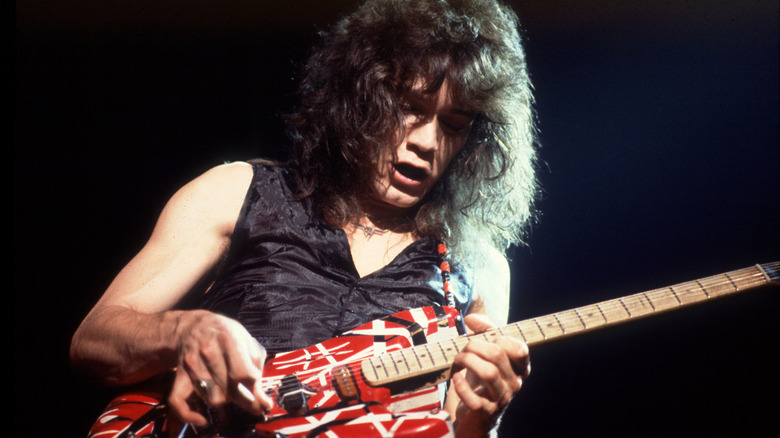
Van Halen's landmark self-titled debut album was, inarguably, a turning point for electric guitar as an instrument and the hard rock-heavy metal landscape as a whole. Amidst the swaggering alpha-male theatrics of frontman David Lee Roth and the steady, locked-in confidence of bassist Michael Anthony and drummer Alex Van Halen was a mind-blowing masterclass in guitar innovation courtesy of Edward Van Halen. Nowhere was that mesmerizing six-string ingenuity more apparent than on the instrumental "Eruption," a piece the young virtuoso originally used as a pre-show warm up with no intention of recording.
It was prolific rock producer Ted Templeman, on hearing Eddie Van Halen run the piece in the studio while preparing to record the band's eponymous debut, who insisted that the solo be put to tape. The guitarist was initially ambivalent about tracking the piece but was spurred on by Templeman's awestruck response. That initial fascination would soon be cast far and wide across the musical landscape, with a new breed of two-hand-tapping-obsessed guitar aspirants emerging from the sea of awestruck onlookers at what seemed less a guitar solo than an unrestrained defiance of the nature of reality. Not bad for a solo only ever intended to wake up Eddie's fingers backstage.
Life in the Fast Lane — Eagles
Although the mammoth success of 1976's "Hotel California" would be down to the popularity of its cheekily foreboding title cut, "Life in the Fast Lane" proved to be a chart-friendly banger as well. Clocking in at No. 11 on the Billboard Hot 100, the hard-driving country blues rocker proved to be one of the Eagles' enduring classics. Central to the song's appeal is the backhand-across-the-jawline smack of its opening riff. It's an iconic guitar riff that (wait for it) came from a warm-up exercise.
As Joe Walsh explained on the "Ultimate Classic Rock Nights" radio program, the guitarist had been approached by bandmates Don Henley and Glenn Frey for a more rock-oriented song motif. To that end, Walsh presented a riff that, until that point, he'd only ever used as pre-concert prep. Frey and Henley promptly converted the passage into a fully fleshed-out final version, beginning an ongoing writing process for the trio. For Walsh, who was replacing the outgoing Bernie Leadon, the riff was one of many signature contributions he would make to the Eagles' catalog going forward.