

5 Folk Rock Songs That Capture The Good, Bad, And Ugly Of Grief
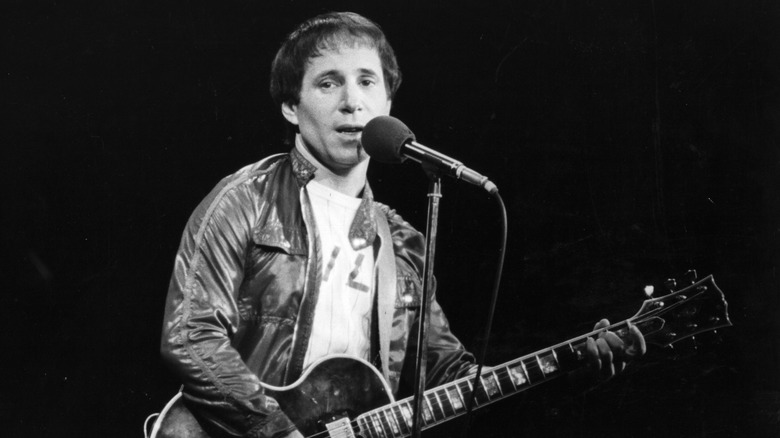
By its unadorned and personal nature, folk rock is a perfect genre for tackling the hardest part of life: the inevitability of loss. Folk has always existed as the music of the common people, and so it's uniquely suited to tackle the most universal emotions and experiences, like love and aging and, of course, grief. Especially when leaning into its acoustic roots, folk leaves more musical space for singers to sit with their feelings and express them in a way that better captures how they tend to linger. Grief, especially, can remain a powerful struggle long after its cause, and hearing it relatively unproduced, straight from the artist, and with enough room to breathe can be one of the best ways to heal, or at least commiserate.
Some of the best artists in the folk rock genre have used their considerable songwriting talents to channel and capture the complexities of grief. From legends like Paul Simon and James Taylor to modern standard-bearers like Fleet Foxes and Sufjan Stevens, many of the great folk artists have tried their hand at tackling grief and the swirl of good, bad, and ugly emotions it brings on. Here are five such songs, each of which captures grief in an especially nuanced and complicated way, because after all, it can be the most complicated emotion you'll ever feel.
Mother and Child Reunion — Paul Simon
In the world of popular folk music, it doesn't get much more accomplished and iconic than Paul Simon, a legend both solo and as one half of the '60s' best duo act, Simon & Garfunkel. This far into his long, long career, there is essentially no topic Simon hasn't expertly written into a song and brought to life through his gentle tenor voice. That certainly includes grief, and one of the most unique and nuanced of Simon's takes on the topic is "Mother and Child Reunion," a song with poignant lyrics wrapped in a surprising upbeat reggae facade.
Simon often layered different emotions on top of one another to create richly textured murals, and "Mother and Child Reunion" is a perfect example. Using a jaunty, syncopated rhythm and pleasant, inviting melody as the sugar, Simon helps his mournful lyrical medicine go down. "I can't for the life of me / Remember a sadder day," he sings. "I know they say let it be / But it just don't work out that way." The loss Simon sings about is a real one: his dog. As Simon explained to Rolling Stone, "We loved this dog. It was the first death I had ever experienced personally. Nobody in my family died that I felt that. But I felt this loss — one minute there, next minute gone." He went on to explain how his thoughts turned toward his then-wife Peggy Harper and the thought of losing her, a real and relatable fear that Simon chose to wrap in a more hopeful-sounding package.
Sunblind — Fleet Foxes
One of the standouts of their 2020 masterwork "Shore," the Fleet Foxes' "Sunblind" is a unique take on loss. Based in part on the death of multi-hyphenate musician Richard Swift, a friend of Fleet Foxes' frontman Robin Pecknold, the song doesn't wallow in its grief, nor does it keep things personal. Instead, it stays sunny throughout, taking the occasion to honor not just Swift but a whole host of musicians who died before their time, all of whom Pecknold cites as inspirations.
The unfortunately passed musicians, or as Pecknold calls them, "every gift lifted far before its will," include Bill Withers, Elliott Smith, Jeff Buckley, and Adam Yauch from the Beastie Boys, among many others. Far from dwelling on their tragedy, Pecknold instead pays tribute to what they gave to the world, a "great coronation [they] deserve." Pecknold explained the song's relatively breezy tone to EW, saying "Music is this weird invisible form of immortality for these people, and I wanted to do it in a joyous way and reframe some of the sorrow of loss into a kind of celebration."
Of the entire song, the final verse acts as a perfect summary, as well as a deftly written bit of lyricism. "And in your rarified air I feel sunblind," sings Pecknold. "I'm looking up at you there high in my mind / Only way that I made it for a long time / But I'm loud and alive, singing you all night." "Sunblind" is a rare look at the joyful remembrance that comes with grief.
Fire and Rain — James Taylor
James Taylor's "Fire and Rain" is not only one of the most iconic and ubiquitous folk rock songs of all time, but it also contains some of the rawest melancholy and grief you'll hear. Ever the great songwriter, Taylor's exploration of such darkness is layered and multifaceted. Though based in part on the death by suicide of his friend Suzanne Schnerr, Taylor also wraps the emotions up in other struggles, like addiction and the simple sadness of life passing by.
The first verse, the most directly about grief, deals with Schnerr's passing and, to twist the emotional knife even further, how Taylor's friends delayed telling him what had happened. "I was recording in England with the Beatles," Taylor explained to NPR. "And my friends had sort of kept the information about this death from me because they thought ... 'This is a crucial time for him, he's doing his work, and we don't want to upset him or bring him down.'" As considerate a tactic as that was, Taylor's friends nonetheless hid something critical from him, and in doing so, prevented him from grieving — just another bittersweet wrinkle in the process.
Taylor's chorus to "Fire and Rain" ends with the heart-wrenching couplet "I've seen lonely times when I could not find a friend / But I always thought that I'd see you again," a statement that manages to be both simple and affecting. Above all, it echoes the bitter longing shared by almost all in times of mourning.
If you or someone you know is struggling or in crisis, help is available. Call or text 988 or chat 988lifeline.org.
Fourth of July — Sufjan Stevens
If there's any throughline to the work of Sufjan Stevens, which varies between lush orchestral soundscapes, exploratory electronica, and alternative folk, it's a shared sense of fragile, poetic beauty. Regardless of what instruments he fancies on any given album, Stevens is known for producing soul-stirring songs with evocative lyrics. When applied to something as personal as the death of Stevens's mother, like on "Fourth of July," his style creates something truly moving — a beautiful piece about something ugly.
Though he eschews any guitar on the track, which drifts the song away from pure folk a bit, Stevens nonetheless keeps things almost entirely driven by his voice and piano. Combined with the intimacy of his lyrics, this captures all the simplicity and universality of his more overt folk fare. In addition, purists will be happy to know that an alternate version exists (dubbed the "April Base Version") with the piano replaced by ukulele and recorded at folk icon Justin Vernon's studio, to boot.
Stevens sings, "The hospital asked, 'Should the body be cast?' / Before I say goodbye, my star in the sky / Such a funny thought to wrap you up in cloth / Do you find it all right, my dragonfly?," pairing the unsettling practicalities of death with an imagined term of endearment for his mother. Alongside that tenderness, Stevens dwells on the ugly with the repeated refrain, "We're all gonna die." It's an intensely personal song, but one that expertly captures the universal nature of grief.
Keep Me in Your Heart — Warren Zevon
There is no album like Warren Zevon's "The Wind," and no song like "Keep Me in Your Heart," its closing track and thesis statement. The song and album capture an experience rarely put into words, especially so directly: being aware of your impending death and being forced to grieve your own loss. Upon receiving a terminal cancer diagnosis in 2002, Zevon got to work making the time he had left count, including his legendary final performance on the Late Show with David Letterman and, of course, recording "The Wind." Many of the album's tracks feature all-star cameos from Zevon's friends, from Bruce Springsteen to Tom Petty to Jackson Browne, but the closer, "Keep Me in Your Heart," is celebrity cameo-free, almost entirely driven by Zevon's earnest, elegiac request to be remembered.
Though it's unusual to hear a singer grieve their own loss, and especially in the future tense, it's even more impactful. Zevon's voice, once full of a rebellious fire, is tamed a bit on "Keep Me in Your Heart," and that only makes his message clearer. After a scant few seconds of intro, the song kicks right in with Zevon's plaintive lyrics: "Shadows are falling, and I'm running out of breath / Keep me in your heart for a while / If I leave you, it doesn't mean I love you any less / Keep me in your heart for a while." In context, those words hit like a freight train. By the end of the song, Zevon has taken listeners into his very soul, and as he intended, the experience stays for a while.