

5 Of The Most Beautiful Voices In Yacht Rock History
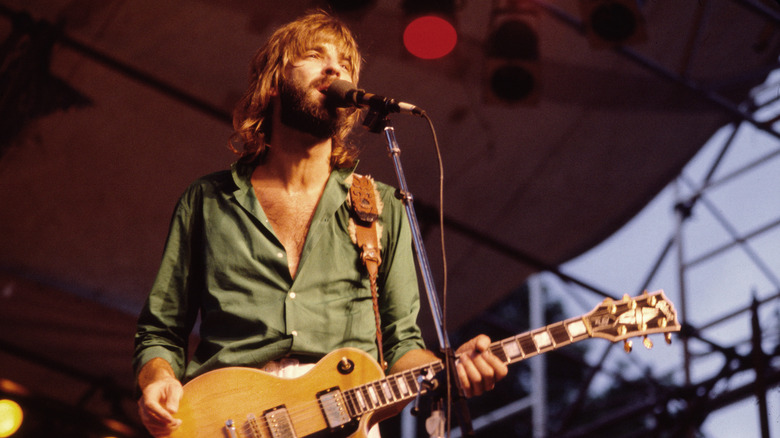
The '70s and early '80s soft rock that came to be known as yacht rock is known for its smooth blend of soft rock, jazz, pop, and R&B. But the slick and funky arrangements that define this vessel are nothing without the wind in its sails: the powerful and emotive singers that grab the helm and guide the groove. What makes this genre so unforgettable and enduring are its beautiful voices: the lead singers delivering raw emotion, passion, and legendary performances.
The admiral of this fleet of bands and artists must be Michael McDonald, the soulful baritone who steered The Doobie Brothers into yacht rock territory and whose fingerprints are all over the sound. His frequent collaborator Kenny Loggins represented the other side of the coin, bringing fiery passion to his vocals on late '70s classics like "Heart to Heart" and "Keep the Fire." And reminding us that this genre isn't just a boy's game, Nicolette Larson introduced California folk and country rock stylings and twang onto the boat with her debut album "Nicolette." These and other legendary voices put their own stamp on the music, giving it its pop appeal, emotional breadth, and holding power.
Over 40 years since yacht rock last dominated the charts, the genre sails on. As of the time of this writing, originals like Loggins are still performing, and there are karaoke nights, themed cruises, tribute bands, and Spotify playlists. And that longstanding seaworthiness has everything to do with the inimitable singers that gave this music heart and soul and made it iconic.
Michael McDonald
Booming, buttery, and soulful, Michael McDonald's voice isn't conventionally beautiful. But it's precisely that lack of polish that makes it so powerful, unforgettable, and iconic. Look no further than The Doobie Brothers' "Minute by Minute," among the classic albums that define yacht rock, to hear what Rolling Stone critic Timothy White called his "coal-cellar singing voice." On the title track, the standout single "What a Fool Believes," and throughout, his smoky and sultry croon carries you away, pulling you along the tides of his songs' grown-up affectations and emotions. But there are so many other gems: from the anthem yacht of "Takin' It to the Streets" with The Doobies to his 1982 solo hit "I Keep Forgettin' (Every Time You're Near)."
But McDonald's presence in yacht rock extends well beyond his time at the helm of The Doobie Brothers. Emerging in the music business first as a sideman — he and guitarist Jeff "Skunk" Baxter had originally been members of Steely Dan — the singer-songwriter is behind countless classics of the genre. That's McDonald harmonizing with Kenny Loggins and snatching the pre-chorus on "This Is It," and that's him backing up Christopher Cross on "Ride Like the Wind."
In the way that you can play "six degrees" of Kevin Bacon with movies, McDonald seems to be a central node of the yacht rock genre. And while his songwriting and arranging are a big reason for that, you can bet that it also had a lot to do with his priceless pipes.
Boz Scaggs
By the time Boz Scaggs put out "Silk Degrees" in 1976, he'd already gone through quite a voyage. He'd dipped his toes into psychedelia as guitarist and vocalist with The Steve Miller Band, and his solo work veered from folk, blues, and roots rock to R&B and soul. But on his landmark album, he moved into a polished and smooth proto-disco pop sensibility. Sometimes called "blue-eyed soul," it's pure, undistilled yacht rock. Just don't tell him that. "I don't like it at all," he told Rolling Stone in 2018 when asked about the term (coined decades after the genre's peak in the mid-2000s), "I hate being put in that bag or categorized in that way. I just wish they would change the name of it."
Sorry, Boz, but if the boat shoes fit, it's better to slip them on. On the hit single off "Silk Degrees," "Lowdown," his rich, tender tenor dances with a tight disco groove — supplied by founding Toto members (keyboardist David Paich, drummer Jeff Porcaro, and bassist David Hungate) — to craft pop perfection. Little wonder it became his biggest hit, reaching No. 3 on the Billboard Hot 100. And with a luminous, melancholy track called "Harbor Lights," it's even harder for Scaggs to beat the yacht rock allegations. Over a mellow keyboard-driven groove, a heartsick sailor is feeling nostalgic and melancholy as he longs for a lost love. "A sailor's dream came true the night I met you," goes the final line of the first verse. That may as well be the motto of the genre.
Nicolette Larson
Yacht rock is a bit of a boys' club, dominated by soulful male voices. But Nicolette Larson busted through the genre's glass ceiling. Spending the mid- and late '70s backing up artists like Neil Young, Linda Ronstadt, Emmylou Harris, and The Doobie Brothers (including singing credits on yacht flagship "Minute by Minute"), she put out her solo debut, "Nicolette," in 1978. Infused with funky yet sophisticated grooves, the album proved that women could helm the ship and sail the smooth seas just as well as their male peers. And it sold, too; by early 1979, it achieved certified Gold record status.
The sultry standout single "Lotta Love," a Young cover (on which she'd originally sung backups), showcases her dynamic, powerful voice. Larson's version dresses up the rootsy, acoustic original in disco finery, adding a sophistication that's undeniably yacht rock. No doubt, the album struck a chord as it catapulted to the top of the Billboard Adult Contemporary charts and No. 8 on the Hot 100. But her vocal prowess is all over the album. The acoustic guitar-driven "Mexican Wedding" serves as a bedrock for her vocals to glide over, rising and falling in intensity. "Baby Don't You Do It" is infectious and upbeat even as it addresses heartbreak. With every verse, she cuts loose and unleashes, singing, "My biggest mistake was lovin' you too much/I'm lettin' you know."
Larson eventually moved on to country music in the mid-'80s, adding additional hits to her catalog. However, there's no denying that in 1978, she became a yacht rock queen and cemented her status as a powerful, peerless voice.
Kenny Loggins
Though Kenny Loggins made his name in folk rock as part of the duo Loggins and Messina in the early '70s, he spent the latter half of the decade helping to define the yacht rock formula. Sometimes breathy, soft, and sweet, sometimes explosive and powerful, his tenor brought urgency and fire to the genre. To the degree that it's possible in this brand of big-market soft rock, his singing was in-your-face and confrontational with its delivery. This punch is why 1979's "Keep the Fire," [3] or his frenetic version of "What a Fool Believes," which he co-wrote, from 1978 are among '70s classic rock songs that sound even cooler today.
But the secret sauce in Loggins' vocals and what makes them so perfect for the emotional tides and crashes of yacht rock resides in his dynamism. That ability to climb down from crackling emotional heights to soft, sensitive depths — from piercing falsettos to aching whispers — cannot be understated. One of the most luminous tracks on his seminal yacht rock masterpiece "Keep the Fire" is "Now and Then," a stripped-down, acoustic-guitar-driven love ballad that embraces you as it urges you to love the one you've got.
Loggins shifted into higher gear in the '80s, finding massive mainstream success with movie soundtrack hits like "Danger Zone" for "Top Gun" and the theme song of "Footloose." But over four decades on, his yacht rock hits remain some of his most enduring and iconic. No doubt, his ship sailed because, for a time, it docked in the marina.
Christopher Cross
Artists like The Doobie Brothers and Boz Scaggs walked so that Christopher Cross could run. Cover to cover, his multiplatinum self-titled debut is a textbook example of yacht rock's R&B grooves, jazz and pop arrangements, and optimism and escapism. And what makes it all shipshape is Cross's aching, tender tenor. On the 1980 Billboard Hot 100 chart-topper "Sailing," off his multiplatinum-selling self-titled debut album, lines like "And if the wind is right, you can find the joy/Of innocence again" simply drip with earnestness and authenticity.
But what makes Cross' voice so powerful is its versatility; just as he can hug you, he can get you on your feet. That's what happens when you put on the lead single of his debut album, "Ride Like The Wind," which hit No. 2 on the Billboard Hot 100. Giving voice not to a lover but rather an outlaw on the run, this upbeat, disco-inflected song is what Rolling Stone called "gangster yacht," the hard edge of the genre. Here, Cross cuts loose, ramping up the intensity with every verse. Every time he repeats "Ride like the wind" in the chorus, his voice edges closer to its limits, as if itself desperate to break free. Look out, Kenny Loggins.
In the grand scheme of things, Cross' time in the spotlight was short. He racked up a record-setting five Grammys for his debut album but never replicated that success. Still, thanks to this masterpiece — and his sweet, golden voice — he crafted yacht rock's finest pearl, which still shimmers decades later.