

The 5 Best Funk Supergroups Of All Time
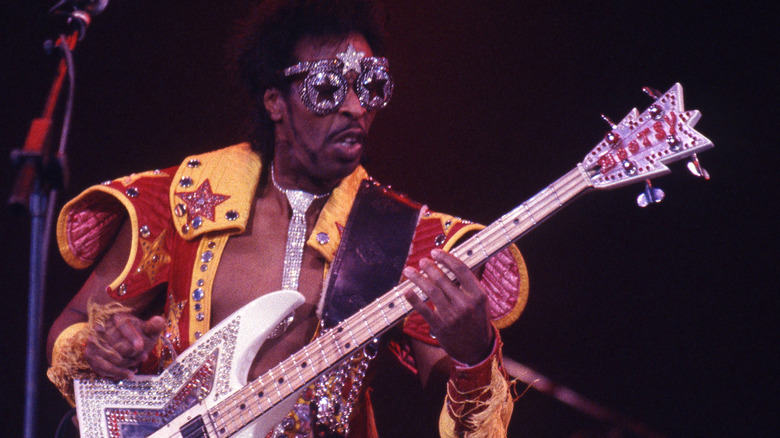
Despite the genre seeming to only ever flirt with mainstream popularity, funk remains one of those rare instances where the party people and the audiophile nerds converge. That dynamic — a confluence of highbrow and lowbrow that pleases fans of both at the expense of neither — yields remarkable output when the genre's learned musical academics and surrealistic sonic thespians collaborate. To that end, we wanted to take a look at some of the most satisfying funk mashups to ever throw down.
Most people can name at least a couple of the classic albums that define funk, but there's a deeper dive to be made into the outer reaches of a genre that remains widely beloved despite only ever seeming to flirt with mainstream popularity. Whether it's the bassist for funk's most accomplished band setting off on a mystical journey or a motley band of thrash rockers scoping out a new groove, there are some seriously dank vibes to be found throughout.
MVP
The MVP moniker, an abbreviation for "The Mark Varney Project," served as the band name for a pair of all-star instrumental recordings released by the titular producer. The project's debut release, 1990's "Truth in Shredding," showcased a bevy of top-shelf guitar artistry in a jazz fusion context. The group's follow-up, 1992's "Centrifugal Funk," expanded the instrumental dynamism into the realm of funk with unrelenting displays of blinding virtuosity firmly intact.
Built around the terrifying chops of guitarists Frank Gambale, Brett Garsed, and Shawn Lane but held together by the unrelenting grooves of drummer Joe Heredia, the album is an intoxicating masterclass in improvisation that is as lyrical and melodic as it is physically punishing. Jazz standards like Miles Davis' "So What" and Herbie Hancock's "Actual Proof" become the canvas onto which ultra-slick funk cadences dialogue with sharp-tongued lead lines. It's the kind of sound that feels equally at home in an early '80s dance hall or in the headphones of a pathologically committed music student whiling away the hours in a practice room.
"Centrifugal Funk" would prove to be the final album released under the MVP moniker. Both LPs are, admittedly, intended as exhibition matches rather than the products of a fully formed, cohesive band, but the second and final release offers a wealth of sonic joyrides for funk and fusion lovers alike.
The Power Station
The 1980s saw funk's initial popularity wane as the style itself hybridized, fusing with emerging genres. Prince, Cameo, and Rick James were among the prominent artists bringing funk into new realms of electronic dance music and hard rock. That expansion in all directions did not go unnoticed by the creative team behind one of the biggest pop acts of the decade.
By 1983, bassist John and guitarist Andy Taylor (no relation) were flying high on the success of Duran Duran but were quickly burning out on the stylistic constraints and commercial demands of playing in a mainstream pop band. Seeking a side hustle where they could really let their hair down (it was the '80s, after all), they formed The Power Station while their main band was taking a break and released their self-titled LP in 1985.
Held together by the intoxicating dance floor grooves of Chic drummer Tony Thompson and completed by the crooning of blue-eyed soul legend Robert Palmer, the album is a cross-cultural tour-de-force with hard rock leads sharing space with funk drum patterns, equally danceable bass riffs, and mature, businessman lead vocals that are as addicted to the rhythm as they are to love. Standout tracks included "Some Like It Hot" and a righteous cover of T. Rex's "Get It On (Bang a Gong)" that strongly echoes funk pioneer James Brown.
The album was a massive hit, reaching No. 6 on the Billboard 200, but the initial success was short-lived. Palmer opted to drop out of the group just days before their upcoming tour, citing budgetary concerns, John and Andy Taylor's rockstar lifestyle, and his own burgeoning solo career. The group reconvened in 1996 for the album "Living in Fear," but the 2003 deaths of Palmer and Thompson ultimately took the Power Station offline.
Scary Goldings
Not all funk supergroups need to be artifacts from a bygone era. In the case of Scary Goldings, the dank throwdown continues unabated into the modern era. Making their recorded debut with 2018's self-titled LP, Scary Goldings is a collaboration between keyboardist Larry Goldings — known in the jazz world for his work with Pat Metheny, Michael Brecker, and Jack DeJohnette, among others — and Scary Pockets, the funk collective founded by none other than Patreon CEO Jack Conte.
The group, whose live and recorded outings often feature jazz guitar legend John Scofield, is an outgrowth of the prolific work ethic that has seen the original Scary Pockets release weekly videos to YouTube since 2017. It's a tight, musician-friendly sound that emphasizes group coherence in the tradition of latter-period Miles Davis or the work of Medeski, Martin and Wood. The result is an instrumental jam ensemble that doesn't feature soloists so much as grant them permission to accentuate the collective's locked-in reverence for the almighty groove.
Scary Goldings isn't just a musically accomplished ensemble — it's a triumph of internet marketing. In a world where cyber self-promotion frequently verges on the pathological, Scary Goldings (and their parent company, Scary Pockets) have racked up millions of views with organic, human jams. In a world where TikTok blipverts rule, Scary Goldings shines through with funky soul.
Infectious Grooves
The elevator pitch for Infectious Grooves might not inspire much confidence among funk purists: the core members of the eclectic punk thrash band Suicidal Tendencies want to start a funk crossover band with hard rock overtones. Given that band's penchant for mindless headbanging, it's reasonable to think that Infectious Grooves might lean more into hardcore mosh-pit rocking than proper funk. But as 1991's debut LP, "The Plague That Makes Your Booty Move," makes clear, this was a band with a remarkable amount of genuine funk literacy and instrumental command to exploit.
Infectious Grooves would eventually become one of those bands that lost their bassists to mega-successful artists when Trujillo joined Metallica. Taking on one of metal's most coveted gigs would, understandably, come to dominate his schedule, but the bassist continues to find time to perform with the group, which has expanded its supergroup bona fides through the years, with Josh Freese (Nine Inch Nails, A Perfect Circle) and Jay Wineberg (Slipknot) stepping in as drummer at different points.
Zillatron
One of the more artistically dense funk supergroups on offer, the one-off Zillatron project began as a solo outing for Parliament-Funkadelic bassist and eternally glammed-up public eccentric Bootsy Collins. But while Collins is at the core of the album's admittedly inexplicable creative vision, he is joined by the madcap shredding of guitarist Buckethead of Praxis and Guns N' Roses fame, the soundscapes of producer and ambient dub pioneer Bill Laswell, and Parliament-Funkadelic keyboardist Bernie Worrell (who, along with Buckethead, would later join Colonel Claypool's Bucket of Bernie Brains, one of the best one-album supergroups of all time).
The project's only album, 1994's "Lords of the Harvest," is less a set of traditionally structured songs than it is a deep dive into what it might have sounded like if Lewis Carroll had partnered with Sun Ra. Proper verses and catchy hooks are wholly eschewed in favor of a stream-of-consciousness journey through a kaleidoscopic sonic landscape of slap bass, delirious electronic noise, and syncopated stabs from guitar and keyboards, as hard to focus on as they are to ignore. There are sassy raps and occasional vocal melodies throughout, but for the most part it's a frenetic funk fever dream that's over before the listener fully comprehends what they just heard.
In light of that abstract experimentation, it might seem odd to tout Zillatron as one of the greatest funk supergroups of all time. Such speculation is no doubt warranted, but the project highlights the often-untapped potential for exploration and avant-garde artistry at the heart of funk music. It's a style that trades in long, open-ended grooves and psychedelic sound-as-art sonic manipulations. Bootsy and company deserve full credit for going there, even if it's debatable whether or not they ever came back.