

5 Classic Albums That Define The Kinks' Rock Legacy
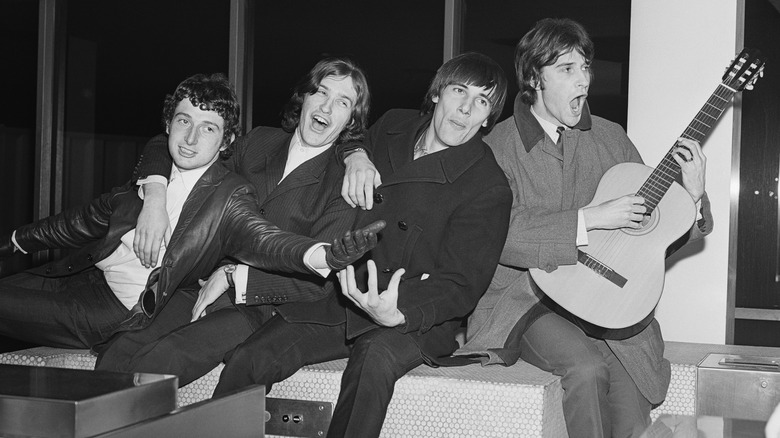
Few bands can boast a career as long and diverse as the Kinks, but a select few albums truly define their legacy. Formed in the early '60s by brothers Ray and Dave Davies, what began as a British Invasion boy band grew into a multifaceted group that inspired upcoming genres such as psych rock and art pop, and the Kinks were among the earliest punk rock pioneers. Although their popularity waned in the 1970s, the Kinks' activity from 1964 to 1970 made them rock 'n' roll legends, with classic songs and a flexible style that made them one of the most influential bands of the 1960s. They released records consistently through 1993, before the Kinks finally broke up in 1996.
From their first album, 1964's "Kinks," to their 1970 smash-hit "Lola Versus Powerman and the Moneygoround, Part One," the Kinks experimented with distortion-driven riffs, cerebral songwriting, and baroque instrumentation, crafting an eclectic and hard-to-pin-down character to their sound; in just five years the band went from a proto-punk band to a British preservationist music hall group, and back again.
Those five to six years were the most commercial and critically successful years of the Kinks' career, so we've chosen five of the most impactful and pivotal Kinks albums from that most creatively fertile period, all of which went on to define their long rock legacy. While some were more commercially successful than others, these records gained retrospective acclaim and influenced later eras of burgeoning rock stars from David Bowie to Queen.
Kinks
The Kinks' self-titled debut album is a definitive artifact of rock 'n' roll history, both for proliferating the second wave of rock music that accompanied the British Invasion and for its iconic single, "You Really Got Me." Released as the band's third-ever single, "You Really Got Me" is an ingenious piece that forever changed the sound of rock 'n' roll thanks to its distinct guitar fuzz and distortion, as well as its three-note, power-chord composition.
Upon release, "You Really Got Me" quickly rose up the charts, reaching No. 1 in the U.K. and No. 7 in the U.S., and also earned significant retrospective praise: it was inducted into the Grammy Hall of Fame in 1999, and Rolling Stone listed it as No. 176 on their list of 500 greatest songs of all time. In an interview with Music Radar, Brian May of Queen said, "... that's got to be the archetypal riff. That's the beginning of all riff-making, isn't it really?" The song didn't just launch the Kinks; a cover also kickstarted Van Halen, released in 1978 as the LA band's first single, which peaked at No. 36 in the U.S. as they prepared to release their debut album.
Although none of the other songs on "Kinks" garnered the same attention and impact as "You Really Got Me," the record was culturally significant for transmuting rock music into a harsher and grittier form than established predecessors like Little Richard or Chuck Berry. The short, abrasive riff-based compositions and repetitive lyrics influenced early '70s artists like the Stooges and David Bowie, as well as early punk acts such as the Ramones and the Sex Pistols. Their influence is still visible in the 21st century in genres like surf punk, where bands like Surf Curse and the Frights continue to emulate the sound of "Kinks."
The Kink Kontroversy
"The Kink Kontroversy" is a definitive example of a transition album. It features fuzzy, riff-based head-bangers like "Milk Cow Blues" and "Where Have All the Good Times Gone," but the record diverges on tracks like "Ring the Bells" and "I'm on an Island," songs which began to display the tendencies towards music hall and baroque pop influences that exemplified their future work. Despite the incongruent sound, the 1965 record was a landmark moment for the Kinks as they developed their act and matured their sound.
This change is due to the evolution of Davies' songwriting, who at the time began to pivot his lyrical content from musings on boy/girl, teeny bopper relationships to adult observations on daily life, suburban banality, and urban voyeurism; a style which ultimately blossomed on future projects such as "Face to Face." It was during this period that the Kinks were banned from performing in the U.S. for four years, which could explain their regression of American influences.
The LP had a significant impact on future acts, including the '90s band Sleater-Kinney, who paid homage to the album cover of "The Kink Kontroversy" on their 1997 record, "Dig Me Out." Drummer Janet Weiss told Salon magazine, "The Kinks are one of my all-time favorite bands and they were revered. It was fun to play with that idea of what makes a revered band."
Face to Face
Just like its brightly colored, psychedelic cover, 1966's "Face to Face" bursts with the slice-of-life musings of songwriter Ray Davies. When making this LP, the Kinks put aside their earlier rock 'n' roll leanings and blossomed into a music hall-inspired pop band. The lyrics are more mature, the song structures are more developed, and the arrangements and instrumentation have almost completely abandoned the distortion-fueled riff writing of their previous records.
While often referred to as a concept album, Davies has since rejected the label entirely, calling it simply a collection of songs that reflect his burgeoning sense of adulthood. In a 2007 interview with Uncut, Davies said, "I was 22, and writing about adult concerns ... It was my first experience of being a grown-up ... 'Face to Face' is a collection of songs, not an album."
The band's biggest hit off the record was "Sunny Afternoon," a satirical track mocking the wealthy class that went No. 1 in the U.K. in the summer of 1966. The 7" vinyl 2026 re-release — which returned the Kinks to the U.K. charts – includes an anecdote from famed English soccer player Sir Geoff Hurst, who led England to victory in the 1966 FIFA World Cup, saying (via Music News), "Somebody started to sing 'Sunny Afternoon' [in the dressing room] and we all joined in ... The Kinks encapsulate that time, they captured the Englishness at its best."
The Kinks Are the Village Green Preservation Society
By the time "The Kinks Are the Village Green Preservation Society" was released in 1968, the Kinks had finally shed their bluesy fervor, abandoned the idea of producing hit singles, and put to rest the power-chord riffage. Instead, they fully embraced the music hall and baroque pop elements of earlier albums such as "Face to Face," bringing those influences together into what can be considered the band's first real concept album.
Soaked in nostalgia and the idealization of British culture, the songs spin tales of the people, places, and parlays that take place around the heart of a village — the village green. Davies has stated that he wanted to create something that was tied to their British identity. "I think every band goes through a phase where they sit back and think about what their future's going to be," said Davies in an interview with Uncut. "I wanted to write something that, if we were never heard of again, this is who we are."
Although the record was a commercial failure and was initially considered a flop, it was lauded by critics upon release and has since become one of the band's most influential albums. Graham Coxon of Blur and Noel Gallagher of Oasis both named it as one of their favorite LPs ever; Pitchfork scored the album a 9.5 out of 10 in a retrospective review, and it is the highest-rated Kinks album on Rolling Stone's list of 500 greatest albums, at No. 384. While not a commercial hit at the time of release, it has become the band's most celebrated record.
Lola Versus Powerman and the Moneygoround, Part One
Any general analysis of the Kinks would be incomplete without mentioning the record that spawned one of the band's most recognizable songs: "Lola." Released in 1970, "Lola Versus Powerman and the Moneygoround, Part One" is a rambunctious album that makes up for its lack of cohesion with stellar songwriting and raucous, passionate performances. The use of resonator guitar, organ, and harmonica gives the record a grittier, less polished sound that harkens back to the American-influenced veneer of their earliest albums.
The tracklist features highlights like "Apeman" and "Strangers," but nothing compares to the album's lead single, "Lola," a track that evokes the hit-making days of their first album. The tune went to No. 2 on the U.K. charts and No. 9 in the U.S., and was featured as No. 386 on Rolling Stone's list of 500 greatest songs of all time. Both "Lola" and its album brought the Kinks back into relevance, and have had possibly the widest cultural influence of their entire discography.
In 1985, Weird Al Yankovic released a parody of "Lola" titled "Yoda," satirizing the little green Jedi master from "Star Wars," while Ray Davies shared a message on X from trans-activist and punk icon Jayne County, who said, "'Lola' broke down the doors of narrow mindedness and I will always be grateful and happy that the Kinks gave me this incredible song with such a great story." Tom Petty even credited the album as an inspiration for his 2002 record, "The Last DJ." As the Kinks entered the 1970s and '80s, they would continue exploring pop and concept albums, but "Lola Versus Powerman and the Moneygoround, Part One" stands as a fitting bookend to their '60s era: a final turn from rock to pop and back again.