

The 5 Best Funk Solos We Wish We Could Hear For The First Time Again
There's just something about the energy of funk music that makes it especially joyous and infectious the first time hearing it. More than any other genre, funk is almost entirely in service to the almighty groove, the rhythmic throughline designed to get the toes tapping and head bopping, and accordingly, funk music just grooves best. As the genre's most definitive albums prove, the funk greats have an uncanny ability to blend complicated rhythms and wide-ranging instrumentation into something not only unique, but uniquely vibrant. And like all the guitar-driven genres, funk solos are often the ecstatic peak for first-time listeners — peaks we wish we could ascend again for the first time.
Maybe time travel is only possible in the psychedelic Afrofuturist world of Parliament's music, but we still wish we could go back and hear some of our favorite funk solos for the first time. Blazing guitar solos from Prince, Ernie Isley, Jimi Hendrix, and more cut through their tracks like lightning, leaving us awed and wishing we could feel that same way again. If you've heard the solos on our list, they're all more than worth revisiting, and if you've never heard them, then congratulations: you're about to experience some of the best funk solos ever for the first time, and there's nothing like a first listen.
Hope You Feel Better Love (Part 1 & 2) — Ernie Isley
The Isley Brothers are absolute legends of soul and funk, and their 1975 album "The Heat Is On" is the group at their best (although their best began in '73 with "3 + 3" and continued on through the '70s, at least). Part of what makes "The Heat Is On" so great is its format. All of its tracks are longer than average and that gives every song ample time to veer off into whatever direction the Isleys choose. In the case of the A-side closer "Hope You Feel Better Love (Part 1 & 2)," it veers into a righteous Ernie Isley guitar solo at about two-and-a-half minutes in and stays there for over three thunderous minutes.
The song before the solo is an uptempo groove with some fun wandering bass and classic Isley harmonies, but it quickly gives way to Ernie's guitar, which jumps in with a bang. Ernie rarely ever lets off the wah-wah pedal, and between that and his thick, soupy tone — evocative of the famous Uni-Vibe pedal — the overall sound is decidedly Hendrix-like. Ernie quickly proves himself no pale imitation, however, by wailing away for so long that the solo could easily be an instrumental by itself. Ernie plays excellent counterpoint to the pulsing, staccato bass by almost never letting off the gas. If there's a moment's rest in his playing, it's only because he's hanging on some screaming bend before launching back in with a flurry. Ernie's solo is a whirlwind we wish we could be caught in again for the first time.
Kiss — Prince
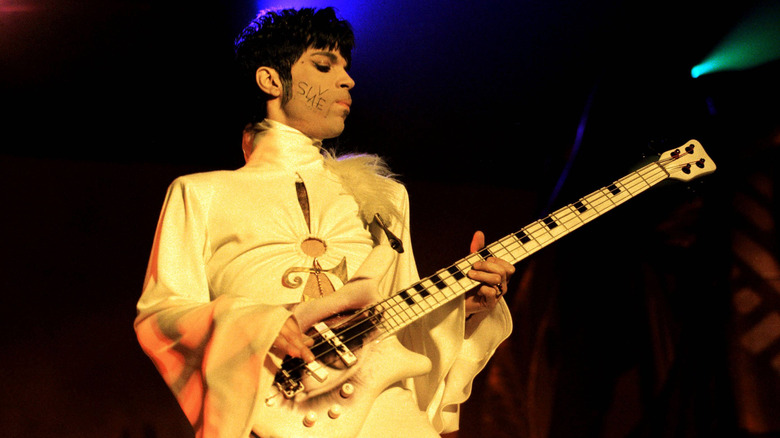
If Prince wasn't also a hitmaker in the worlds of pop, rock, and soul, it would be tempting to say that he simply was funk in the '80s. Aside from the possible exception of Rick James, no one did more to suffuse the mainstream with funk rhythms and instrumentation than Prince during the decade. Prince was so tuned in to the spirit of the genre, in fact, that he managed to create a track like "Kiss" without a moment of bass and still make it undeniably funky. The song, which hit No. 1 on the Billboard Hot 100, is also astonishingly absent of guitar for most of its length, with the most notable exception being its solo — a perfect example of funk minimalism from a guitarist who knew exactly what, and what not, to include.
There are thousands of extended, multi-section solos that could be covered, but Prince's beautifully economical work on "Kiss" deserves recognition, too, if not for its catchiness, then at least to demonstrate what restraint can do for a solo. It opens with some rhythmically strummed extended chords — a funk staple — high up on the guitar in the grand funk tradition. In this section, it's less about the chords themselves and more about their snappy rhythm, which is exceptionally danceable. The next section sees Prince riffing through a thick wah-wah pedal, and for all the catchiness and deftness of the lines, they're still kept low and focus on rhythm over meteoric energy. By its end, Prince has set himself up perfectly for his screaming, climactic final section.
Who Knows — Jimi Hendrix
In his tragically short time on this Earth, Jimi Hendrix dabbled in (and often mastered) a range of styles. His earlier work with the Jimi Hendrix Experience drifted between blues, hard rock, and psychedelia, and once he founded Band of Gypsys, he plowed headlong into funk, a genre that saturates their sole, self-titled album. Though the album is most known for another guitar piece, the Vietnam sound-effect-mimicking tour de force "Machine Gun," all of its other tracks are astounding pieces of guitar work. Perhaps the funkiest of the bunch is the opener, "Who Knows," a song built entirely around one funky riff and the magic Hendrix creates by soloing atop it.
In typical Hendrix fashion, there isn't really one solo to the song but rather several interspersed throughout. A few keep the energy up between the verses, and even while singing, Hendrix sometimes doubles his vocal melody, making much of the song feel like one seamless lead line. The only real pause in Hendrix's instrumental fire comes about four minutes in when drummer Buddy Miles begins a hybrid sing-scat section, allegedly because during the live recording, Hendrix broke a string and needed time filled. When Hendrix jumps back in, he does so gingerly at first, slowly building back his volume and speed, making the unexpected break a bonus bit of dynamism. When he's back to his zenith, it's as blazing as Hendrix ever was, with an added sense of playfulness in his tone and riffs. Who knows about funk? Clearly, Band of Gypsys does.
If You Have to Ask — John Frusciante
Funk may have had its heyday in the '70s and '80s, but it certainly didn't die. There's no better indication of that than the collected work of the Red Hot Chili Peppers, which for all its idiosyncrasies and eccentricities, is rooted in energetic, attitudinal funk. A number of their funkiest tracks, like "Give It Away" and the aptly named "Funky Monks," are found on their 1991 masterpiece Blood Sugar Sex Magik, alongside another with an outstandingly funky solo, "If You Have to Ask."
All of "If You Have to Ask" is pure funk. Flea's bass is a restless force that almost never ceases in exploring the fretboard. It complements John Frusciante's thin, muted chords, which would make an excellent example in a "Funk Rhythm Guitar 101" course. That isn't to say they're simple, however, as the complicated extended chords during the pre-solo interlude prove.
Following that interlude, Frusciante launches into a smooth and expressive guitar solo that fills the final minute of the track. Like so many great funk solos, it employs a thick tone in order to differentiate from, and build upon, the thinness of the preceding and background chords. While the background chords keep at a constant staccato, Frusciante lets his dramatic bends soar and hang in the air. When the song ends, Frusciante's solo ebbs away to the sound of applause, a fitting reaction for such an exemplary funk solo.
Maggot Brain — Eddie Hazel
And really, could there be any other choice? Funkadelic's "Maggot Brain," off the 1971 album of the same name, is a landmark in the genre's more experimental side, and its 10-minute-plus title track is the epitome of what makes it so great. After a brief spoken-word intro by frontman and funk legend George Clinton, the rest of "Maggot Brain" is an instrumental and not just any instrumental — an extended, wide-ranging, impassioned guitar solo by Funkadelic (and Parliament) guitarist Eddie Hazel. Inspired by Clinton's direction to play as if his mother had just died, Hazel took the opportunity to lay down a solo that is considered one of the greatest of all time.
The backing to Hazel's solo is a soft, delicate arpeggio that feels dreamlike, and it lends a surreal air to Hazel's roaring leads by contrast. Over the course of his solo, Hazel seems to take Clinton's advice to heart, drifting between sounds that evoke mournful despair, bitter anger, gentle acceptance, and especially in the final minute, playful happiness. For much of the middle section, starting at two minutes exactly, Hazel employs a delay effect that he uses both to strengthen his crushing bends and for fun little explorations like the crystalline pseudo-tapping lines at around 5:30. Without the backing music ever changing very much, Hazel takes listeners on a remarkably intricate and far-ranging journey, and even more impressively, the entire performance was recorded in one take. "Maggot Brain" is truly a sonic odyssey, one whose first listen is pure magic.