

The Best Amp And Pedal Setups For Electric Guitar Beginners
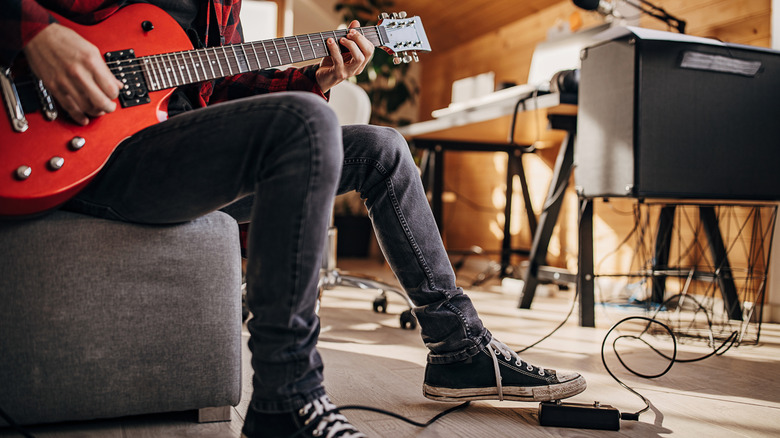
With such a dizzying array of options available, it can be tough to choose what gear to start learning guitar with. Once your instrument is picked out, there's still the matter of finding an amp and all the essential accessories a beginner guitar player needs to get that perfect sound. Amps and effect pedals come in all shapes, sizes, varieties, and, just as importantly, price ranges, and without a guide, sifting through them for the right combination is a long process. Here, we'll give you that guidance and get you started picking the right amp and pedal combinations to get the tone you're after.
For this list, we're specifically focusing on setups on the more affordable end. Even though pedals and amps can soar into the high thousands (as with some expensive guitars that rock legends swear by), we're keeping it capped within the low hundreds. Beyond that, the only criteria are well-reviewed products from time-tested brands, each distinct enough to capture its own vibe — and hopefully yours. Read on for setups including gear from iconic brands like Fender, Marshall, Boss, Dunlop, Ibanez, and more. Between them is sure to be an amp and pedal setup for you.
A classic blues rock sound
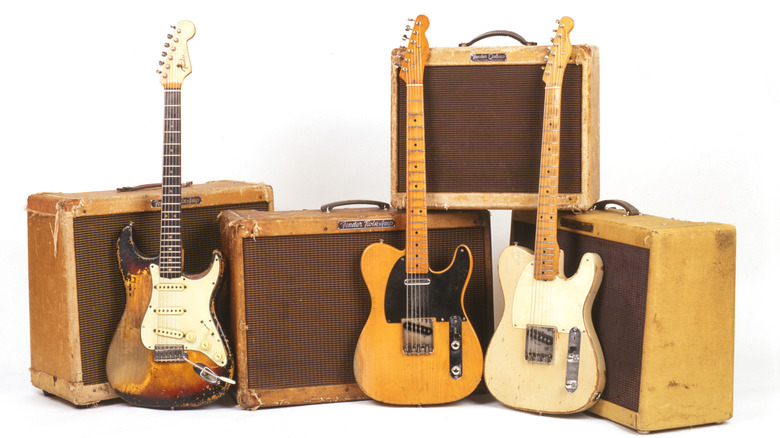
For a number of reasons, a lot of new guitarists tend to gravitate toward the blues, the backbone of rock and pop. Luckily, the major sounds of the genre, like its crunchy overdrive and thick, bassy tones, are pretty easy to obtain — and cheaply, too. With a suitable guitar in hand, such as a Fender Stratocaster, the classic blues rock sound takes merely the right amp, and a pedal or two is optional.
Fender is one of the most classic brands, not only for blues equipment but for beginner amps in general. At the lowest end in price, it offers Frontman amps, and for just a bit more — yet still within the low hundreds — its line of Mustang amps makes for remarkably versatile and good-sounding first amps. The Fender Mustangs, like the excellent LT25, contain dozens of built-in presets that use digital modeling technology to mimic the most iconic guitar tones. For beginner amps, Fender or not, a crucial decision is the wattage, which translates to how loud the amp will get. For beginners looking to practice in their room, 10-40 watts (and potentially up to 50 if desired) is ideal.
As for pedals in blues rock, few are more famous and ubiquitous than the wah-wah pedal, of which the Dunlop Cry Baby is the undisputed icon. For distortion, an overdrive or overdrive-like distortion is the most bluesy, and the aptly named Boss BD-2 Blues Driver pedal does the trick well. For bonus points, consider an MXR Uni-Vibe to get that rich, thick, Hendrix-y lead tone.
An all-purpose rock rig
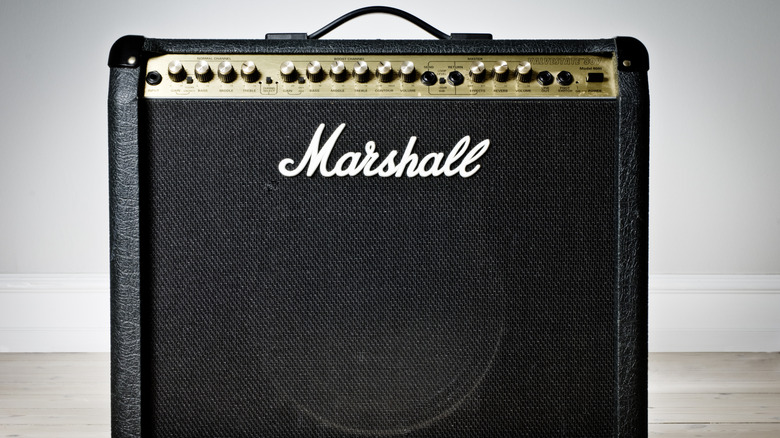
There's a certain type of new guitarist, maybe one who chooses a Gibson SG or Les Paul, who is after straightforward, all-purpose rock crunchiness, and that is easily achievable. When shooting for something middle-of-the-road, any standard amp model will do just fine, but none are more ubiquitous and beloved than Marshall amps. The brand has been a go-to for guitarists of basically every stripe since the '60s, and its exceptional sound quality has even earned the nickname "The Marshall sound." A great nexus between price, tone, and features is the MG30GFX Combo (the practice amp of choice for this writer for years), a 30-watt amp with lush tone and a few built-in effects to tinker with. And the good news is that Marshall amps are built to last.
Rock is a pedal-lovers' playground, and there are hundreds that can complement your playing and spark invention, even as a beginner. One of the more commonly used is the Big Muff by Electro-Harmonix, a distortion pedal that has myriad variations, but the Big Muff Pi is the modern classic. The distortion is more of a fuzz, which is why some players refer to it as "fuzzstortion," and it growls in a way that lends itself well to rock and hard rock.
Other effect pedals that many players employ include the Boss Super Chorus, in order to create the swelling, angelic clean sound heard on innumerable classic rock albums, and the Boss DD-3T Delay Pedal, a standard for creating repeating effects at a very reasonable cost.
Make it hard rock and metal
As rock has become harder and harder through the decades, guitar equipment has evolved to accommodate the changing sound. Boss, though known for its effects pedals more than anything, has produced some excellent amplifiers in recent years. One of them, the Boss Katana 50, often shows up in best-of lists, partly because of its great tone — which is also about as adjustable as it gets for the price — and partly because it packs 50 watts of punchy power into a relatively affordable package. Marshalls are go-tos for the hard rock community, as well, and always worth considering, especially those with high amounts of potential gain built in.
Considering how great modern amps are for hard rock and metal, it's perhaps surprising that a number of the old standby pedals are still favored among hard rock and metal guitarists. Undoubtedly, distortion pedals are the most critical to the metal sound, and there are a couple that whole hosts of working guitarists swear by.
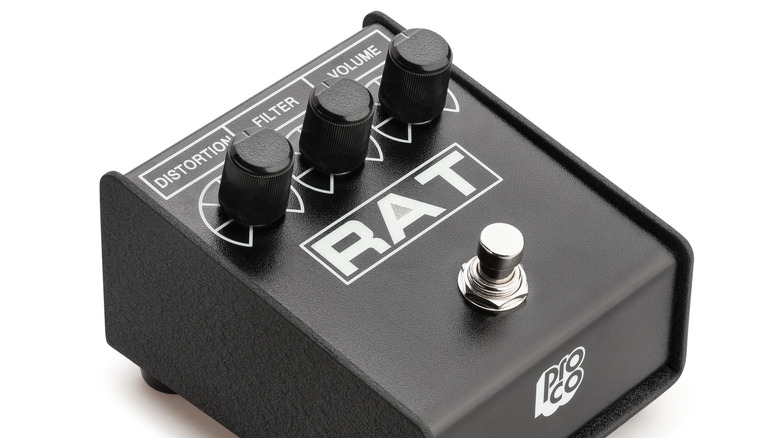
The RAT Distortion pedal by Pro Co was labeled by Guitar.com as "arguably the distortion pedal" and for good reason. It is a versatile pedal that sits somewhere between overdrive and fuzz but manages to truly embody both. Its sound is thick, heavy, and sustains for days, just what a metal guitarist needs. The other contender for the most go-to distortion pedal is the Ibanez Tube Screamer, a classic, oft-used overdrive pedal with a penetrating, mid-heavy sound for screaming solos.
A setup all about options
To truly recreate the exact nuances of a certain sound, the right guitar, technique, amps, and pedals are all required. But for those who don't mind getting the tone 95% right for only a fraction of the work and price, there are multi-effects pedals and even amps with their own built-in multi-effects that get the job done.
Line 6 is an industry leader in this area, offering amps with relatively huge built-in effects suites, and if you prefer more modularity, effects pedals that do the same, like the POD Express. Not only that, but many of its amps, like the Catalyst CX 60, also come with the ability to digitally model a range of other amps independently of their onboard effects. The end result is an almost unbeatable amount of sonic versatility.
If you prefer a simpler amp or one with a more old-school construction, but still want the versatility and ease of a multi-effects rig, this can be accomplished with a single, multi-effects pedal. These come with a number of built-in effects, usually including distortion, delay, reverb, phaser, chorus, octavers, and more. Zoom is a well-regarded company in this field, and its MS-50G+ model packs a whopping 102 effects into a pedal that barely costs $100. Another great pedal Zoom offers at roughly the same price is the Zoom G1X Four. It also comes with dozens of effects, but with the added bonus of a rocking expression pedal, allowing you to control effects while playing.
Keep it classic
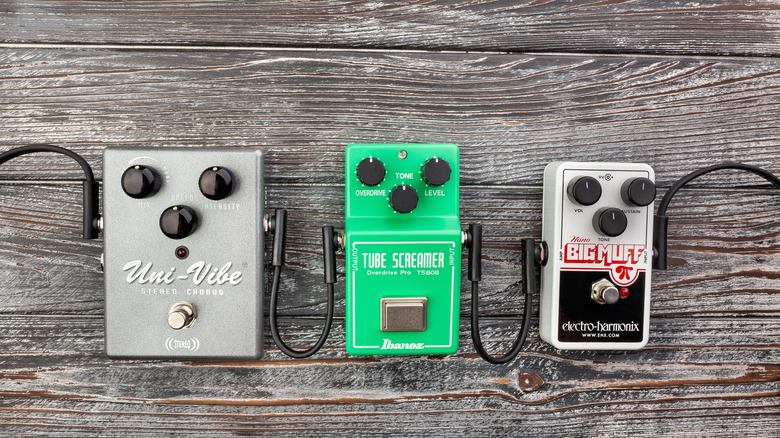
If you're willing to spend just a hair more (but still in the low hundreds), there are plenty of options that eschew modern touches like digitization, modeling, and complicated effects. Instrument manufacturers tend to emphasize their products' tradition and heritage, which is why many keep the old technologies going strong for decades.
Blackstar was founded by Marshall amp technicians, and its amps rival Marshall's in quality. Its Debut series of amps, of which we recommend the 30E or 50R for beginners, are made with all-analog technology, eschewing modern digital emulations in favor of capturing the purest all-around response and tone. For the most authentic vintage tone, tube amplifiers are the way to go, although they are more expensive on average. The Marshall DSL1CR tube amp is a great amp, and about as cheap (and small) as a tube amp will get, at around the $400 mark.
For the simplest and most classic effects pedals, analog pedals are typically the preferred option. As with amps, there is a fidelity to analog sound that just can't be captured digitally. A few of the classics mentioned above are analog and fit the bill nicely, including the Ibanez Tube Screamer, Electro-Harmonix Big Muff Pi, BOSS DS-1 Distortion, and Dunlop Cry Baby. Not only are they analog, but they're also what a vast number of guitar legends have been using for decades, making them the best option to capture classic tone in two different ways.