

The Greatest Self-Taught Sax Players In Rock History
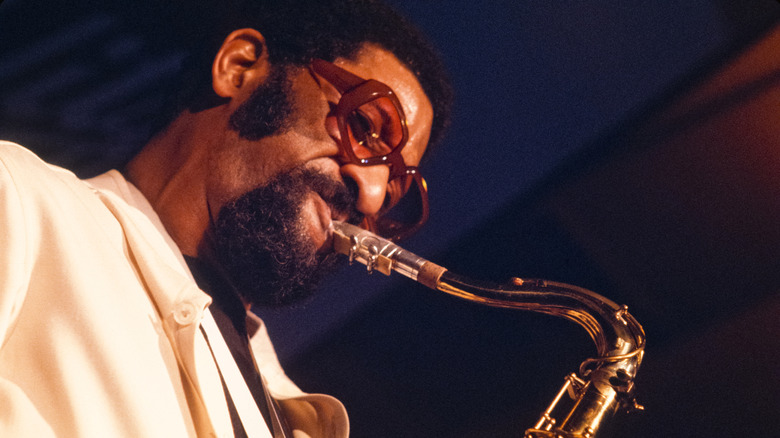
There's something oddly compelling about self-taught musicians. While in most circumstances even the most intrepid of musical explorers rely on some form of formal instruction, there are, nonetheless, those bold (or just introverted) enough to work it all out on their own. It's a fairly regular occurrence among the core rock band instruments of guitar, drums, and bass, but the saxophone is another matter.
Horn players are more likely to have had proper instruction, given that their instruments are taught in school bands. That said, there are those that apply their autodidactic tendencies to the instrument and come back bearing gold. These may not be the best sax solos in rock history, but they are a fascinating cross section of saxophone players. Whether it's a genre-mad experimentation fanatic going hardcore or a faceless mystery man mercilessly mocking mainstream mundanity, we wanted to take a look at the self-taught cats that decided a straight backbeat could replace the swing.
John Zorn
To call John Zorn a genre-hopper would be woefully insufficient. Across a discography so vast it defies easy cataloguing, he has explored everything from worldbeat to traditional Jewish music, classical, electronic noise, and rock, though even that fails to do him justice. The 2006 recipient of a MacArthur Foundation Fellowship, Zorn's prolific cross-genre forays are borne out of a largely self-taught background.
Some jazz musicians make tasteful forays into rock music, often when the mood for a clever cover strikes. Miles Davis did a radio-friendly rendition of Cyndi Lauper's "Time After Time," for example. But John Zorn is perhaps the only jazz musician to fully and intentionally forge inroads into the violent, chaotic worlds of punk and hardcore. To that end, Zorn became a fixture in the punk underground with his band Naked City, an avant-garde rock band featuring jazz luminaries such as Bill Frisell and Fred Frith alongside vocalist Yamatsuka Eye of Japanese noise rockers Boredoms. Albums like the group's 1989 self-titled debut see the group almost arrogantly flaunting their ability to switch genres at warp speed as they fly through rockabilly, punk, surf rock, and a whole lot of other territory with effortless fluency.
Zorn's infatuation with the outer reaches of rock music remained unsatisfied, and he went on to found PainKiller, an effort to combine the unrestrained harmonic realm of free jazz with the horrific fury of grindcore (an extreme metal subgenre that sounds like incoherent noise to outsiders and slightly coherent noise to its fans). To that end, the project sees him collaborating with electric jazz bass legend Bill Laswell and Napalm Death drummer Mick Harris for a band whose ability to traffic in sensory overload is a gift unto itself.
The Residents
Someone in the Residents plays saxophone (actually, the word "plays" should always be in quotes when it comes to the Residents). We don't know who, since the group's membership is officially anonymous, but starting from absolute scratch with no formal training was integral to how the band of non-musicians established their sound. None of their work will show up on a list of the best soft rock solos, but there's something fascinating to consider here nonetheless.
That unorthodox approach has resulted in decades of surrealistic sonic experiments that — while frequently impenetrable to unadventurous listeners — have seen the group explore previously uncharted musical territory with a confidence that would be daunting to the more regimented minds of formally trained musicians. In the case of the saxophone, that exploratory spirit is heard in the soundtrack stylings of the "Whatever Happened to Vileness Fats?" LP where belligerent stabs and atonal wails show up to impudently mock traditional solo passages before settling pensively into the foreboding harmonic backdrop. Similarly, "Rest Aria" finds those same warbled yelps fitting surprisingly well into an unexpectedly languid sojourn. As the group expanded into electronic instrumentation, their saxophone work began to include electronic wind instruments, as heard in the "Night Music" stage show among many other examples.
It may not be what most listeners think of when they imagine "rock saxophone" but, like the rest of the Residents' work, it embodies a crucial component of the rock ethos: a defiant, boundary-pushing belligerence that is unafraid to come across as profane and absurd in the face of the mainstream establishment. Their identities may be a bigger mystery than what happened to Bill Clinton's inaugural saxophone, but their impact on popular culture remains.
Sonny Rollins
In the royal court of jazz legends, Sonny Rollins stands among the gaints. His work with Bud Powell, Thelonious Monk, and Miles Davis alone is enough to canonize the largely self-taught tenor man among the heavenly host of jazz masters, but he also has a notable presence in the rock realm as well.
Rollins, who passed in May of this year at the age of 95, made a set of notable appearances on the Rolling Stones' 1981 album "Tattoo You." Approached about the collaboration by frontman Mick Jagger, Rollins was initially reluctant. The Rolling Stones seemed like a step down from the world he normally occupied. Nevertheless, Rollins went forward with the idea after encouragement from his wife. For a player who initially saw the prospect of a rock collab as fundamentally beneath him, the songs in question see Rollins stepping out of his element in the humblest of ways. "Slave" finds the saxophonist setting aside the harmonically intricate runs that define his jazz work in favor of the sort of soulful saxophone pastiche that speaks more from tonal grit and expressive vibrato than modal intellectualism. That stripped-down, unadorned approach allows Rollins to interact more cohesively with the rhythm section and meet his fellow soloist, guitarist Keith Richards, rather than blasting him out of the room with cerebral jazz.
"Neighbors" works in a similar vein, but Rollins' standout performance comes on the gospel/blues tinged "Waiting on a Friend," where he lays down phrases that speak to the song's earnest, yearning nature. He eventually becomes the song's messenger at the point where lyrics fall short. It's enough to make us think that friend we were waiting on has already arrived.
Ornette Coleman
Ornette Coleman slides into the rock world at an odd angle, but that's okay — he was never about conventional approaches in the first place. From the outset of his career, the self-taught Coleman made a controversial splash as a leading innovator in free jazz. For the uninitiated, that's the style that loosens or abandons conventional chord progressions, fixed structures, and other traditional constraints on improvisation. The result is an approach that's seen as bold and iconoclastic by its fans and as an unwelcome form of outsider art by its detractors.
Coleman's early career was shaped by the success of albums like "Tomorrow is the Question!" and "The Shape of Jazz to Come" (both released in 1959), but it was his late '70s shift into funk fusion with his band Prime Time that warrants consideration in the rock spectrum. 1978's "Body Meta" finds Coleman leaning on straight-ahead rock drums and the hard-edged electric guitar work of Bern Nix and Charlie Ellerbee. The very concept of dual guitarists is usually a component of rock music, not jazz, and it adds to the album's gritty gravitas. Coleman is wise to let the two guitarists carry the opening bars of "Voice Poetry," where they quickly establish the rock edge for two and a half minutes before Coleman weighs in.
So, while Prime Time albums will always be stocked under "jazz" in the record bins, they're undeniably full of rock 'n' roll swagger and forward-thinking experimentation. That alone makes them a worthwhile addition to the rock listener's sax repertoire.