

The 5 Best Sax Solos In Rock History
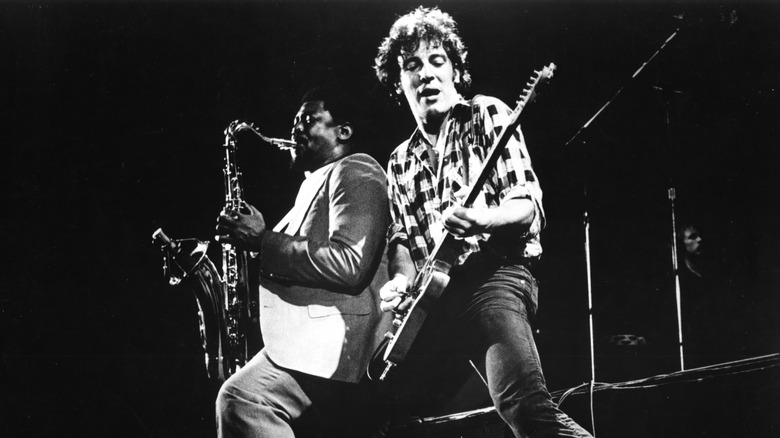
The five best saxophone solos in the history of rock all come from the classic rock era, a time in which bands did everything they could to make their hard-driving hits pop, excite, and surprise. In addition to delivering soaring vocals, searing guitar licks, and heavy drums, the biggest artists of the era occasionally turned things over to a sax player and let them rip. As far as instrumentation goes, the sax was omnipresent in the early days of rock 'n' roll, but by the 1970s, the instrument had fallen out of favor. But then it came back in a big way as a showcase instrument and solo vehicle for some of the genre's most notable and creative bands.
Some songs, even smash hits, are maybe even more remembered for their absolutely killer and seemingly out-of-nowhere saxophone solos. These tracks from the 1970s and early 1980s by the likes of the Rolling Stones, Bruce Springsteen, and more gave the world classic rock's five greatest all-time sax performances.
Miss You — Mel Collins
In August 1978, "Miss You" became the Rolling Stones' eighth and final No. 1 single on the Billboard Hot 100. The song is one example of rock musicians trying '70s disco, and the band was quite successful blending its propulsive, bluesy rock with the funky sounds of the discotheques popping up all over the U.S. and the U.K. at the time. "Miss You" also mixed it up for the Stones in that the breakout star of the track is an outside, hired session musician: Mel Collins. The saxophonist — better known for his regular role in the progressive rock band King Crimson — gave the song a gritty, urban feel befitting the sophisticated music and Mick Jagger's lyrics about pining for a loved one.
Collins nailed the solo in only two or possibly three takes, capturing for posterity a searing emotional performance that played off of Keith Richards' guitar licks as if he had come undone and were howling in the night. Unfortunately, Collins' big moment was deleted from the single version, so the solo could only be experienced on the "Some Girls" LP.
Money — Dick Parry
A No. 13 hit in 1973, "Money" is the only song from Pink Floyd's "The Dark Side of the Moon" album to chart on the Billboard Hot 100. Loaded with intricately layered sound effects and sarcastic lyrics critical of materialism, "Money" is just one of many songs on the LP about disconnection and isolation. But then there's that saxophone solo. It's as spooky and unnerving as the rest of the song, thus serving and explaining the material, and it's also a much-needed taste of something organic and acoustic in a musical sea of manipulated artificial and electric sounds.
Saxophonist Dick Parry often played live with Pink Floyd in the 1970s, as his work was crucial to the overall sound of favorites like "Wish You Were Here" and "Us and Them." His contributions to "Money," though, are singular in progressive rock, the Pink Floyd canon, and instrumental solos. It's like jazz, big band, soul, and early rock all at once as Parry effortlessly glides back and forth between horn blasts, sensual lines, light improvisation, and satisfying brassy bits.
Baker Street — Raphael Ravenscroft
After leaving the moderately successful Stealers Wheel and launching a solo career, singer-songwriter Gerry Rafferty had a monster No. 2 hit on the Billboard Hot 100 in 1978 with "Baker Street." It spent six weeks in the runner-up slot, but what was clearly driving its success was not Rafferty's low-key vocals — it was the repeated saxophone solos. They were provided by Raphael Ravenscroft and used in lieu of a chorus. Perhaps the most memorable saxophone part in rock history, Ravenscroft's portions feel like they come from a different song, as high-playing, ambitious, and epic as they are.
Ravenscroft's haunting and triumphant sax work is the best known and best part of "Baker Street," and it was something of an afterthought. Rafferty intended to play that affecting and jazzy motif himself on the guitar with some piano, but he couldn't decide on an arrangement he liked. That prompted him to bring in Ravenscroft, who played that hummable melody on the sax, which has since been heard in dozens of movies and TV shows.
Born to Run — Clarence Clemons
The E Street Band has always given Bruce Springsteen a lot of options. Packed with exemplary musicians, they can either play as one, providing a walloping wall of sound, or individually break out of the group and show off their skills. For "Born to Run," a song Springsteen hated at first, the E Street Band did all of that. Frenetic, grand, agitated, and romantic in multiple senses of the word, "Born to the song washes over listeners with operatic might as well as a remarkable saxophone solo by longtime group member Clarence Clemons.
Peaking at No. 23 in September 1975, "Born to Run" was Springsteen's first real hit, and what might have finally gotten him on the pop chart was an undeniable and captivating saxophone solo. Clemons plays with urgency, fierceness, and empathy for the uneasy characters at the heart of the song. His solo rings out as if from on high, a prolonged burst of joyful noise that captures the anarchy of rock 'n' roll, youth, and the bittersweet "Born to Run" storyline.
Urgent — Junior Walker
A wise choice for the lead single from Foreigner's fourth official studio album "4," "Urgent" showed the band bridging its guitar-based arena rock of the '70s with the new, exciting, and smooth sounds of '80s new wave. The first of Foreigner's five hits from the LP, "Urgent" went Top 5 of the Billboard Hot 100 in the summer of 1981. All the keyboards melding with guitars would've been plentiful, but then Foreigner also threw in the rich throwback of a sax solo.
While sax sounds are laced throughout "Urgent," it's still surprising when legendary Motown musician Junior Walker completely takes over the track. The song showed why Walker was a sensation, because his wailing on the tenor sax reminds listeners of early rock 'n' roll while also merging with the electronic instruments to create a futuristic and engrossing sound. He's such a virtuoso that he completely outclasses the competent musicians of Foreigner, making "Urgent" into his own idea of what a soulful rock song should sound like — his non-lyrical solo is the most lyrical part of the song.