

5 Best Duets Of The Golden Oldies
As soon as recorded music began to spread far and wide in the mid-20th century, artists and listeners took a shine to the expressive power of combined voices. Many of the most popular, iconic, and beloved songs of the so-called golden oldies — which we'll define here as the period spanning roughly from the '50s into the late '60s — were duets, made up of singers taking turns at the mic for snappy musical dialogues or harmonizing mellifluously to create a third, previously unheard frequency.
For this list of the very best duets of the golden oldies, we've elected to focus on songs that worked as crossover events, so to speak — meaning that each one of these marked a meeting between singers with separate careers, who got together only for the benefit of specific singles or albums. Inevitably, this leaves out innumerable great records by double acts such as Sonny & Cher, Simon & Garfunkel, Ike & Tina Turner, and the Everly Brothers; the logic behind this choice is that, precisely because these were established duos who primarily put out music together in this period, the volume of duets they released is so great that it would crowd out "occasional" duos on a comprehensive list. Therefore, what you'll find below is a list of songs that showcased special, momentous musical pairings at the peak of their chemistry, maximizing through collaboration the greatness they were already known for on their own.
Baby (You've Got What It Takes) — Dinah Washington and Brook Benton
Dinah Washington is among the most iconic performers in the history of blues, R&B, and jazz, and some of her best-known songs were recorded in collaboration with Brook Benton, a multi-hyphenate crooner whose legacy as a songwriter is as significant as his singing oeuvre. Although the pair reportedly had a rocky and less-than-friendly personal relationship, they were a transcendent musical match, as demonstrated by their most notable hit: 1960's "Baby (You've Got What It Takes)."
Written by Clyde Otis (who had previously penned songs for both Washington and Benton) and Murray Stein, "Baby" was originally recorded by Benton's sister Dorothy Pay in 1958 before Otis brought it over to the two singers who would catapult it into legend. A reportedly tense recording session yielded magic on the tape: With their impeccable vocal technique as a sturdy foundation, Washington and Benton trade snappy verses about their high standards for love and the other's ability to meet them, each one enunciating as though their duet partner were being granted a rare, unrefusable privilege.
In between effortless harmonies and quick-thinking ad-libs (including Washington warning Benton that he cut into her verse by saying "You're in my spot again, honey," and Benton replying with a rascally "I like your spot"), the alchemy of the two singers' voices reaches something like R&B perfection. "Baby (You've Got What It Takes)" became one of the most popular duets of the '60s and one of Washington's signature songs for a reason; its energy and sense of peppy fun are just unmatched.
Ain't No Mountain High Enough — Marvin Gaye and Tammi Terrell
From its bass line's iconic opening slide down the chromatic scale, the Nickolas Ashford and Valerie Simpson-penned "Ain't No Mountain High Enough" announces itself as a show-stopper. At one point coveted by Dusty Springfield, the song was kept by Ashford and Simpson as a potential entry ticket into Motown. Sure enough, it became one of the label's most legendary songs ever when Marvin Gaye and Tammi Terrell joined forces on it in 1967 and turned it into one of the best duets in pop history.
The chorus of "Ain't No Mountain High Enough," with Terrell mirroring the lyrics by scaling to ecstatic high notes while Gaye puts full-throated passion into the lower end of the harmony, is one of those musical moments that have come to define '60s pop culture. What not everyone realizes is that this most joyful of all duets was assembled from separate sessions: Terrell recorded her vocals alone, and it was only later that producers Harvey Fuqua and Johnny Bristol brought in Gaye to fill out the recording.
The result of this musical collage was a pop song so perfectly calibrated, so triumphantly written and performed, that it felt like being led by the hand into a realm of pure bliss by Terrell and Gaye themselves. It was the birth of both a new musical standard and a new historical partnership: Ashford and Simpson's song went on to sail to the top of the charts when Diana Ross covered it in 1970, and Gaye and Terrell went on to actually share the recording booth for an all-timer run of hit duets.
Lady Bird — Nancy Sinatra and Lee Hazlewood
There may be no cooler sound in all of music than the sound of Nancy Sinatra and Lee Hazlewood singing together. The two '60s superstars got enormous amounts of mileage out of the sultry interplay between Sinatra's sassy alto and Hazlewood's theatrical bass-baritone, putting out duets that felt cinematic in their depth and drama. Their brilliant 1968 album "Nancy & Lee" gathers many of those duets, and the best of them, arguably, is "Lady Bird."
Written by Hazlewood, the 10th track on "Nancy & Lee" utilizes a back-and-forth structure, with each singer contributing separate verses from their corner of the ring: Sinatra tells of a passionate and sadly abbreviated relationship through a series of lush weather metaphors, painting a picture somewhere between a Western and a nature documentary; in turn, Hazlewood punctuates each of her verses with the same repeating plea for his "lady bird" to come meet him on the ground.
Although the verses are melodically and metrically identical, always culminating on the "lady bird" refrain atop a string riff, the effect of this duality is that the girl in the story flows through changing states, while the guy stays put on a de-facto chorus. "Lady Bird" thus emerges as the tale of a free-spirited woman getting continually drawn to a man whose promises of love may not hold water — and, like movie stars, Sinatra and Hazlewood embody these characters fully, all while their underlying screen personas shoot knowing winks to the audience. When they finally sing together in the last verse, it's a climax worthy of a classic.
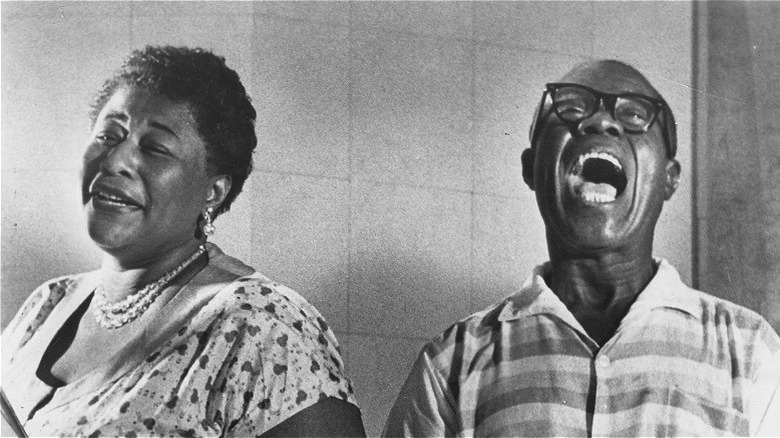
Let's Call the Whole Thing Off — Ella Fitzgerald and Louis Armstrong
As power rankings of midcentury American singers go, you could hardly come up with a mightier combo than Ella Fitzgerald and Louis Armstrong — and their work together is every bit as incredible as you'd expect. The two jazz titans already had recorded collaborations dating as far back as the 1940s, but 1956's "Ella and Louis" album crystallized them as a duo for the ages — and its 1957 sequel, "Ella and Louis Again," features the most delightful sample of what magic could be worked by their combined genius.
On side three, track one of the 90-minute album, Fitzgerald and Armstrong team up for a rendition of "Let's Call the Whole Thing Off," a Gershwin brothers song originally performed by none other than Fred Astaire and Ginger Rogers in the 1937 film "Shall We Dance." And, though the record doesn't have the benefit of an accompanying dance number, Ella and Louis still manage to put on a show of equal caliber to Fred and Ginger just off the gracefulness of their singing.
"Let's Call the Whole Thing Off" is essentially a pronunciation-based playtime rhyme, in which the narrators delineate their irreconcilable differences in temper by listing off their disparate ways of saying certain words — "ee-ther" vs. "eye-ther," "to-may-to" vs. "to-mah-to." It works only to the extent that the singers performing it are in on the play — and Fitzgerald and Armstrong, whose voices could scale the most daunting of jazz operas, have so much giddy fun with the syllabic back-and-forth that it genuinely feels like you're watching them dance.
Bonnie and Clyde — Serge Gainsbourg and Brigitte Bardot
The 1967 Arthur Penn film "Bonnie and Clyde" galvanized the American movie industry and helped usher in New Hollywood — and, a few months after its release, it received an unofficial yet equally iconic appendage in the form of an eponymous French chanson. Written by Serge Gainsbourg, with inspiration drawn from a poem by the real-life Bonnie Parker, "Bonnie and Clyde" became one of the most significant French pop songs of the late '60s, and went on to score its own share of movie scenes. And its mystique was all down to the meeting of forces that brought it into being.
Gainsbourg himself was his era's most globally famous exponent of French music — a singer-songwriter on a level of fame and prestige comparable to what Bob Dylan was enjoying in the U.S. at the same time. Brigitte Bardot, meanwhile, was arguably the defining star of European cinema in the '60s, and a handful of albums and singles had already proved her mettle as a sly interpreter of French-language pop songs.
When they got together in the studio to record "Bonnie and Clyde," it was the interfacing of two realms of rarefied, larger-than-life celebrity. And the resulting sound is suitably enormous: Embodying the titular characters in a straightforward telling of their infamous criminal biography, Gainsbourg and Bardot ground the operatic, string-heavy production with layers of raw feeling tucked away underneath the icy movie star pose. Every time they get back to the "Bonnie and Clyde..." chorus, you can feel the wind in your hair as though you were on the run with them.