

The 5 Best Duets To Ever Come Out Of Motown
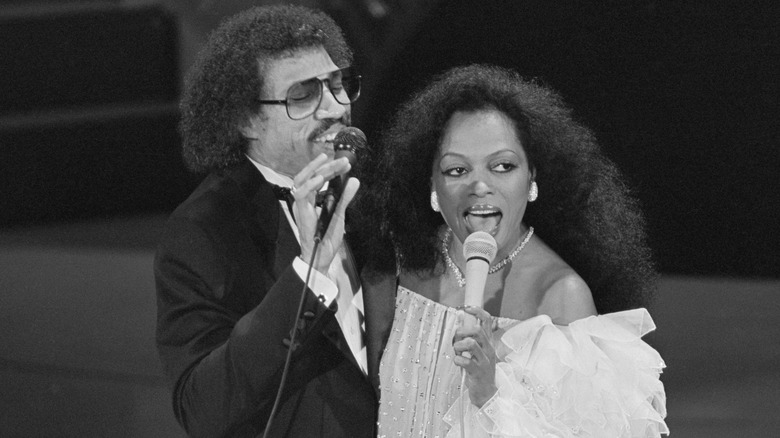
Motown Records is one of the most influential record labels ever. The sound of American pop music of the 1960s and 1970s came to be one and the same with that of the R&B and soul factory operating out of Detroit under the eye of founder Berry Gordy. With stunning regularity, Motown generated hit singles and developed homegrown superstars, and it cross-promoted freely. Motown made Diana Ross, Marvin Gaye, Lionel Richie, and others even more famous by teaming them up with duet partners and giving them a brassy and inspiring love song to belt out. Many of those two-voice singles became some of Motown's biggest hits and pop classics.
Motown kept providing the soundtrack for the ups and downs of love and relationships well into the 1980s, because it had such a hold on songwriting and performing talent. These are the best — meaning the most gloriously romantic and silky-smooth — duets ever to come out of the Motown Records machine.
Ain't No Mountain High Enough – Marvin Gaye and Tammi Terrell
Long before married pop duo Ashford & Simpson recorded hits like "Solid" for other labels, the pair worked as house songwriters for Motown. They presumably poured their real and profound feelings for one another into a series of jubilant and luxurious duets they wrote that were earmarked for Motown's Marvin Gaye and Tammi Terrell. Among the tunes that Ashford & Simpson wrote, and which Gaye and Terrell turned into '60s gems: "Your Precious Love," "Ain't Nothing Like the Real Thing," "You're All I Need to Get By," and most notably, "Ain't No Mountain High Enough."
While Diana Ross took it to No. 1 in 1970, it was originally recorded by Gaye and Terrell, and the secular hymn is even more emotionally powerful when performed by a committed duo. Bearing the transcendent and spiritual influence of gospel, the song blends Gaye and Terrell's voices in unison and harmony as they proclaim how nothing in the physical world could ever prevent their characters from being together. And that's just in the verses, before that famous, chill-inducing, and anthemic chorus kicks in.
I'm Gonna Make You Love Me – Diana Ross & the Supremes and the Temptations
A one-album event that qualifies it as one of the best pop supergroups of all time, "Diana Ross & the Supremes Joins the Temptations" found Motown's two most major vocal groups joining forces for a collaborative album. Motown brass wasn't convinced that "I'm Gonna Make You Love Me," a song already performed by Dee Dee Warwick and Madeline Bell, should be a single, but an influential DJ in Philadelphia played the cut from his pre-release copy of the album, and listeners enjoyed it so much that Motown assented on public demand. With most of the Supremes and the Temptations providing backing vocals, "I'm Gonna Make You Love Me" wound up being a duet between one group's leader, Ross, and the other's most compelling singer, Eddie Kendricks.
"I'm Gonna Make You Love Me" possesses that classic Motown sound heard on so many of the two constituent groups' other songs, with that confident bass line, insistent percussion, and underlying bounce. True to Motown style, strings and powerful background vocals constitute most of the track's many layers. Kendricks delivers the first verse earnestly, before Ross joins him with a sensual and honest counterpoint. "I'm Gonna Make You Love Me" was a smash, reaching No. 2 in early 1969.
Endless Love – Diana Ross and Lionel Richie
Spending nine weeks at No. 1 in the summer and fall of 1981, "Endless Love" was the biggest Motown Records single ever to that point, as well as the most popular soundtrack cut. "Endless Love," a standard love ballad about undying devotion and desire, could've come out corny if handled by anyone other than Motown's most bankable solo performers: Diana Ross and Lionel Richie, the latter of whom wrote and produced the track for the since-forgotten Brooke Shields melodrama "Endless Love." Instead, it's a sweeping mini-epic.
Ross and Richie really sell "Endless Love," fully inhabiting the characters who only have eyes for one another and whose lives didn't begin until they met and which would otherwise be meaningless. Curiously, neither singer sings with each other, but rather at the other, constantly escalating the stakes of the song with vocal runs and credible emotional outpourings. It's a beyond-dreamy slow song of the '80s that's also a showcase of some of the greatest talent Motown ever attracted.
With You I'm Born Again – Billy Preston and Syreeta
Another highly memorable hit Motown Records duet written and performed for the soundtrack of a movie that the average listener probably can't remember, "With You I'm Born Again" was the standout musical moment of 1979's "Fast Break." Featuring "Welcome Back, Kotter" star Gabe Kaplan as the coach of a ragtag college basketball team, his relatives rally around him to help him realize his dream, and "With You I'm Born Again" is the somewhat romantic but also spiritual song used to highlight those themes.
"With You I'm Born Again" is up for interpretation, as it details a search and desire for warmth, comfort, and meaning. Former Beatles collaborator and keyboard rocker Billy Preston shows off his softer side on this duet with previously little-known Motown signee Syreeta. Hopeful and celebratory, and as cozy as a '60s Christmas song, "With You I'm Born Again" was a big hit, peaking at No. 4 on the pop chart in 1980, and providing the airwaves of the era with a winning and unabashedly schmaltzy love song.
Don't Look Any Further – Dennis Edwards and Siedah Garrett
In the 1980s, Motown updated its sound, bringing in the sounds of disco and funk to create a danceable soft rock on songs like "Don't Look Any Further." Dennis Edwards, a breakout star of the Temptations in their psychedelic soul era a decade prior, was ready to go solo in 1984, and the label armed him with this song — a duet that also marked the debut single for singer Siedah Garrett, best known for her 1987 No. 1 duet with Michael Jackson, "I Just Can't Stop Loving You."
Edwards' performance is quite disarming as he belts out the platitudes and adorations. Garrett's vocals are restrained, perhaps because there's not much room after Edwards' theatrics and crooning on the final mix, which is funky, muscular, and bass-heavy, sounding more like rock than classic Motown soul. Edwards and Garrett clearly had a great time recording "Don't Look Any Further," and that's the kind of chemistry that can turn a good duet into a great one. As such, music buyers agreed and they made "Don't Look Any Further" into a No. 2 R&B hit.