

Born 109 Years Ago Today In North Carolina, This Piano Genius Changed Jazz Forever
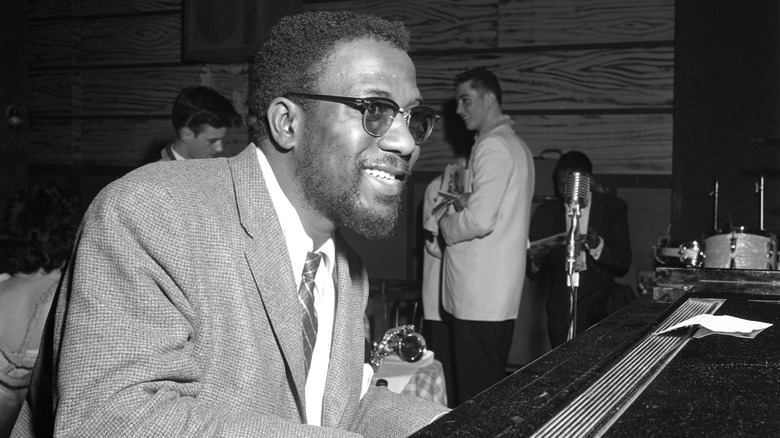
Thelonious Sphere Monk was born in Rocky Mount, North Carolina, on October 10, 1917, but relocated to New York City with his family at age 4. Showing early signs of being a musical prodigy, he began playing professionally while still in his teens, dropping out of high school in his sophomore year to tour, playing worship music with an evangelist. After returning to New York two years later, he began performing with his own quartet before landing the gig as house pianist at Minton's Playhouse in Harlem, the club regarded as the birthplace of modern jazz and the bebop revolution.
That was 1941, the same year as the tragic death of jazz innovator "Jelly Roll" Morton, and it began a career that was as prestigious as it was perilous, with Monk playing a central role in jazz history. His career would be off to a rocky start until the release of 1957's "Brilliant Corners," one of those classic '50s albums on vinyl that's actually worth your money. Though less prolific, his compositional impact would rival Duke Ellington himself in terms of contribution to the jazz idiom.
His style was eccentric, but so was he
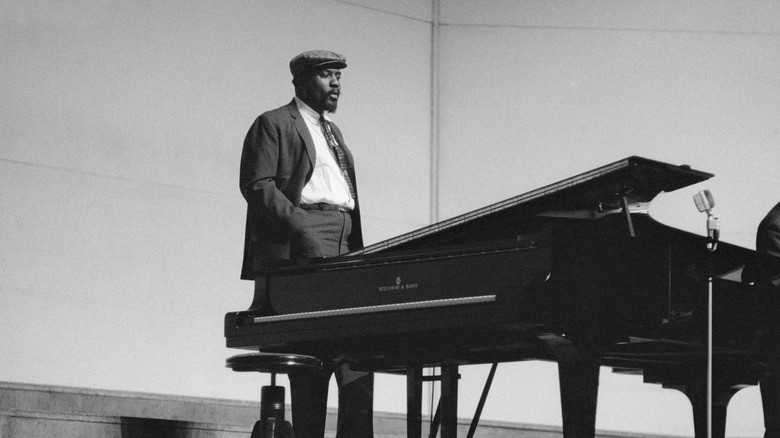
While Thelonious Monk is instantly placed at the top of the jazz hierarchy in retrospect, his style was an acquired taste for many. Most immediately apparent — at least when contrasted with his contemporaries — is just how much harmonic information he places in his left hand. Where traditional piano, irrespective of genre, gives the left hand the bassline, Monk inserts harsh intervals, larger chordal structures, and other unorthodox statements that defy the left hand's prescribed role of just sauntering along.
That left hand forms the foundation (musically and theoretically) of Monk's innovative and often beguiling technique. Although a technical soloist par excellence, he's less interested in shredding his chops than creating challenging harmonic spaces for his players to inhabit. When those musical gambits pay off, we're left with something extraordinary like "At Carnegie Hall," the mesmerizing live album recorded in 1957 with John Coltrane a decade before the legendary saxophonist's death. Harsh critics would suggest that Monk's harmonic density was born more out of incompetence than internal logic, but solo outings like 1965's "Solo Monk" reveal a conceptual framework that is as satisfying as it is convoluted.
Monk's unorthodox approaches came through in his often puzzling behavior. He was given to standing up from the piano and dancing while on stage and would often give directions that were puzzling to his band members. The pianist would seek ongoing treatment for mental health issues throughout his life, but specific conditions were never disclosed publicly. Though the strain of those internal struggles wore on him throughout his life, he nevertheless channeled them into a brilliant and revolutionary recording career.