

The 5 Top Motown Hits Of The '80s
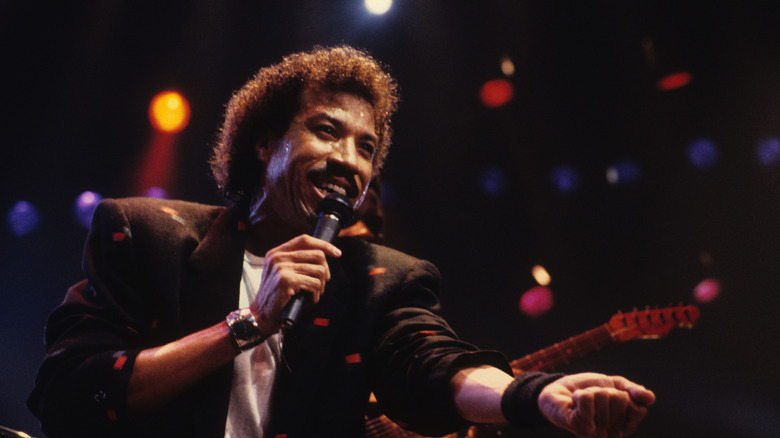
The 1980s were a tumultuous time for Motown. The label's Queen, Diana Ross, jumped ship in 1980. Two years later, Lionel Richie left the Commodores to launch a solo career. Ross returned to Motown in 1989, but to a very different company since founder Berry Gordy, Jr. sold the label to MCA the year before. But through all the drama, the hits didn't miss a beat.
Ross announced "I'm Coming Out" just before her Motown exit. Richie proved he could do fine on his own, keeping the party going with "All Night Long." The Commodores struggled without him but eventually found their groove again with "Nightshift." Meanwhile, Rick James was being Rick James, unleashing his inner "Super Freak." And Stevie Wonder scored the biggest hit of his career while tethered to a touchtone phone: "I Just Called to Say I Love You."
We chose these songs based on a combo of chart success (every song reached the Top 20 on the Billboard Hot 100), staying power (these songs still matter today), and variety. That last requirement is mostly Richie's fault. He could fill a list of top 1980s Motown hits by himself. But he only gets one, leaving room for an eclectic list of hits with everything from Motown royalty to super freaks.
I'm Coming Out — Diana Ross
Picture a 1970s midtown Manhattan nightclub bathroom packed stall to stall with Diana Ross impersonators. Might not be the usual birthplace of a pop classic, but it's exactly where "I'm Coming Out" found its spark. Songwriter Nile Rodgers told Premier Guitar that he stepped up to do his business and noticed Ross lookalikes flanking him on both sides, "like six or seven deep." In that moment, as he explains it, "the light bulb goes off over my head." He sprinted to a telephone booth to call his co-writer, Bernard Edwards, with an urgent request: "Please write this down because I guarantee you I'm gonna get drunk tonight, I'm gonna forget this. I said, write down 'I'm coming out.'"
The empowering message landed with Ross at the perfect moment, when she had been looking to reinvent herself. As Rodgers explained it to the New York Post, Ross had "said that she just wanted to turn her whole career upside down." Cue the No. 1 hit, "Upside Down."
As for "I'm Coming Out," it peaked at No. 5 in November of 1980, but its real power came in the decades that followed. It became a Pride-season staple, the track Notorious B.I.G. sampled for "Mo Money Mo Problems," and Ross's go-to opener for live shows: "I'm coming out, I want the world to know / I got to let it show." How else would you expect her to come out on stage?
Super Freak — Rick James
Before "Super Freak" hit the airwaves in 1981, Rick James teamed up with Los Angeles radio director Alonzo Miller to tone down the song's raunchy lyrics. What'd the original sound like? Let your imagination run wild. Though that too-risqué-for-the-airwaves version might be lost to history, what James and Miller came up with keeps on thumping.
With that powerful bassline and new wave synths, "Super Freak" sounds nothing like 1960s Motown. But the label's DNA is right there in the mix — that's the Temptations on background vocals. It's a nice little thread tying classic Motown to the punk-funk sound James was about to rule like a sequined king.
"Super Freak" became James' biggest hit, climbing into the Top 20 on the Billboard pop charts, powering the triple-platinum album "Street Songs," and launching a tour that outgrossed rock giants like The Rolling Stones. But "Super Freak" grew beyond the decade of big hair. When M.C. Hammer sampled that bassline for 1990's "U Can't Touch This," James received a songwriting credit. That earned him a Grammy when "U Can't Touch This" won Best Rhythm & Blues Song. Even today, James' legacy helps define punk-funk, and his most famous song literally helps define the word "freak" itself. "The Routledge Dictionary of Modern American Slang and Unconventional English" quotes the lyrics in its entry for freak: "That girl is pretty wild now / The girl's a super freak / The kind of girl you read about / In New-wave magazines."
All Night Long — Lionel Richie
From the Nobel Peace Prize concert to a parody on "The Simpsons," Lionel Richie's "All Night Long (All Night)" has been all over the place. But for a song that sounds so cool and relaxed, "All Night Long" did not come easily. Richie told the New York Post that he'd written most of it, but then took months hunting for the hook. And even after he found it, the bridge gave him trouble. The "Tam bo li de say de moi ya" that ended up in there is Richie's made-up language.
That gibberish wasn't the first plan. He wanted real phrases, so he called a friend at the United Nations. But as Richie explained to the New York Post, his friend told him there are hundreds of African dialects and that an answer would take a few weeks. Richie didn't have a few weeks, so the deadline-driven songwriter invented his own.
Clearly, it worked just fine. In 1983, "All Night Long" spent four weeks at No. 1, an especially impressive feat given the big-name competition. The song shared the Top 5 with two of the most famous duets of the 1980s: Kenny Rogers and Dolly Parton's "Islands in the Stream" and Paul McCartney and Michael Jackson's "Say Say Say." While McCartney was urging everyone to "Say, say, say what you want," Richie was doing exactly that — he was even making up his own words.
I Just Called to Say I Love You — Stevie Wonder
Keep it simple, Stevie. That's what Stevie Wonder did with "I Just Called to Say I Love You," written for the "The Woman in Red" movie soundtrack. Music snobs sometimes give the song grief because it's sweeter and simpler than prime-1970s Wonder. But sophisticated songwriting can also mean knowing exactly how little a song needs.
Everything here is rather straightforward, from the melody to the lyrics to the instrumentation. And that's part of what makes the song work. With nothing in the way, Wonder sells the heartfelt message on the warmth of his voice alone. This isn't about some grand gesture or special day. It's a song about a day with absolutely nothing going for it. The verses go on and on about every holiday that isn't happening: "No New Year's Day to celebrate / No chocolate-covered candy hearts to give away / No first of spring, no song to sing / In fact, it's just another ordinary day." In "The Sound of Stevie Wonder," music scholar James E. Perone notes, "About the only thing lyricist Wonder leaves out is Groundhog Day."
That omission didn't seem to hurt the song's success. It became Wonder's biggest hit, spending three weeks at No. 1 in 1984 and winning an Academy Award for best original song. In his acceptance speech, Wonder thanked Gene Wilder for thinking he could contribute "some songs for your film." Wonder most certainly answered that call.
Nightshift — Commodores
The Commodores had a rough start to the 1980s. Founding members Lionel Richie and Thomas McClary both left the group, and longtime manager Benny Ashburn died of a heart attack. After years of chart-topping success, the group struggled. But the Commodores weren't ready to clock out just yet. Instead, they were ready for their "Nightshift," a song that reached the Top 3 on the Billboard Hot 100 in 1985 and won the group its first and only Grammy.
The award-winning song was a tribute to Marvin Gaye and Jackie Wilson, two soul legends who died in 1984. Gaye had become the "Prince of Motown" with classics like "I Heard It Through the Grapevine" and "How Sweet It Is (To Be Loved By You)." The opening verse of "Nightshift" honors him: "Marvin, he was a friend of mine / And he could sing a song, his heart in every line."
The second verse turns to Wilson, with lyrics that nod to his 1967 hit, "(Your Love Keeps Lifting Me) Higher and Higher." The Commodores sing: "Jackie, oh you set the world on fire / You came and gifted us, your love it lifted us higher and higher." The emotional tribute was a powerful second act for a group many believed couldn't survive without Richie. In singing about musicians whose voices would never be forgotten, the Commodores ensured their own voices would be remembered, too.