

The Top 5 Motown Hits Of The '70s
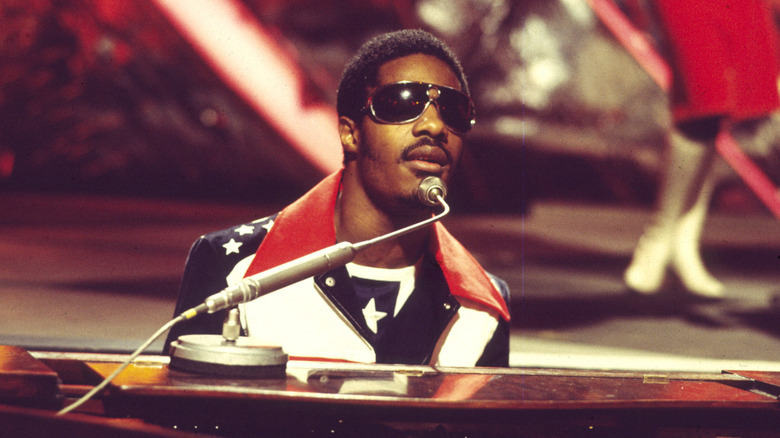
In the 1970s, Motown produced some of its biggest and best hits, many of which are still beloved staples to this day. By the '70s, Berry Gordy's record company and its many subsidiaries had already been established as almost unparalleled hit factories, with a massive stable of young musicians churning out one popular single after another. Acts like the Jackson 5, the Temptations, Marvin Gaye, and Stevie Wonder made songs that were not only some of Motown's best, but some of the decade's best.
In picking the era's top Motown hits, we looked at how well the songs performed as singles, their musical innovation and influence, and how well they've remained in the public consciousness today. All the songs we'll talk about excel in every one of these respects, as well as achieving the equally admirable goal of being darn great pieces of music. These Motown hits represent the best of the genre — its roots in gospel and soul, its intricate and angelic harmonies, and its fun-loving, infectious energy. These are five of the top Motown hits from the most danceable decade yet, the '70s.
I'll Be There — The Jackson 5
In the late '60s and early '70s, the Jackson 5 emerged as a phenomenon that transcended the labels of "youth band" and "family band" to become all-around stars. Their first four singles all hit No. 1 on the Billboard Hot 100 — three bubblegum pop hits, and then seemingly out of nowhere (especially for such a young group), came the sincere, romantic ballad "I'll Be There." With a surprising amount of maturity, they delivered "I'll Be There" with the grace and confidence of seasoned adults, and the tender tune held its grip on the No. 1 spot for five weeks in 1970 as a result.
The bulk of the song's vocals are handled by a then-11-year-old Michael Jackson, whose innocent and angelic voice actually reinforces the song's wizened words instead of undermining them, as might be expected. "If you should ever find someone new / I know he better be good to you / 'Cause if he doesn't, I'll be there" are not words that a tween could identify with, and yet Michael's delivery still comes across as genuine — evidence not only of his generational talent, but also the song's tight, timeless construction.
The single has endured as a radio staple and as an early testament to Michael's almost peerless prowess as a performer. Not only does it sit in the Grammy Hall of Fame, it also spawned a cover by Mariah Carey that hit No. 1 22 years later.
Papa Was a Rollin' Stone — The Temptations
You won't find many No. 1 hits as long as the Temptations' "Papa Was a Rollin' Stone," with an album cut almost 12 minutes long and a single edit that's still nearly seven minutes itself. Despite the Temptations' acclaim as a vocal group more than anything, the song's album cut doesn't even introduce its vocals until over four minutes in, which is already longer than most hit singles run in total. Nevertheless, the song was a runaway success, and the fact that audiences en masse were willing to invest two to three times as much attention as usual into one single is a testament to how monumental the song really is.
The song held the No. 1 spot for a week in '72, outperforming the prior version by the Undisputed Truth by 62 spots. Part of what makes the song so listenable is its atmosphere, which builds ever so slowly into a rich tapestry of feeling. The drums and bass give the song a tense, almost menacing air, while the ethereal, wah-wah guitar seems to waft among like steam rising from a city street. The trumpets employ a delay at times, which adds to the guitar's dreamlike feeling and plays as excellent contrast to the song's non-nonsense, bass-led core.
The song scored the auspicious number of 333 on Rolling Stone's list of the 500 Greatest Songs of All Time, and 2nd on their list of the 100 Greatest Motown Songs. In both cases, its cinematic, storytelling nature was cited as a reason why the song remains such a monolith to this day.
War — Edwin Starr
Not every Motown hit was an upbeat number meant for the whole family to dance to, as proven by Edwin Starr's "War." The song is a screaming, raging protest that doesn't hide its meaning behind one iota of subtlety. Its chorus, which repeats variations of "War! Huh! Yeah! / What is it good for? Absolutely nothin'!" is as direct as any in history, and perhaps owing to that, is a line immediately recognizable by any who hear it. Even those who've never heard Starr's name are certain to know that chorus and likewise know exactly what it means. Evidently that frankness was the right choice, as the song also hit No. 1 on the Billboard Hot 100 in 1970 and became by far Starr's most acclaimed piece.
The song, written by Motown songwriting icon Norman Whitfield, was originally recorded by the Temptations, but not released as a single for fear that the band's considerable reputation would be tarnished by its controversial message. After unsuccessfully being offered to Rare Earth to rerecord as a single, Whitfield went even farther down the pecking order to the relatively unknown Starr, and luckily Starr agreed.
It's hard to even imagine "War" without Starr's commanding, bassy vocals. His many apparent ad libs make the song feel both personal and genuine. Given its release during the waning days of the increasingly unpopular Vietnam War, it likely was. Starr's "War" remains one of the greatest protest songs to date.
Superstition — Stevie Wonder
Stevie Wonder's impossibly catchy "Superstition" is a rare song that gets people of all types out and in their dancing shoes from its opening moments and never lets up. The song's legendary riff, performed by Wonder on an electric Clavinet, is actually a deceptively simple line that only lightly varies throughout, and yet it is one of the most instantly recognizable and infectiously toe-tapping riffs in popular music. The song was surprisingly written by Wonder for someone else — namely cult guitar hero Jeff Beck. What Beck would have done with the song will forever be a mystery, but we know that Wonder took it and made it a sensation.
Wonder's "Superstition" hit No. 1 on both the Hot 100 and R&B charts, proving itself a crossover success. In addition, as both Wonder's de facto signature song and a seemingly permanent radio fixture, it has remained an icon of funk and Motown ever since. The reason for the song's incredible appeal is not due to any one factor over all others, but rather its superb construction and production, which blends its disparate elements into one masterfully controlled whirlwind. The horn section stands out for its solid sustained lines and deft runs, which expertly break up the frenetic Clavinet, and likewise, Wonder's vocals freely roam and deviate throughout, playing counterpoint to both. "Superstition" doesn't sound like any other Motown hit, and yet still exemplifies the craftsmanship and vigor of the genre better than most.
What's Going On — Marvin Gaye
Like Starr's "War," the late and beyond great Marvin Gaye's "What's Going On" is a far cry from the unflappable positivity that characterized the bulk of Motown's hits. Also like "War," the song has a clear anti-war message, but Gaye's masterpiece also benefits from a more general message of peace over conflict. Suitably, Gaye's vocals in the song are gentle and expressive through their dynamic melody. If there's any one emotion that comes through Gaye's voice, it's not anger or bitterness, but grief over the sad truth of human suffering.
Gaye wrote the song from the point of view of his brother, who had returned from serving in Vietnam a different man than he had been when he left. Likewise, a swirl of issues for Gaye, both in his personal life and as a citizen during an especially turbulent time socially for the U.S., informed his songwriting and delivery. The iconic opening lines "Mother, mother / There's too many of you crying / Brother, brother, brother / There's far too many of you dying" are more than just a plea to end the war. They're a call to everyone to be better in the face of growing despair.
Gaye's anthem held the No. 1 spot for two weeks in '73, and the song stands as one of the most important works in the history of Motown, soul, and American music in general.