

The Funk Band That Influenced Generations Of Rock Stars
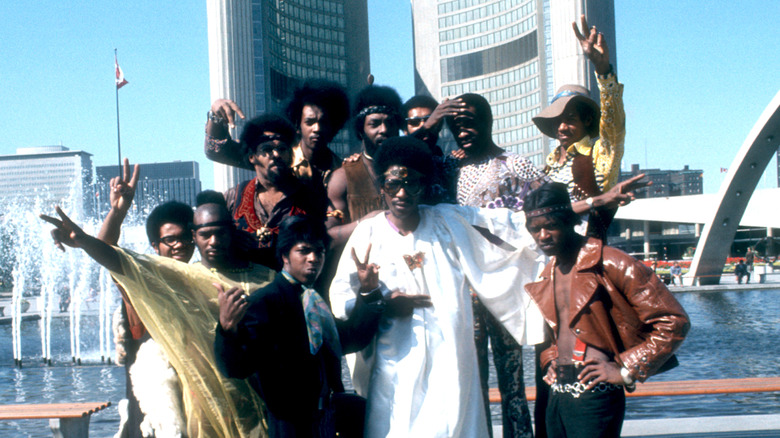
When is one band two bands? Or when is two bands one band? These questions don't come up often, but when they do, they tend to be about Parliament and Funkadelic, aka Parliament-Funkadelic, aka P-Funk, the sprawling music collective of more than 50 musicians that has defined funk music since the late 1960s and been hugely influential not just in the sphere of funk itself, but across vast swathes of rock music as a whole.
Founded and led primarily by George Clinton, the collective is considered alongside James Brown and Sly and the Family Stone as the primary purveyors of the funk genre, who pushed boundaries not only musically but in terms of theatricality, imagery, and mythos. They have been feted throughout the years for their ambitious stage shows, their effortless genre-blending, and their incredible musicianship and vision. But while many of their albums are rightly held up as classics that have had a huge effect on countless musicians to come after them, it is arguable that, in the sphere of rock, their influence is still somewhat understated.
The history of Parliament-Funkadelic
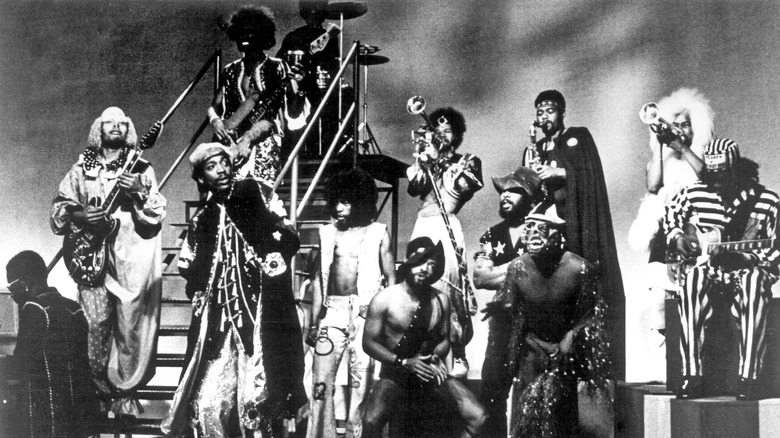
George Clinton is now lauded as one of the most boundary-pushing bandleaders of the 20th century. But as they say, an artist must learn their tools before they can make improvements, and considering his exploratory body of work, his career in music began in a surprisingly conventional fashion.
His first group, the Parliaments, was a barbershop quintet based in New Jersey, who made their first steps in the recording industry as a typical doo wop act also performing R&B and soul. Although they enjoyed some commercial success with early singles such as 1967's "(I Wanna) Testify," new influences were beginning to affect the group. In rock music, the psychedelic revolution was taking hold, present in the sound of British Invasion groups such as the Beatles, and being pushed even further by the primal guitar style of Jimi Hendrix.
Hendrix's work in the late 1960s was an evolution of rock guitar, and his influence on the P-Funk musicians would be profound, with the mystic atmosphere of the Jimi Hendrix Experience's three classic albums setting the tone of many Parliament-Funkadelic recordings. Just take the famous guitar part from 1971's "Maggot Brain" — one of many classic funk solos — for which Clinton instructed guitarist Eddie Hazel to perform as if he was in mourning for his own mother. The classic track shows both the debt Clinton's group owed to Hendrix, and the group's growing rock credentials emerging a few years after evolving from a doo wop combo.
Parliament-Funkadelic's sprawling influence on rock musicians
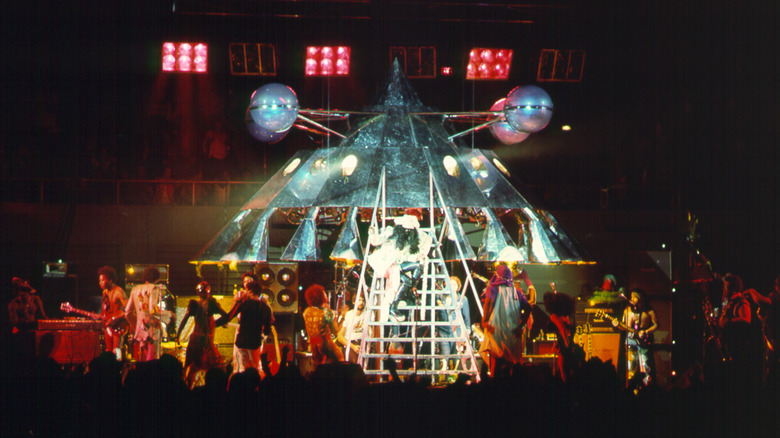
The P-Funk collective widened out the technical aspects of the genre into the foundation of their own imaginative world too. "The One," for example, was a technique of accentuating the first beat of a measure that bassist Bootsy Collins had brought with him when he joined Funkadelic from the JB's. But in P-Funk it became much more: a symbolic call to unity that became central to the message the collective intended to transmit to their audiences. Their big-budget stage shows grew their mythos, with the famous Mothership, an imposing prop spaceship, delivering P-Funk musicians to the stage.
In this way, they prefigured many of the high-concept rock shows that would dominate the late 1970s, such as Pink Floyd's "The Wall," but few would do it with P-Funk's wit and humor. Funk would emerge later in the work of funk-rock groups such as the Red Hot Chili Peppers, as well as multi-genre artists such as Prince, who would blend rock, funk, and more, taking it in an innovative pop-centric direction. Meanwhile, throughout their existence, Clinton's P-Funk collective and Frank Zappa's Mothers of Invention shared a mutual respect and direct influence on one another. "Burning Down the House," the 1983 hit by new wave band Talking Heads, was also inspired by a chant at a P-Funk show.
"Funk is anything it needs to be to save your life," Clinton told CBC's "Q" podcast. "It can morph like a caterpillar to a butterfly — it can morph into everything. If you're funky, you can change your mind. You can do the best you can and then say, 'funk it.'"