

Not Jimmy Page Or Tony Iommi: The Iconic Guitarist Who Helped Pave The Way For Heavy Metal
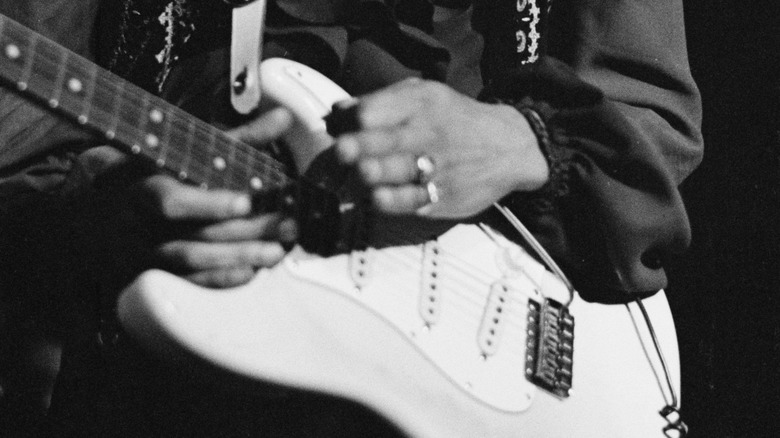
Was heavy metal born with Tony Iommi's opening chords to "Black Sabbath," or Jimmy Page's wailing guitar licks with Led Zeppelin's version of "Dazed and Confused?" Or did heavy metal actually arrive in a puff of "purple haze," thanks to Jimi Hendrix? Because before Black Sabbath, Led Zeppelin, Deep Purple, and Judas Priest transformed hard rock into heavy metal, Hendrix was laying the foundation for that headbanging sound.
Now, there was plenty of metal before there was metal. Poobah, Josefus, Dust, Budgie, and Uriah Heep are just some of the pioneering proto-metal bands that time forgot. But Hendrix has more in common with Blue Cheer than their respective big hits being a cover: he took rock to darker and louder places. Yes, Hendrix didn't invent heavy metal. However, he helped pave the way within the span of two years: "Purple Haze" from "Are You Experienced," "Spanish Castle Magic" from "Axis: Bold as Love," and "Voodoo Chile" from "Electric Ladyland" are fuzzed and far out, the kind of blistering guitar god goodness that many attribute to heavy metal heroes like Judas Priest's K.K. Downing and Deep Purple's Ritchie Blackmore.
"When I saw Hendrix, I thought, Oh my God. This guy is doing everything that I was trying to do," Brian May of Queen told Guitar Player. "He completely blew me away," May said. "I thought, 'He's it.' ... Anybody in the world would find it hard to follow Hendrix." And he's not the only one who feels that way.
Jimi Hendrix Set The Stage For Heavy Metal: 'He Changed the World'
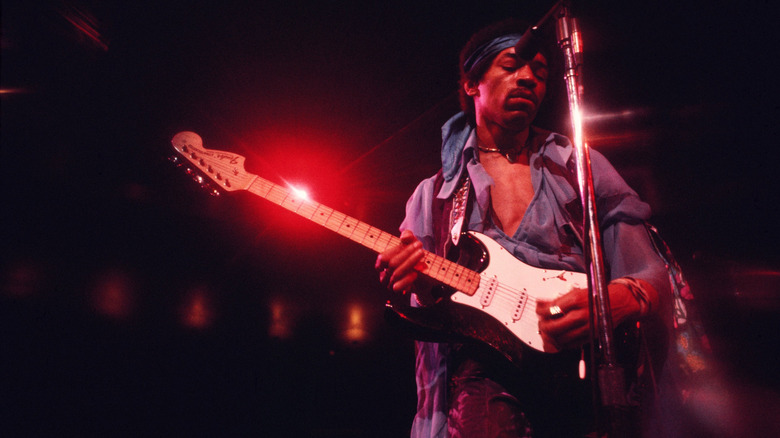
Hendrix's influence on the future titans of heavy metal is undeniable. K.K. Downing said that Hendrix was the sound he was "looking for" as a youth, a sound he would perfect as guitarist for Judas Priest. "I saw him in 1967 — that was obviously it," K.K. Downing explained on The Ex-Man Podcast in 2021. "When you hear riffs like 'Purple Haze,' I mean, these songs, they're just so special. And 'Foxy Lady,' my god. Why does he have a heaviness about it?"
A lot of that heaviness comes from Hendrix tuning down his guitars. "All Along the Watchtower" and "Manic Depression" were tuned a half-step down, giving the songs a deeper sound, for example. For comparison, Black Sabbath's Tony Iommi tuned down his guitar around 1971's "Master of Reality," arguably the band's heaviest album.
Plus, Hendrix's music planted the seed that grew the genre's guitar gods. Deep Purple's Ritchie Blackmore told Vintage Guitar that he thought Hendrix could "emote amazing stuff on the guitar" and "come up with riffs that nobody else would." Jimmy Page of Led Zeppelin told Rolling Stone in 1975 that with Jimi's death in 1970, "We've lost the best guitarist any of us ever had, and that was Hendrix." Zakk Wylde, Ozzy Osbourne's longtime guitarist, made his thoughts clear on Hendrix's influence, telling Consequence, "He changed the world. Jimi Hendrix was basically the Jesus Christ of electric guitar. That's the ceiling — you can't do anything more with guitar."
Jimi Hendrix Used Heavy Metal Sounds Before Heavy Metal
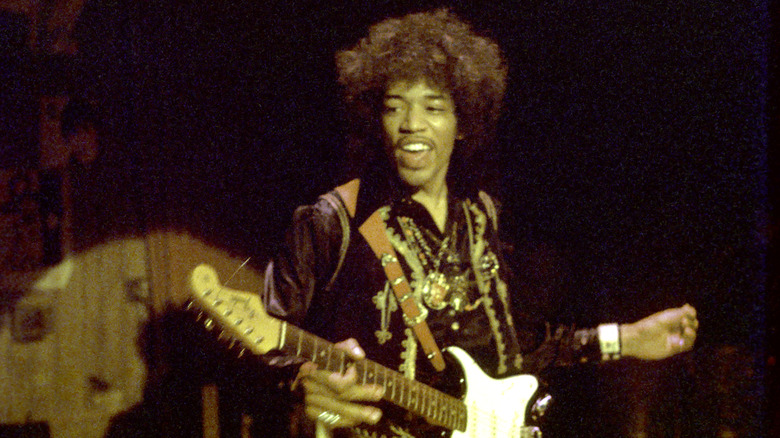
Perhaps the strongest case for Hendrix's influence on metal came via Kirk Hammett. "Theoretically, you can say 'Purple Haze' was one of the first songs I'd ever heard," the Metallica guitarist recalls in Greg Prato's book, "Avatar of the Electric Guitar: The Genius of Jimi Hendrix" (via Classic Rock). "And I'll tell you, you know what I reacted to most? The tone of the guitar. Just that fuzzed out Strat through a Marshall sound."
Hammett connected "Purple Haze" to heavy metal while trying to learn how to play it. He couldn't get it right until he realized Hendrix was playing the flattened fifth. According to Hammett, Jimi is playing the E-note under an A-Sharp. "When I realized that, 'This is the key to that sound that Black Sabbath uses, that Deep Purple uses, that all these blues bands use ... it's that flatted fifth! It's that 'blues note' that's in the pentatonic scale,'" said Hammett.
Dubbed "Diabolus in musica," or "the devil's interval," the flattened fifth earned its name because most people found it unpleasant to listen to because of its sinister sound. Tony Iommi used it on "Black Sabbath," the title track to the band's 1970 debut, which gives the tune its eerie atmosphere. With the myth that the Catholic Church banned the flattened fifth due to it being devil music, the flattened fifth became found its way to heavy metal. Metallica's "Enter Sandman" uses it, as does Slayer's "Bitter Peace" . But Hendrix was there, busting it out before all of them. Metal!