

Classic Rock Artists Whose One Big Hit Was Actually A Cover
There are a few acts held up and remembered among the greatest classic rock artists of all time, and all the while they're surprisingly and technically one-hit wonders. More so, and overshadowing the rest of their output, their sole Top 40 hits were covers of songs originally written or made famous by other musicians.
Such bands and solo performers sold many critically acclaimed albums or had a distinct and profound influence on rock music or later generations of performers, but they just never emerged as singles artists. Even some inductees into the Rock 'n' Roll Hall of Fame were never able to translate their impact into sending songs up the Hot 100 pop chart. And when the music-buying masses did respond by buying a 45 of their single, the one they chose was overwhelmingly a remake of a song they already knew.
Here then are the singles that actually got some airplay and action in the record store singles bins for Richie Havens, Ram Jam, Jimi Hendrix, Janis Joplin, and Blue Cheer — all of them new takes on older material.
Here Comes the Sun – Richie Havens
John Lennon and Paul McCartney dominated the Beatles with their compositions, but they allowed George Harrison to contribute two songs to the band's 1969 album "Abbey Road." Along with "Something," Harrison conceived "Here Comes the Sun," a sweet, earnest, and optimistic masterpiece about rebirth and new beginnings. Powered by acoustic guitar, "Here Comes the Sun" grows muscular with the addition of a heavy bass line and harmonizing backing vocals. It was never issued as a single in the U.S., but the folk-rock gem eventually became the Beatles' most-streamed song by a comfortable margin, demonstrating that over the decades, the world loved "Here Comes the Sun."
Among its fans, and those who furthered its legacy, was singer-songwriter Richie Havens. So important among the hippie scene that he opened the Woodstock Festival in August 1969 with an almost three-hour set, Havens played parts of three reimagined Beatles songs that day: "With a Little Help from My Friends," "Strawberry Fields Forever," and "Hey Jude." Launched to fame by Woodstock, Havens issued the LP "Alarm Clock" in 1970, which opens with his cover of "Here Comes the Sun." Havens transformed a layered folk-rock song into a stripped-down, profound, and moving guitar hymn that enchants audiences. In 1971, Havens' "Here Comes the Sun" became his only smash hit, reaching No. 16 on the Hot 100.
Black Betty – Ram Jam
In 1977, Southern rock band Ram Jam unleashed one of the genre's stone-cold classics, the stomping, clapping, guitar-shredding "Black Betty." As much hard rock as it is bar band or blues, "Black Betty" is a song about an exciting and wayward woman from Alabama, although Ram Jam guitarist and songwriter Bill Bartlett imagined it to be about 1950s model and poster star Bettie Page. However, Bartlett didn't fully write "Black Betty"; he came up with some extra lyrics, arranged it for his band Starstruck, and re-recorded it when Ram Jam formed.
That makes "Black Betty" a cover of a cover of a cover of a song whose origins are lost to history. Bartlett interpreted the song after he heard legendary musician Lead Belly's recording in 1939. That version followed a 1933 take by James "Iron Head" Baker, recorded by musicologists John and Alan Lomax on a prison farm in 1933. By that point, the song was thought to be centuries or decades old, sung and passed down by enslaved people on Southern plantations. Ram Jam's modern update is the most commercially successful "Black Betty." The group's only hit, it made it up to No. 18 in 1977.
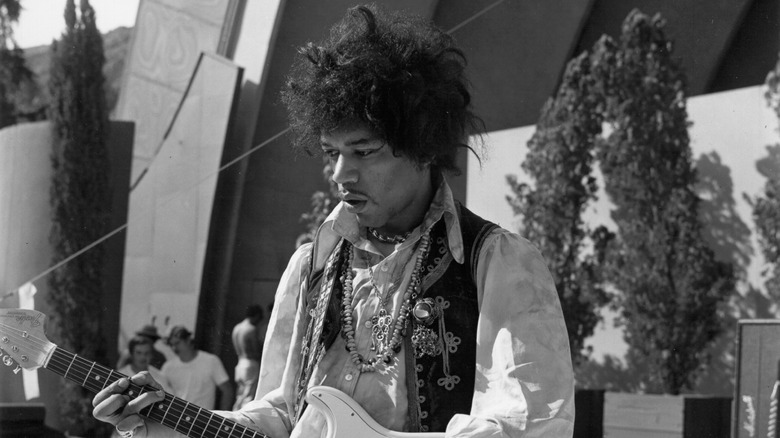
All Along the Watchtower – The Jimi Hendrix Experience
An unsettling, if otherwise inscrutable, song full of evocative imagery in which a thief and a joker engage in an existential conversation, "All Along the Watchtower" was written and recorded by Bob Dylan for his folky, country-leaning album "John Wesley Harding." That LP hit stores in January 1968, and while "All Along the Watchtower" wasn't initially available as a single, guitar genius of the moment, Jimi Hendrix, was a fast fan, likely first hearing it at a party shortly after its release. In late January, Hendrix's power trio, the Jimi Hendrix Experience, found time in its schedule while recording the album "Electric Ladyland" to cut a cover of "All Along the Watchtower."
Marked by powerful, echoing percussion and Hendrix's searing guitar work, both in the introduction and in several showcase moments throughout the song, the Jimi Hendrix Experience transformed Dylan's haunting folk song into an apocalyptic piece of heavy rock. Released as a single later in 1968, "All Along the Watchtower" peaked at No. 20, the only hit that Hendrix ever had, with or without the Experience.
Me and Bobby McGee – Janis Joplin
As influential and legendary as Janis Joplin is and was, blending an affinity and respect for the blues with late '60s hard rock, she wasn't all that commercially successful in her lifetime. Joplin was really a two-time one-hit wonder. With her band, Big Brother & the Holding Company, Joplin sang the ferocious lead vocals on "Piece of My Heart," a No. 12 hit in 1968 and the collective's only Top 40 placement. That was a cover of a hit first performed in 1967 by R&B vocalist Erma Franklin. After Joplin moved away from Big Brother & the Holding Company to pursue a solo career, she once more made the Hot 100 — and only once — by reinterpreting another's song: "Me and Bobby McGee."
Written by Kris Kristofferson before his own recording career took off, the song was covered by Roger Miller, Kenny Rogers and the First Edition, and Gordon Lightfoot; Miller's was a No. 12 hit on the U.S. country chart. But then Joplin's tender and vulnerable recording became the definitive version. A heroin overdose killed Joplin in October 1970 at age 27, and in early 1971, her "Me and Bobby McGee" was issued as a single. She joined the group of classic singers whose songs hit No. 1 shortly after they died, with "Me and Bobby McGee" spending two weeks at the top of the charts.
Summertime Blues – Blue Cheer
The tragic death of Eddie Cochran in 1960 prematurely ended a promising career for a young rock 'n' roll breakout star. Cochran's best-known song and biggest hit was "Summertime Blues," a snarky, youthful lament about wasting the sunniest, most fun months of the year on thankless, tedious, low-paying jobs. In 1958, the track peaked at No. 8 on the Hot 100.
A decade later, the musical landscape had enormously changed. By the end of the 1960s, rockabilly-influenced guitar-pop like Cochran's was extremely passé, replaced by edgy garage rock and druggy psychedelic rock. Those styles gave way to early works in what would later be called heavy metal, as produced by San Francisco trio Blue Cheer.
A track from their very loud, heavy, sludgy, and experimental 1968 album "Vincebus Eruptum" stood out among the others as the most palatable in part because it was a cover. Blue Cheer's "Summertime Blues" doesn't sound much like Cochran's version, as it's so drenched in electric guitars and droning feedback that it buries the main melody. The public was delighted by Blue Cheer's novel form of music and how it reinvented an old chestnut. Blue Cheer was too weird for lasting mainstream success, but its take on "Summertime Blues" peaked at No. 14 in 1968.