

The Ultimate Beginner's Guide To Collecting Vintage And Original Concert Posters

We may receive a commission on purchases made from links.
In the same way that the trade in antique vinyl has become a half-billion-dollar industry, the market for collecting vintage concert posters is also thriving, so we put together a guide for those embarking on the latter for the first time. Our tips will help you avoid common beginner mistakes, like spending too much on a poster with little monetary value or doing things to decrease its worth after purchasing.
At one time, posters in the rock world were purely informational and had a single purpose: To promote an upcoming concert and give the who, when, and where. Then once the event was over, the posters were discarded after being placed around town. That would change in the '70s, when the collection of music memorabilia started to form and grow into a bona fide industry. In April 2026, for example, Florida's Heritage Auctions made $1.28 million in sales after selling all of their vintage concert posters, and a poster promoting a 1959 Buddy Holly & the Crickets show sold for $100,000.
Whether you're starting your vintage poster collection at thrift stores or estate sales, it may take a while to go from beginner to serious collector, but our advice will definitely set you on the right path.
Where to purchase
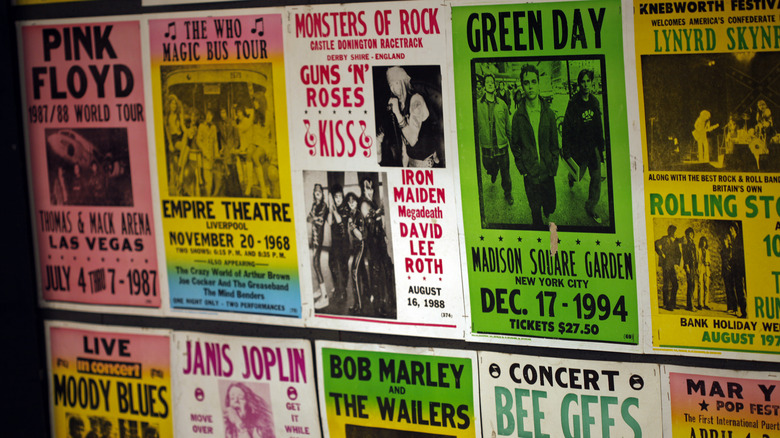
Fortunately, you have a few options for buying vintage posters, and each has its own benefit. Purchasing online, for example, gives you the opportunity to look at a large number of posters in a single place fairly quickly. Many of these online stores authenticate posters and guarantee that they're originals, saving you a lot of research and guesswork.
There are also plenty of brick-and-mortar stores selling vintage posters, including vintage record outlets and thrift stores. Of course, going to a physical retailer allows you to see the posters up close, so you can determine their authenticity through touch and visual inspection. You may also be able to do a little haggling with the store owner, depending on how eager they are to make a sale.
Buying posters at an estate sale is another option. That's when a person's belongings are sold after a major event such as death or divorce, or when a company sells off its stock due to downsizing or bankruptcy. You won't find a vintage poster at every estate sale, but if you do find one, you may get it for a much lower price, as the estate may be eager to liquidate everything.
Find out if the poster is really an original
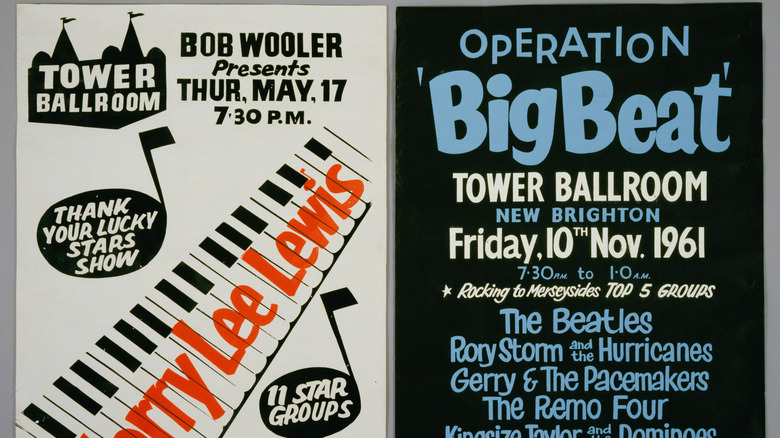
The main difference between an original and a reprinted poster is when it was created and for what purpose. If the poster was specifically made prior to a concert date for promotion, it's likely to be an original, and therefore more valuable. This extends to how the poster was made in the first place.
A great way to tell an original from a reprint is to determine the printing process that was used. Many vintage rock posters were printed using offset lithography, a process where an image is transferred indirectly from an oil-based original to the poster blank. Letterpress printing was also employed, using raised, three-dimensional lettering. Vintage rock posters weren't printed on thick, shiny paper, either, so an original shouldn't have a glossy sheen.
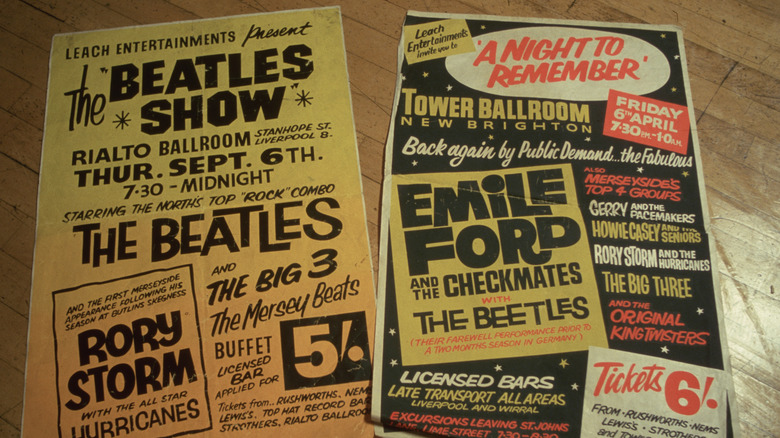
A real original might have fraying or discoloration on its edges, so if it looks flawless with colors that pop, it's more than likely a reprint. A magnifying glass can be used to detect poster images formed from tiny dots, as that will indicate if it was printed digitally, a process that began picking up steam in the '90s. You can also do a sniff test, because a poster that was printed three decades ago, say, won't have a new waxy scent.
Learn about poster grading
As a collector, you want to look for a grade on a poster to determine its condition. The company CGC provides a grading service based on a 10-point system, with perfect, flawless posters ranked 10, all the way down to 0.5 for those in terrible condition. After grading, the company puts it in sealed plastic for protection, and the grade is placed in the upper left-hand corner.
CGC grades posters from the music venue Grande Ballroom, the Family Dog poster series, the Neon Rose poster series, the Art of Rock, the band MoonAlice, as well as Bill Graham, Bill Graham Presents, and the New Fillmore series. CGC also has a certification verification tool that allows you to plug in the company's certification number to see if your vintage poster is the real deal before plunking down serious cash.
If you're interested in a vintage poster that falls outside of what CGC will grade, you can use companies such as Psychedelic Art Exchange, an auction house that buys and sells vintage posters. They also have a search tool that allows you to see past auctions. So, if you're interested in buying an original poster and it's already placed in a plastic CGC seal, you can head to Psychedelic Art Exchange's database to see what it sold for. Other trustworthy online stores often have their own search tools, too.
How to care for your posters
So, you've officially started your vintage poster collection, and you've scored some real gems. The next step is to make sure that they're properly cared for. First off, it's vital to use clean hands or gloves when touching your posters to avoid dirt and grime. Be gentle when handling vintage posters, too, since the paper used back in the day won't be the strongest, so it's best to use both hands and avoid grabbing the edges and corners.
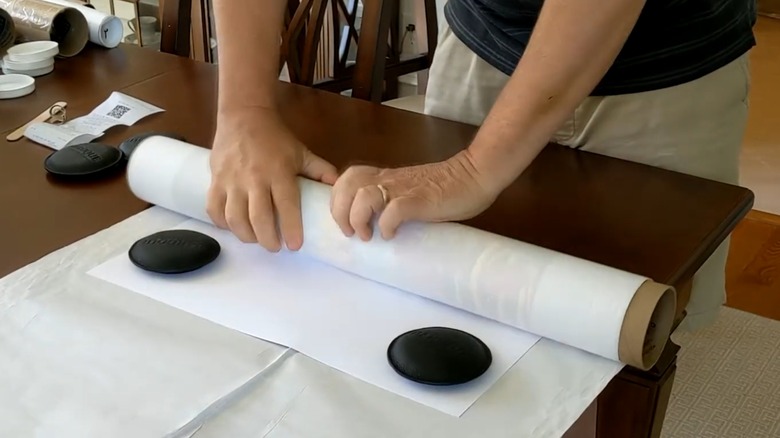
You also want to flatten your posters if they were purchased rolled up in a round canister. One method is to use a cardboard tube, such as from paper towels, and roll the poster around the tube in the opposite way that it was rolled after being opened — known as a reverse roll – and unroll after a few hours. Another flattening method involves placing flat, heavy objects such as books on each corner, which can take a day or two.
It's important to store the posters flat in a flat storage box or portfolio, and keep them in a place that doesn't have excessive heat, humidity, or cold, with the ideal temperature being between 65 and 70 degrees Fahrenheit.