

5 Underrated Artists Every Bubblegum Pop Fan Should Know
Bubblegum pop is generally overlooked and undervalued. While dismissed as lightweight because it was produced with blatant commercial intentions for an audience of children, bubblegum pop also introduced youthful music fans to rock 'n' roll. The producers and session musicians who made bubblegum such a phenomenon in the late '60s and early '70s, if accidentally, made some solid mainstream rock — and many of the bands and singers whose names appeared on the records quickly faded from public memory or just were never taken seriously.
In the wake of the infectious, radio-friendly rock of the British Invasion, innocent bubblegum pop filled the void for music that appealed to the youngest listeners, those who weren't quite ready for psychedelic or hard rock. Precision-crafted in studios, bubblegum gave the world the Monkees, the Archies, the Ohio Express, and numerous one-hit wonders and bands that barely existed. Many of those acts churned out work that deserves another listen, including Salt Water Taffy, Captain Groovy and His Bubblegum Army, and the Wombles. We chose these artists because their output, even if it was a single song, ranks with the best and most fondly recalled bubblegum pop and radio rock of its era. Their work is extremely catchy and laden with irresistible melodic hooks, uncanny harmonies, killer guitar riffs, and propulsive drum beats that make children of the '60s and '70s, both then and now, want to get up and dance.
Salt Water Taffy
The Val-Rays were a surf rock band that had a minor hit in 1964 with "Yo Me Pregunto (I Ask Myself)," and after their subsequent split, guitarist Rod McBrien found work as a session musician. After helping out on numerous bubblegum pop sessions, he and ex-bandmate and songwriting partner John Giametta pivoted to writing for that genre. Bringing back Val-Rays singer Phil Giarrantano and adding some new members, they formed the studio creation Salt Water Taffy.
Prolific bubblegum label Buddah Records issued the band's first single, the hypnotically catchy "Finders Keepers." Starting with a bunch of kids shouting out the title in playground-taunt fashion, the song finds its groove and never lets go of it, delivering catchy harmonies with a supportive horn section, low-key vocals, and low-stakes romantic lyrics. On "Finders Keepers," the single and the album that also bore that name, Salt Water Taffy was appropriately sweet and chewy, sounding like a mixture between a couple of the most popular groups of the era: bubblegum progenitors the Monkees and the freewheeling Herb Alpert and the Tijuana Brass.
Salt Water Taffy only had the one minor hit with "Finders Keepers," unsuccessfully following it up with other juvenilia-oriented songs like "Sticks and Stones" and "Loop de Loop." By the time bubblegum pop was on the way out in the early '70s, Salt Water Taffy's members had gone their separate ways, and McBrien had returned to the studio.
Captain Groovy and His Bubblegum Army
In the bubblegum era, producers frequently assembled session musicians, recorded some music, and released it under the name of a band from a children's TV show. Along with the well-remembered Archies, Josie and the Pussycats, and the Banana Splits, so too did the fictional Captain Groovy and His Bubblegum Army inspire actual music. They're not just a one-hit wonder — they're a one-song wonder. But that sole offering still charted, and it's a compelling and progressive mixture of bubblegum pop, psychedelic rock, and garage rock.
In 1969, TV animation house Hanna-Barbera met with bubblegum studio Super K Productions to launch the project, a cartoon show with tie-in records. House songwriter Ritchie Cordell, formerly associated with Tommy James and the Shondells, helped compose a theme song for the animated series "Captain Groovy and His Bubblegum Army," with studio singer Bobby Bloom backed by session musicians. His vocals were altered to sound like those of former Super K warbler of choice Joey Levine, known for his work with the Ohio Express, Reunion, and the Third Rail.
The show fell apart in pre-production, but that eponymous "Captain Groovy" tune still came out on vinyl and hit No. 27 on the below-the-Hot 100 "Bubbling Under" chart. It's a great lost gem of bubblegum pop. With insistent, high-pitched keyboards, persistent drumming, and some daring, fuzzy, spaced-out guitar, the song was influenced by the counterculture rock of the late '60s.
The Wombles
The Wombles were friendly monsters introduced in an ecologically-minded 1960s children's book. They got their own show on British television in 1973, and, like the Archies and the Monkees before them, became a bubblegum pop group. But a band of fuzzy fantasy creatures who existed only in scripted adventures weren't really making the music — that was all led by Mike Batt.
With a large regular audience of kid viewers, the costumed Wombles had the opportunity to regularly promote and perform their songs. The band of anteater-like things released six full-length LPs in the 1970s and hit the Top 40 of the U.K. charts with eight singles in 1974 and 1975. Many of them were self-referential takes on Womble life, such as "Super Womble," "Remember You're a Womble," and "Wombling Song." In the U.S., only "Wombling Summer Party" made it onto the Hot 100.
The Wombles was truly a vehicle for the musical impulses of producer, arranger, and songwriter Batt, who made both enduring and emerging musical styles palatable to kids and tweens just getting interested in rock. "Super Womble," for example, is a chugging glam-rock song reminiscent of T. Rex tracks, while "Wombling Summer Party" is a full-scale Beach Boys tribute with sing-along lyrics about surfing and California.
Bay City Rollers
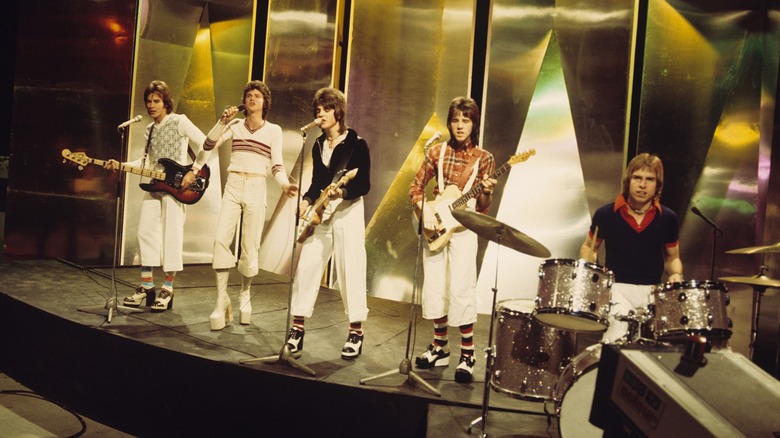
The "Rollermania" craze of the 1970s played out like something between the all-consuming Beatlemania of a decade before, and how tweens would scream for 2000s boy bands outside the studios of MTV's "TRL" before it disappeared. Such an extreme and faddish reaction to the Bay City Rollers, the Scotland-based bubblegum rock band, may have turned off fans of more mature music of the time, but the group's output was among the best ever labeled bubblegum, and they left a legacy of tight, catchy pop-rock that pulled from the classics and even influenced iconic punk band the Ramones.
"I Only Wanna Be With You," with its swirling, frenetic, high-pitched guitar riff and disco beat, reinvented a song made famous by soul singer Dusty Springfield. The Rollers' take on the Four Seasons' "Bye Bye Baby" also reimagined a pop-R&B song as a kid-friendly power pop anthem. But their most memorable song is the Bay City Rollers in a nutshell. With an agreeable chant of its title and its grinding electric guitar and arena-ready stomp, "Saturday Night" was the biggest American hit for the band. While the Bay City Rollers enjoyed a dozen smash hits in Britain, they made it into the American Top 10 just three times, with "Saturday Night" spending a week at No. 1 early 1976.
Bobby Sherman
Bobby Sherman began his recording career in 1962, long before bubblegum pop was invented. Performing as the staff vocalist on the music TV show "Shindig!" didn't help much, but he finally started to score some hits when he switched from crooning and soft rock to crunchy and bouncy bubblegum pop. That coincided with Sherman's ascendence to teen idol status with his major role on the Western TV series "Here Come the Brides," giving him a much larger musical audience than ever before. In the fleeting period of 1969 to 1971, Sherman was one of the biggest pop stars around, sending seven likable, swaggering bubblegum hits into the Top 30.
Among Sherman's best-selling singles from the peak of the bubblegum era was "Little Woman." Bubblegum pop is a craft strongly associated with the studio, and this layered, professional record pairs a guitar-driven song with an orchestral backing that serves Sherman's emotive but not-too-aggressive come-on. "Easy Come, Easy Go" is another song about young and early love, pulling in the bubblegum audience with its relative innocuousness and providing an earful of sugary, pleasant pop rock and tons of ringing xylophone.