

The 5 Best Girl Groups Of The '50s
When you think of girl groups, perhaps you initially flash back to TLC, Destiny's Child, and other mega acts of the '90s and early 2000s, but all-female vocal groups have been around for much longer. The first girl groups got started in the 1920s and became more prominent in the '40s, as acts like the Andrews Sisters linked up with the cultural image of a capable and cheerful working woman (though the Andrews Sisters weren't always quite so cuddly). Then, as the '50s saw listeners shift their attention to the siren call of rock 'n' roll, things in the music industry began to change. Like any other act, girl groups were forced to navigate this shifting landscape, with some fading and others thriving. But who was the best? Picking out the foremost girl groups of the decade means focusing on artists with excellent singing, a fun sound, and a commitment to their music, even if a group didn't always experience the meteoric rise to fame enjoyed by other '50s musicians.
Of course, personal taste is always a factor, but the passage of time has helped focus things, with some groups standing out artistically and historically. A few, like the Chordettes, called back to earlier eras of barbershop-style harmonies and inoffensive images. Others were willing to push the envelope, at least musically, like the Chantels' mixture of pop, R&B, and doo-wop that presaged '60s girl groups like the Shirelles and the Supremes.
The Chordettes
Sure, the Chordettes may at first seem so squeaky-clean that saying "darn" in their presence might send you straight to jail. Hyperbole aside, this group of college friends did ride to fame in part on their respectable middle-class aesthetic, but that wasn't all. They showed a masterful command of tight, barbershop-style harmonies and were hard workers besides, with an impressive list of performances, wins, and contracts to their name.
Years before they released their 1954 hit single "Mr. Sandman," the Chordettes had already begun making waves with live performances and on local and then national radio shows, winning a 1949 talent competition on "Arthur Godfrey's Talent Scouts." It was only after regular media appearances that the group finally signed a record contract, starting with Columbia Records and then moving to Cadence Records in 1953. Besides "Mr. Sandman," which sat at the top of the charts for seven weeks, you've likely also heard their crystal-clear voices and pitch-perfect harmonies on "Lollipop," the jubilant 1958 single that's been a persistent earworm for multiple generations now.
Yet, as the rougher edges of rock 'n' roll began to command more attention, their star began to fade. A cheerful quartet in formal gloves could only compete with Elvis' hip-wiggling for so long. In 1961, the Chordettes broke up, though their voices remained compelling. Their smooth delivery of "Mr. Sandman" got a considerable makeover when it was used to open the 1981 horror film "Halloween II." The line "Make him the cutest that I've ever seen" does ring differently when a guy in an altered William Shatner mask is chasing you.
The McGuire Sisters
The McGuire Sisters consisted of three real siblings, Christine, Dorothy, and Phyllis, from Middletown, Ohio. Much like the Chordettes, they got their start performing locally before landing a months-long contract to perform for U.S. military service members. Eventually, they, too, won a round of "Arthur Godfrey's Talent Scouts" and became regular performers there for six years.
The sisters' mother, who was a pastor, allowed them to perform at her church when they were children. But to listen to anything beyond hymns, they were obliged to sneakily tune in on the radio (presumably with a hand on the dial in case parental footsteps approached). Their 1954 cover of "Goodnight, Sweetheart, Goodnight" was their first single to break the Top 10, reaching No. 7. The next year saw the release of the chart-topping "Sincerely," a cover of a Moonglows song. The McGuire Sisters' version stayed at the top of the charts for 10 weeks.
If you think the McGuire Sisters were yet another '50s act so wholesome you needed a mud bath after listening to them, know the mob gets involved. Mobster Sam Giancana connected with Phyllis when she was working as a guest blackjack dealer in the late '50s at the Desert Inn casino. Though she turned down his proposal, they remained together until Giancana's murder in 1975. The McGuire Sisters broke up in the '60s, yet Phyllis continued performing solo and also did well as an investor, as evidenced by her lavish Las Vegas mansion and a townhouse on New York City's Upper East Side. The act re-formed in 1985, leaning into nostalgia and performing into the '90s.
Shirley Gunter & the Queens
So, what does a song like "Oop Shoop" mean, anyway? You could have asked Shirley Gunter & the Queens, but they wouldn't have revealed a deeper meaning. Their cheerfully silly single was the work of Gunter and fellow group member Blondean Taylor, who were inspired by the nostalgic doo-wop boomer fave "Sh-Boom" by the Chords. That song was also peppered with nonsense words and nevertheless became a major hit. "Oop Shoop" also did quite nicely, eventually reaching No. 8 on the R&B chart and No. 1 on the Los Angeles regional chart. Gunter was the lead vocalist, of course, and it's her energetic and clearly delivered singing that really distinguished the act from the growing ranks of girl groups. Shirley Gunter & the Queens eventually became known as one of the first R&B or doo-wop girl groups with a chart hit, depending on which source you consult.
"Oop Shoop" was eventually covered by a white group, the Crew-Cuts, whose version reached No. 13 on Billboard's pop chart. The Queens kept writing some of their own songs, including "You're Mine" and "Why, " but nothing quite matched the success of "Oop Shoop." Though they made multiple media appearances and performed with bigger-name acts, the group broke up in 1956. Gunter continued on as a solo artist well into the '60s, receiving good reviews for her vocal talent but never quite reaching the "Oop Shoop" heights again.
The DeCastro Sisters
Billed as Latin American singing sensations, the DeCastro Sisters were the real deal. The trio of Peggy, Cherie, and Babette DeCastro were indeed sisters, though occasionally Peggy and Babette would step away from performing and be replaced by either their cousin Olgita or Lois Denny. The bilingual act sang in both Spanish and English, which makes sense given that their father, Juan DeCastro, was a Swiss-educated member of the upper class who was once a big deal in Cuba (before Fidel Castro took over, anyway). Indeed, Peggy was born in the Dominican Republic, on a sugar plantation owned by her father, and the sisters would eventually grow up in Havana. Though the DeCastro Sisters capitalized on this background in their music and public personae, it wasn't always an easy task. "We didn't want to be Latin singers. We wanted to be American," Peggy said of their early performances (via Las Vegas Sun).
Still, even if they experienced tension over this awkward mix of marketing and heritage (and sometimes even dropped the Latin act entirely), it wasn't a gimmick. There was also their powerful mix of excellent singing, memorable stage presence, and key connections, including their mentor, Carmen Miranda. Their top single, "Teach Me Tonight," hit No. 2 after its 1954 release. This led to a career as a genuinely big act that saw them co-starring in Vegas shows with the likes of George Burns and Bobby Darin.
The Chantels
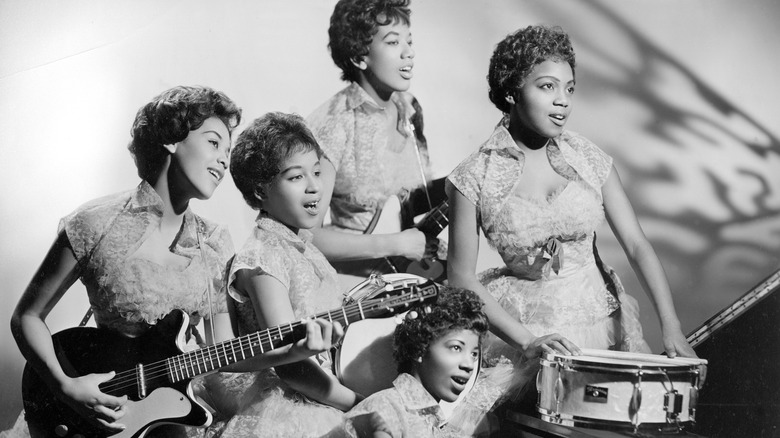
At the beginning, the Chantels may have seemed like a long shot. Could a group of Catholic schoolgirls really write music that captured nationwide attention? But they became one of the first Black girl groups to garner the interest of Americans everywhere. The choir-like sound of the Chantels made sense, as its original members met in the choir at St. Anthony of Padua school in the Bronx. Arlene Smith, the lead singer with a powerful, clear voice, was also a lyricist and songwriter who sometimes referenced classical and religious music when writing for the Chantels.
As the story goes, a chance meeting with producer Richard Barrett led to them signing with End Records in 1957. "He's Gone," inspired by a former boyfriend of Smith's, was released that year as the group's first single and reached No. 71; the following year's Smith-penned "Maybe" shot to No. 2 on the R&B chart and No. 15 on the Hot 100. Soon, the Chantels were navigating the tricky world of the 1950s music industry, working with future Motown choreographer Cholly Atkins on their stage moves, securing spots on "American Bandstand" and "The Dick Clark Show," and constantly rehearsing. But their singles — still showcasing beautiful vocal work — weren't reaching the same chart heights as before. End Records ultimately dropped them in spring 1959.
At that point, Smith ventured out as a solo artist, while three of the group's members teamed with new lead singers throughout the '60s and kept recording as the Chantels before splitting up in 1970. In 1973, Smith — who had by then worked with Phil Spector and attended Juilliard — put together the Chantels again for a few nostalgic performances, though with different supporting singers.