

5 Classic Rock Songs That Belong On Every Boomer's Halloween Playlist
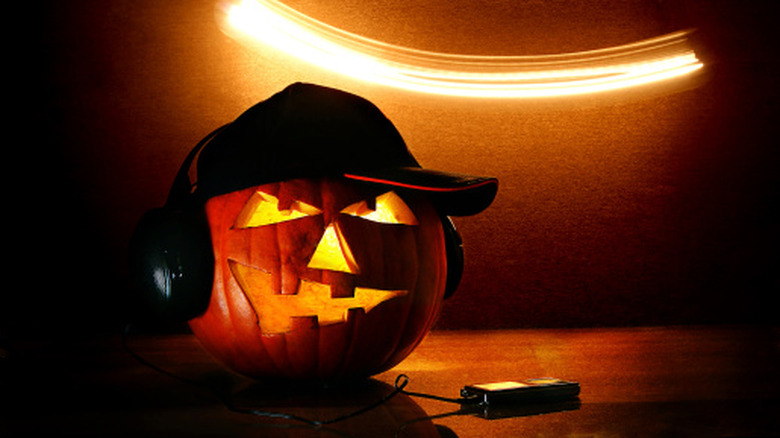
Whether you're planning a playlist for your Halloween party or simply want to put together a bunch of songs to celebrate the spookiest of seasons, you've got a lot of choices. If you narrow things down to the faves boomers remember from their youth, some truly standout tracks begin to emerge. A good Halloween song doesn't have to overtly mention the holiday, of course. However, it does have to be creepy in some way, whether that's delivered via some well-placed minor chords or lyrics that reference eerie situations.
Maybe the song's subject is the grim reaper; maybe it's a witch, or just the concept of paranoia; maybe it's a werewolf wandering around a fashionable district of London with really nice hair. However you define it, these classic rock songs are just perfect for every boomer's Halloween playlist — though, really, why restrict these to just one generation of listeners? Everyone should get a chance to rock out, Halloween-style, to these delightfully creepy tracks.
(Don't Fear) The Reaper — Blue Öyster Cult
As it turns out, "(Don't Fear) The Reaper" is about — you'll never guess — mortality. Seems like real heavy stuff, but this 1976 track from Blue Öyster Cult is smoothly ominous, with a propulsive musical line, mystical guitar riffs, and melancholic vocals perfectly suited to a meditative Halloween playlist. Yes, also, there are the cowbells, which guitarist Eric Bloom has said he played on the original track, though the idea of bringing one into the song in the first place was owed to producer David Lucas. And take heart that the members of the band love the "More Cowbell" sketch from "Saturday Night Live" that gave new life to the song. There, Will Ferrell's fictional band member, Gene Frenkle, is encouraged to go whole hog on the pivotal cowbell part.
However, there's quite a lot more to the song than the cowbell. Though songwriter Donald "Buck Dharma" Roeser believed the song would go under the radar, he still put quite a lot of thought into it, having just been diagnosed with a heart condition at the time he wrote "(Don't Fear) The Reaper." The song posits that, just maybe, there's a way to keep up a connection with someone who's passed from our world into the afterlife. Roeser adamantly maintains that he never wanted to promote self-harm, as some critics have claimed based on that "Romeo and Juliet are together in eternity" lyric. It's meant more as an acceptance of death, with no need to rush toward it prematurely.
Mr. Crowley — Ozzy Osbourne
Let's give some credit to Ozzy Osbourne for doing his homework. While some parents weren't happy to learn their kids were listening to rock's Prince of Darkness, he might have at least taught them a thing or two about history. Well, creepy history, anyway. The track "Mr. Crowley," from Osbourne's first solo album, 1980's "Blizzard of Ozz," was inspired by a book detailing the exploits of Aleister Crowley, an infamous occultist who had died in 1947.
Bassist Bob Daisley, one of the song's co-writers (along with Osbourne and guitarist Randy Rhoads) has explained that the song is more like a letter to Crowley. As he told Rolling Stone, "I didn't want to make a negative song," he said. "I wanted to make it a little bit like talking to Mr. Crowley and going, 'What the f–k were you thinking?"
The answer from Crowley, if we could get him on the line somehow, would surely be quite a long one. Crowley was, in modern parlance, a real edgelord, gaining notoriety for his avowed rejection of Christianity and embrace of the occult, not to mention an early attempt to summit K2 and briefly working as a WWI spy. That alternative lifestyle was initially funded by an inheritance via his devoutly Christian father (talk about awkward). After making enemies in the existing Golden Dawn secret society, Crowley eventually formed a new religion, Thelema, then died practically destitute. It was only later that people built upon his reputation as the "wickedest man in the world," a persona that clearly called to Osbourne.
Season of the Witch — Donovan
When you put on "Season of the Witch," it's clear immediately that this is seemingly tailor-made for Halloween. From the creeping bass groove to the prickly guitar riff, it brings to mind something eerie stalking about as shadows lengthen. That's not far from the original inspiration for the song, which recalled British singer Donovan's sense of paranoia fueled by his use of psychedelic substances in late '60s London. In fact, that was where he was arrested for cannabis possession, the legal implications of which kept him from making it to the 1967 Monterey Pop Festival in California.
Eventually, Donovan beat the rap, and this track from the album "Sunshine Superman" has become part of his musical legacy. When discussing the eerie feel of "Season of the Witch," Donovan has also spoken of the changing psychedelic culture in Britain at the time, especially regarding the infiltration of dark elements and harder substances into the scene.
It's not all ominous, though, as the song also has its origins in a friendly get-together at folk guitarist Bert Jansch's home. There, Jansch showed Donovan a chord progression featuring a D ninth chord that so gripped Donovan that he played around with the riff for seven hours. Well, at least that's what he was told, as Donovan has admitted that his memory of that evening is hazy. Yet, the creepy-cool song that resulted is unforgettable and worth a listen for younger generations getting into boomer-era rock.
Bad Moon Rising — Creedence Clearwater Revival
As a horror movie track, few songs have more cred than Creedence Clearwater Revival's "Bad Moon Rising." It popped up in a rather on-the-nose reference in "American Werewolf in London" and also made appearances in "The Twilight Zone: The Movie," "Blade," and spooky shows like "Supernatural." Though frontman and songwriter John Fogerty didn't necessarily intend it for it to sound so apocalyptic, it was nevertheless influenced by the downbeat feeling many people sensed at the close of the '60s, with widespread unrest and an increasingly unpopular view of U.S. participation in the Vietnam War. There's also a bit of '60s-era youth culture mixed up in there, as the trending interest in astrology — perhaps you remember smoothly asking someone their sign? — connects to the lyrics referencing ill portents in the sky.
At the time of the song's release in 1969, Fogerty fretted that the band's rising success was only temporary. But, given the high performance of prior singles, the pressure to write the next song was on. He took inspiration from the 1941 film, "The Devil and Daniel Webster," particularly a scene where a huge storm wreaks destruction after the protagonist has made a diabolical deal.
"Bad Moon Rising" became one of CCR's biggest hits of all time, reaching No. 2 in the U.S. (where, somehow, they never managed to secure the top spot). But maybe there was something to that apocalypticism after all. Fogerty has since wondered if the success of "Bad Moon Rising" and its album, "Green River," presaged the crumbling of the band as fame and further pressure mounted.
Werewolves of London — Warren Zevon
You just can't build a Halloween-themed classic rock playlist without including Warren Zevon's "Werewolves of London." Hey, we don't make the rules, but why would you want to break this one when the track in question is so much creepy fun? Zevon, who died in 2003, remains widely praised for his exceptional songwriting and musical talent. "Werewolves of London," released in studio form on his 1978 album, "Excitable Boy," is surely his most-played song today, though fans argue that he has plenty of other good work to enjoy. Still, this track deserves recognition for its satirical take on a culturally beloved madman, one who always seems to slip away from real criticism because he's just that charismatic. As Zevon sings, "his hair was perfect," which is apparently enough to handwave the gruesome fate of a little old lady earlier in the song.
Though Zevon very much deserves credit for the song, it was kind of, sort of taken from the Everly Brothers, for whom Zevon worked as bandleader alongside guitarist friend Robert "Waddy" Wachtel. Phil Everly had suggested the idea of coming up with a silly, spooky song, thinking, just maybe, that it could turn into a dance craze. Depending on the account, either Everly or Wachtel brought the idea to Zevon, who then ran with it. Even if the original germ of an idea wasn't his, the resulting song is very much a Zevon creation, with a bouncy, catchy musical line in contrast with the satirical and sometimes quite gory lyrics.