

The 5 Best Halloween Songs Of The '60s
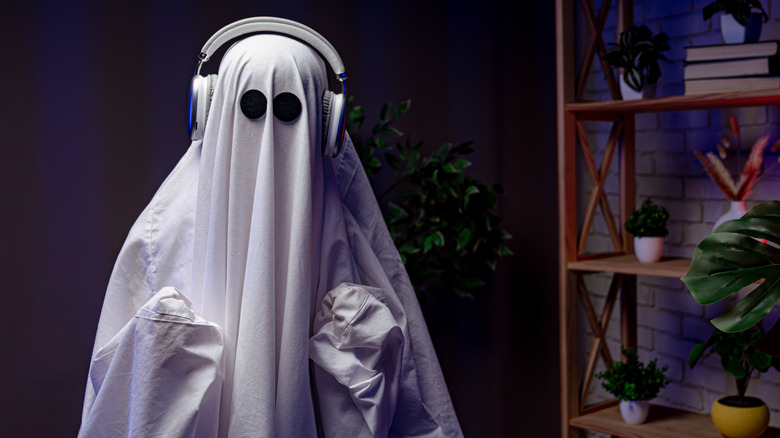
Now that you've donned your pumpkin suit, sack in hand, you need some theme music. Something mysterious, spooky, and all together ooky, perhaps? Strangely enough, there was a lot of witchy, often kooky, Halloween-appropriate songs from the '60s.
When choosing the best of these Halloween tunes, we don't want to be too prescriptive about lyrics (e.g., the song must talk about zombies) or music (e.g., the song must contain eerie tritones, aka, the "devil's interval"). Rather, we've cast a wide net to collect ditties that fit the holiday vibes. Our songs are universal in appeal, suitable for all ages (nothing gory or explicit), fun enough while being spine-tingling in some way, are actually musically well-composed, and aren't so silly that they're unlistenable except once a year at Halloween. We're also omitting theme tunes, so no "Addams Family" theme song (despite the earlier allusion).
There's also a mountain of honorable mentions we've left off the list, like "Season of the Witch" by Donovan (an artist that boomers are still waiting for younger generations to discover), "Wicked Annabella" by the Kinks, "The Witch" by the Sonics, and more. You can consider our five choices five of the best, several of which you might be able to guess. But, many more '60s Halloween songs await the curious.
Monster Mash — Bobby (Boris) Pickett And The Crypt-Kickers
There isn't a more recognizable, singable, well-loved (okay, some folks probably think it's really annoying) Halloween song in history than "Monster Mash" by Bobby (Boris) Pickett And The Crypt-Kickers. Even now, 64 years after its release in 1962 on the album, "The Original Monster Mash," it's still the go-to Halloween bop.
We likely don't have to remind anyone, but "Monster Mash" works so well because it's so undeniably catchy and so undeniably absurd. The song collects every prominent Universal monster movie icon into one bundle — Wolfman, Dracula, Frankenstein, plus generic zombies, vampires, and howling hounds — and crafts a kooky tale where they're all quite literally dancing together and doing the Mash, the Monster Mash.
As the story goes, Bobby Pickett (the singer) wrote "Monster Mash" along with Leonard Capizzi, who were both in a small Massachusetts band, the Cordials. The two were intentionally trying to capitalize on dance trends like the Twist, and Gary S. Paxton of Garpax Records bit. Maybe Paxton had some secret communiques with the dead, because this seemingly ridiculous decision and song transformed into a No. 1 hit on the Billboard Hot 100. To this day, "Monster Mash" remains Halloween's perennial graveyard smash, suitable for costumed kids prowling for candy, costumed adults swigging adult beverages, and pretty much any Halloween-related activity to get you in the spirit.
Riboflavin-Flavored, Non-Carbonated, Polyunsaturated Blood — Don Hinson And The Rigamorticians
Thanks to all the spooks, specters, and ghouls for "Riboflavin-Flavored, Non-Carbonated, Polyunsaturated Blood" by Don Hinson & The Rigamorticians. You're in for quite a treat if you've never heard this song — a trick or treat, in fact. Sure, it's more of a novelty song, but if it doesn't suit Halloween, then what does? The track comes from a comical 1964 album called "Monster Dance Party," featuring a narrator acting like a mad doctor prescribing laboratory-crafted blood to a desperate Dracula at midnight.
Don Hinson, the man behind "Riboflavin-Flavored, Non-Carbonated, Polyunsaturated Blood," is the true mystery of "Monster Dance Party." By all scant accounts, Hinson was a Las Vegas DJ and something of a voice actor who does the tune's Bela Lugosi-esque spoken voice. It's not clear if Hinson helped write any of the songs on "Monster Dance Party," but we know that Gary Paxton — the "Monster Mash" producer again — headed up the whole shebang. The only other thing we know about Hinson comes from the back of the original vinyl cover, with shows a funny headshot and a bio that says he did stage work.
But no matter the details, "Riboflavin-Flavored, Non-Carbonated, Polyunsaturated Blood" is a surefire Halloween song winner. It's got a creepy, danceable bounce, some trumpet lines and background singers, and silly lyrics like, "It helps promote perspiration odor / It puts bad breath in ghouls / Why, our group had 21% fewer fangs," and, "It gives you quick relief, you see / From fang aches and corpuscle deficiency / And after consuming my laboratory brew / It'll make a new a new vampire of you." Glorious.
I Put a Spell on You — Creedence Clearwater Revival
CCR's rendition of Screamin' Jay Hawkins' 1955 "I Put a Spell on You" brims with unnerving, sinister sound perfectly suited to Halloween proceedings. This sound comes from both the broadest songwriting strokes and most minor (so to speak) details: an eerie natural minor scale, John Fogerty's superb, intense vocal delivery and inflections in lines like "I ain't lyin'," a protracted guitar solo that sounds like the narrator brooding over disturbed thoughts, and more.
Unlike CCR's five songs to hit No. 2 on the Billboard Hot 100 (a surprising record), "I Put a Spell on You" peaked at No. 58 in 1968. But, the cover came right at the beginning of the CCR storm that swept across the music world during the band's limited run from 1967 to 1972; it was the first very track on the band's very first, self-titled album. As such, "I Put a Spell on You" rooted CCR's sound in blues and grit, but eschewed their swampier, janglier elements of their music for something closer to weird '60s psychedelia.
If CCR means bouncier, plink-plonk fare like "Down on the Corner" to you, then this Halloween is your chance to get reacquainted with the absolute eeriness of "I Put a Spell on You." The track, combined with anything from a corn maze to an unlit trick-or-treating street, ought to give you the shivers.
Black Magic Woman — Fleetwood Mac
Many readers will probably hear the lyrics, "Got a black magic woman," in Gregg Rolie's voice, the vocalist for Carlos Santana's rendition of "Black Magic Woman" from 1970's "Abraxas." But, that version is a cover of a Fleetwood Mac song from 1968's "English Rose," aka, Mac's original incarnation, sung by Peter Green and sans Stevie Nicks and Lindsey Buckingham. That version takes inspiration from blues guitarists Otis Rush and Jody Williams going all the way back to 1957. What does all this mean for the music? It means that "Black Magic Woman" has the most serious musical pedigree out of all the songs on this list, one that reflects the most bewitching aspects of the blues.
Musically, "Black Magic Woman" sounds like someone swooning after having drank a love potion, possessed and unable to break free. It's as seductive in tone and melody as it is menacing. This combination of witchcraft, lyrical talk of spells and the Devil, seduction, and menace makes "Black Magic Woman" the perfect song for Halloween gatherings, especially of the costumed variety. But the song is also playful enough for lighthearted Halloween outings.
Live versions of "Black Magic Woman" completely outdo the original studio recording. They transform the original, sub-three-minute song into a full-on, extended jam session that lets the tune's ominousness and musical motifs settle and expand. The song is also so utterly different from the music of Fleetwood Mac's mid-to-late '70s heyday that it sounds like a completely different band. This is a good thing, as it detaches the listener from Mac's incessant feuds and lets the song speak for itself.
Black Night — Cheryl Thompson
"Black Night" from Cheryl Thompson (1964) wins our final vote for spooky, Halloween-appropriate song from the '60s. Nothing in the song's lyrics alludes to anything supernatural, mystical, or magical. Rather, it's the song's overall sound combined with the refrain "Black night / Black night / Black and so lonely and blue" and elemental imagery — fire, trees, wind, whispers — that conveys an overall witchy impression.
Interestingly, Thompson wasn't a full-time, professional singer. She was a beauty pageant winner who won Miss Las Vegas and Miss Nevada in 1963, one year before releasing "Black Night." That song is the first of six singles, with no full albums released under various labels from 1964 to 1967. By all accounts, Thompson tried to pursue a career in Las Vegas as a singer, but wound up working as a showgirl at the Sahara Hotel and marrying Norman Kaye, one of the Mary Kaye Trio jazz group. One of her songs, "The Third Person" (the B side to 1966's "Mansion of Tears") was actually nominated for a Grammy, indicating what direction Thompson's career could have gone. But, childbirth and family business obligations sidelined her career and left us just with a few singles.
This somewhat disappointing career ending (though we no idea how happy Thompson was) only amplifies the dejected, forlorn feelings behind "Black Night." The song's warbling guitars, descending melody, and eerie lyrical fragments cast a spell over the listener evocative of the most windswept and blackened Halloween night.