

The 5 Most Beautiful Male Voices Of The '60s
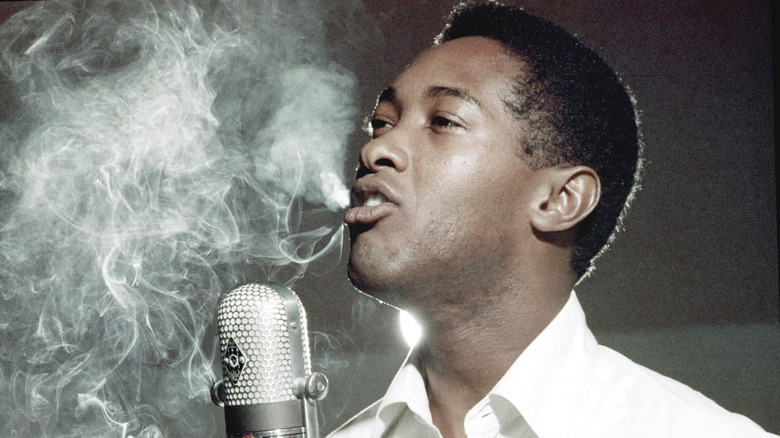
The 1960s were filled with iconic music from singalong folk standards to lush and spirit-moving soul and blues music to the vibrant and electric sounds of a flourishing rock 'n' roll — but in each genre, vocalists took their sounds (even sometimes over harsh instrumentals) to an entirely new level of beauty thanks to sheer talent, as well as excellent choices of melody. These vocalists, in this case male, were all impressively gifted at whatever they chose to do on the microphone, whether it was soaring runs or emotional and intimate portraits into their songwriting.
Though there is plenty of stiff competition among an incredibly loaded decade, in this list we'll feature five of the most truly beautiful male voices of the 1960s, ranging from the kings of soul music to the headliners of folk rock and pop. Some of the decade's most iconic titans were not known for the standalone and universal beauty of their voices — think Bob Dylan, Neil Young, or Lou Reed, though each has impressive vocals in their own right — proving the decade wasn't all about vocals, but the five singers on this list showed that a simple beauty truly resonated in the ears of mass audiences. From the heights of John Lennon to the more niche but critically renowned bellows of Otis Redding, these are the five most beautiful voices of the 1960s.
Otis Redding
Iconic for his vocals alone, not to mention the strength of his songwriting and knack for incredibly moving arrangements, Otis Redding is an absolutely necessary inclusion on this list. His voice is a raw beauty, often shown off in jawdropping wails and runs that were truly one of a kind on every track he got his hands on. Redding's tragic death in a 1967 plane crash ended his career much too early, robbing listeners worldwide of a full discography of his generational vocal (and altogether musical) talent.
Redding's voice is also easily recognizable — more than most vocalists of this era, with a tone so unique to himself that no other musician has really come close to it, even with similar styles. His excellence can best be heard on tracks like "(Sittin' On) The Dock of the Bay," "Cigarettes and Coffee," and "Try a Little Tenderness," and each were respectable hits (the former even reaching as high as No. 1 for four straight weeks in 1968), as well as the now-popular "Cigarettes and Coffee." With a voice as unique as any singer from the '60s, Otis Redding should be in every top vocalists' conversation, with his star power shining even on the deepest of cuts in his discography.
Art Garfunkel
During the 1960s, this renowned singer was one half of arguably the ultimate duo of the decade, bringing his choirboy harmonies to iconic tracks until their dissolution and his resulting solo career. Art Garfunkel is perhaps best known for said work with Simon & Garfunkel throughout the decade, as well as a 1970s pinnacle, in which he often graced the track with true standout vocals. Garfunkel's tone is dynamic and of extreme range, with fluid switches between his standard delivery and his highest register. It's a graceful and still powerful belt, which can feel incredibly soft and moments later be at full horsepower.
Garfunkel's style correlates best with beauty, at least in terms of male vocalists, and can prove captivating and pensive on every song. His best work vocally can be found on the 1970 smash hit "Bridge Over Troubled Water," which spent a year-topping six weeks at No. 1, though there are plenty of '60s examples, including "For Emily, Whenever I May Find Her" and "Scarborough Fair/Canticle," both of which charted in the Billboard Hot 100. Even in other decades, there are few male singers who achieve such beautiful heights as Art Garfunkel, by far one of the most excellent vocalists of the 1960s.
Sam Cooke
Dubbed the "King of Soul," it's not much of a surprise that this music legend sported one of the top '60s voices, despite only living for less than half of the decade. Sam Cooke is a household 1960s name, thanks to both his poignant and essential songwriting as well as a voice that brought acclaim and radio play to almost anything he sang. Cooke's crowning achievement, of course, was the now classic standard "A Change Is Gonna Come," which brought an anthemic power to accompany the Civil Rights Movement. His death in 1964 unfortunately prevented him from seeing the standout power of this tune.
Though Cooke's voice isn't extreme at one particular category, such as Garfunkel's range or Redding's tone, it stands out in every subcategory that supports a quality voice, where the final result's excellence is glaringly obvious. It feels synonymous with an inherent '60s softness, best evidenced on songs like "Nothing Can Change This Love" and "(What A) Wonderful World." It's impossible to leave out the incredible "Bring It On Home To Me" as well. Cooke makes any song he sings on considerably improved, and his romantic and gentle performing nature compounds his vocal beauty.
John Lennon
In a noticeable stylistic difference than some of the more polished vocalists of this list, this defining character on '60s music brought a rawness and nasally register to his and his legendary band's songs. John Lennon's singing and songwriting brought together people of all kinds during the Beatles' 1960s dominance, balancing his lead singing star power with Paul McCartney. Lennon's voice has a particular quality to it that's simply enchanting, and its style has become synonymous with the heights of '60s pop music.
There's a warmth and almost everyman quality to Lennon's vocal tone that makes each Beatles song approachable — he was able to imbue deep emotion, whether it was serious or carefree, in each line. This charismatic style found its way to listeners' hearts on a variety of different tracks, helping accentuate another strength of Lennon's voice: its versatility. Whether it was the R&B-influenced style of "Twist and Shout," the pretty tune of "Strawberry Fields Forever," or the pure passion behind "Don't Let Me Down," Lennon could do it all, and listeners connected each time. This versatility was propped up by a genuinely beautiful and expressive voice, cementing John Lennon among the top male vocalists of his era.
Leonard Cohen
Despite only releasing two full-length records during the '60s, this male vocalist blended his poetic penmanship with a gentle and truly beautiful voice. Leonard Cohen was a published poet before he was a songwriter and commercial musician, which largely influenced a folk and folk rock style that he would help pioneer. His '60s tunes were often acoustic, simply arranged, and filled with open space so as to let Cohen's voice and poetry shine. There's an airiness to each of these songs, with tender and often agonizing pleas felt in the delivery of the lyrics.
With a nasally and high tone, much different than the deep bass he'd often sing in later in his career, Cohen captures a classic feel in each of his hits and deep cuts. The heights of his vocal beauty can be found on songs like the golden "Suzanne," the romantic "Hey, That's No Way to Say Goodbye," and the lovely "Bird on the Wire." Now renowned as one of the leaders in '60s folk music, Cohen is far and away one of the most beautiful male voices of his day, turning each song he touched into an intimate and profoundly moving piece.