

The Best Live Albums Of The '80s
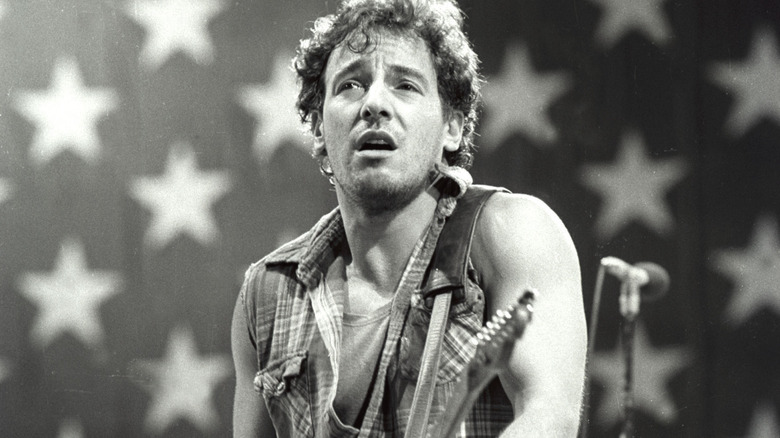
The 1980s musical landscape was vibrant with the blooming of genres like post-punk, new wave, and hardcore, along with the continued success of acts that rose to fame in the 1970s. But unlike the earlier decade, which many consider the best era for live albums, the 1980s saw less focus on this type of album. That said, there were still some exceptional forays into this genre from acts as varied as Bruce Springsteen and the E Street Band and Bad Brains.
The best live albums are able to transport you to the moment when the music was being made in front of a band's rabid fans with all the crackling energy that plays out between performers and the crowd. And like the best live concerts, on these albums the bands should stretch their wings, push songs to the limit, and take risks rather than giving a rote rendering of a studio recording.
Although picking the best live albums of an entire decade was no easy feat, we believe we've hit upon the five that shine brightest. They're full of that energy fans crave in a live performance, as demonstrated by U2's "Under a Blood Red Sky," and with versions of the band's songs that go beyond the studio and, in many cases, surpass the originals, as is the case with the Talking Heads' "Stop Making Sense."
Under a Blood Red Sky — U2
On June 5, 1983, the Irish band U2 gave a performance at Red Rocks, the historic concert venue outside of Denver, Colorado, that helped catapult them to stardom. The concert, part of the band's tour for their album "War," nearly didn't happen due to a raging rainstorm that dropped temperatures into the 40s. Still, 4,400 fans braved the weather and showed up to witness a show for the ages that would be used as the basis of both a concert video and a live album.
Besides two performances from the Red Rocks show, the album also includes material recorded in Sankt Goarshausen, Germany, and in Boston, Massachusetts. "Under a Blood Red Sky" not only captures U2 at their most ferocious and raw before attaining global fame, but puts the listener there with them. Besides the electricity provided by the crowd noise, on songs like "Gloria" and "Party Girl," the audience becomes a major part of the song, providing rhythmic shouting that gives them added punch.
Every song on the album brings it, whether it's the stellar interpretation of their breakout hit "New Year's Day" or the lesser-known "11 O'clock Tick Tock" that had previously only appeared as a non-album single from 1980. "Under a Blood Red Sky" burns brightly and still sounds as fresh today as it did more than 40 years ago.
Live/1975-85 — Bruce Springsteen & The E Street Band
Some musicians are renowned for their live performances, and Bruce Springsteen and his tight-knit backing group, the E Street Band, are at the top of that list. In 1986, Springsteen did the world a solid by releasing an album that came close to giving us a true taste of what it's like to experience his electrifying performances in person. "75/85" encompasses 40 tracks representing a decade of live performances from the Boss and his cohorts recorded at multiple venues from small clubs to arenas, like LA's Roxy Theatre and Giants Stadium in New Jersey.
The album's length of 3.5 hours rivals the typical length of an actual Springsteen concert. When "75/85" came out, Springsteen was at the height of his fame on the heels of his massively successful "Born in the USA" and landed at No. 1 on the Billboard 200 chart. Beyond the whoopla, what makes this album (albums, actually, it encompasses five vinyls) one of the best is the listening experience today.
Besides including sinewy versions of such nearly perfect Springsteen hits as "Born to Run," there are jewels like "Fire" and "Because the Night (co-written with Patti Smith) that make their official debuts, plus some fine covers, such as Tom Waits' "Jersey Girl." There's also Springsteen's between-song banter that includes a poignant discussion of his relationship with his parents during "Growin' Up." This is truly as close as a live album can get to the real thing.
Stop Making Sense — Talking Heads
In 1983, art rockers Talking Heads crafted a visually striking concert film directed by Jonathan Demme as part of the band's "Speaking in Tongues" tour and a live album both named "Stop Making Sense." The film is a must-see with such emblematic visuals as David Byrne in his giant-sized "Big Suit" performing "Girlfriend is Better." But the album is equally as dynamic, demonstrating Talking Heads' virile mix of new wave, post-punk, and angular polyrhythmic funk.
The album begins with a minimalist version of "Psycho Killer" featuring David Byrne, his guitar, and a boom box, before the album flowers into the full band of bassist Tina Weymouth, Chris Frantz on drums, and guitarist-keyboardist Jerry Harrison. Added to this is the superb musicianship of guitarist Alex Weir, Steve Scales on percussion, keyboardist Bernie Worrell, and backing vocalists Lynn Mabry and Edna Holt that give the album a richer sound. Many of the renditions of Talking Heads' songs on the album, such as "Slippery People," "Life During Wartime," and "Once in a Lifetime," have become the definitive versions.
The album (and film) were recorded over three nights in December 1983 at LA's Pantages Theater and came out the following fall. Since its original release, the album has been expanded with the latest, from 2023, including twice as many songs as the original and some beautiful additions like "Cities." The album "Stop Making Sense" has earned its spot as one of the '80s best live albums.
Live — Bad Brains
Bad Brains, with their explosive combination of punk fury and reggae vibes, blasted out of Washington, D.C. like a lightning strike and helped change the face of rock. The all-Black band that formed in 1977 influenced everyone from Kurt Cobain to Metallica to Sublime to the Beastie Boys. Bad Brains created a sound that at once defined hardcore but went beyond it.
The band — singer Paul "H.R." Hudson, guitarist Dr. Know (Gary Miller), bassist Darryl Jenifer, and drummer Earl Hudson — was fast and propulsive with breakneck time changes and a jaw-dropping musical fluency when playing either punk or reggae. Dr. Know could go from blisteringly fast and aggressive playing to a clean reggae tone in a heartbeat. Their live shows, including those at New York's famed punk epicenter CBGBs, were legendary for their energy and chaos, with H.R. moving constantly, doing acrobatic backflips, while the crowd at times seemed to spill onto the stage (we saw Bad Brains several times).
In 1988, the band released its first live album, "Live," that captures some of what made the band's live shows so incredible. The album was recorded during the band's tour for "I Against I," when they were at the height of their power before H.R. and his brother Earl Hudson split (the band would go through personnel changes before eventually regrouping). "Live" includes songs from their first two albums and manages to catch Bad Brains' lightning in a bottle.
Alchemy: Dire Straits Live — Dire Straits
Guitar god Mark Knopfler formed Dire Straits in London in 1977 with his brother David on rhythm guitar, bassist John Illsley, and drummer Pick Withers. Knopfler shepherded the band from the city's pub scene to global stardom. Two years before Dire Straits would reach rock's highest heights with their 1985 album "Brothers in Arms," they recorded their first live album, "Alchemy: Dire Straits Live." At this point, David Knopfler and Withers were no longer in Dire Straits, having been replaced by guitarist Hal Lindes and Terry Williams on drums, with the addition of Alan Clark on keyboards.
The band recorded the album during two July 1983 performances at London's Hammersmith Odeon at the end of a long tour for their album "Love Over Gold." It showcases material from the band's first four albums, from their earliest hit, 1978's "Sultans of Swing," to classics like "Romeo and Juliet," "Tunnel of Love." and "Telegraph Road." The album opens with one of the best rock songs inspired by classic Westerns, "Once Upon a Time in the West," with its laid-back atmospheric groove and Knopfler's gorgeous fingerpicking guitar style.
"Alchemy" greatly expands on the band's studio recordings, making it a must-listen for fans and highlights Knopfler's incredible guitar playing, especially on the extended "Sultans of Swing" with its long and intricate guitar solo. This all adds up to "Alchemy" being one of the greatest live albums of the '80s, along with the others in this article.