

The 5 Best Rock Songs Inspired By Classic Westerns
There's something uniquely compelling about a good Western movie that translates to other art forms, including even the modern world of rock songs. Maybe it's the grand themes of the best films from the genre, which often use the unforgiving backdrop of a frontier town or parched desert to dig into Shakespearean-level questions about love, death, and the human condition. The characters pondering those quandaries (or just trying to survive) can also be deeply compelling. Done right, they can show what humans in desperate situations are capable of becoming, whether that's something good or evil. How could a rock 'n' roll songwriter resist all that?
Seemingly everything in the Western film genre has proven to be a grand inspiration for some of the best rock songs, from the near-mythical figure of the cowboy to films like the famously sprawling "Once Upon a Time in the West." Even if they skip over some of the craziest real-life cowboy stories or engage in a bit of cowboy mythmaking, songwriters have a lot of inspiration to mine from the film world alone. The best songs inspired by classic Westerns, including these tracks from Billy Joel, Bob Dylan, Dire Straits, and more, manage to capture both the desolation and rollicking joy that runs through the genre — not unlike how a constantly traveling rockstar might feel as they tour across the world or create their next big song.
The Ballad of Billy the Kid — Billy Joel
The pop rock of Billy Joel is seemingly everywhere and carries a myriad of inspirations, including a classic Western and a legendary film composer. Written in 1973, Joel's song "The Ballad of Billy the Kid" isn't quite historically accurate. (There are quite a lot of misconceptions about Billy the Kid apart from Joel's song, to be fair.) Joel was partially inspired by a Long Island bartender he knew who led a rather colorful life, even if it was far from the time and place of the Wild West. The result is a dramatic song with a lush score that makes you feel as if you're galloping on a horse next to the Kid himself.
The film connection comes courtesy of 1960's "The Magnificent Seven" and, more specifically, its iconic score by composer Elmer Bernstein. Joel has expressed effusive praise for Bernstein's work on "The Magnificent Seven" and has even said that he's always wanted to write a soundtrack, though apparently the chance never presented itself. Listen to "The Ballad of Billy the Kid," and the inspiration is right there. The wild, galloping theme for the Western film is reflected in the orchestral sweep of Joel's own song, which goes heavy on the strings and horn section just like Bernstein. In the opening bars, Joel also uses an instrumental rendering of clip-clopping hoof-beats familiar to any fans of cowboy film scores, making it all the easier to imagine you're settling in to watch a long-lost movie about Billy the Kid ... scored by Joel himself, of course.
Knockin' on Heaven's Door — Bob Dylan
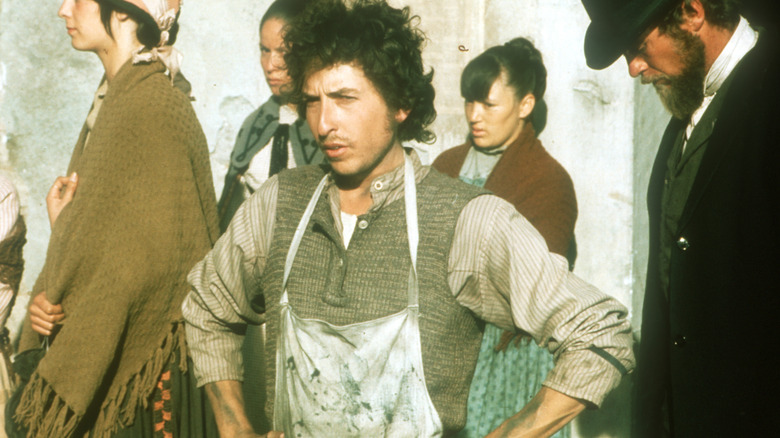
No, "Knockin' on Heaven's Door" wasn't originally recorded by Guns N' Roses, though you might have first encountered this song via the band's highly successful cover that went to No. 12 on the Billboard Hot 100 and brought the original song back to life decades after its debut. But it was written and first recorded by none other than Bob Dylan himself, who developed it in 1973 for director Sam Peckinpah's "Pat Garrett and Billy the Kid," starring Kris Kristofferson as Billy the Kid. (Dylan snagged a role in the movie, too.) Specifically, it was written for a death scene in which Billy the Kid shoots down Sheriff Colin Baker, played by Slim Pickens. Peckinpah was pretty dismissive at first, telling Dylan to his face that he actually preferred country-pop artist Roger Miller to the folk rocker.
As the account goes, however, Dylan's songwriting won Peckinpah over. All you have to do is listen to Dylan's original to get it. His "Knockin' on Heaven's Door" is deceptively simple, with just two verses and a pared-down sound that gets its hooks in you right away, with the singer saying, "Mama, take this badge off of me / I can't use it anymore / It's getting dark, too dark to see." The Guns N' Roses version might take you back to teenage moodiness, but Dylan's delivery is a more mature, tired sigh that's perfectly paired with the film's heartbreaking death scene. It's so compelling that Dylan has performed it hundreds of times, with many artists afterward taking their chance to cover this evocative song.
Cowboy Song — Thin Lizzy
Thin Lizzy's "Cowboy Song" isn't inspired by one particular movie, but it is absolutely influenced by the cinematic figure of the lonely, occasionally rowdy cowboy setting out on a long, dusty journey. Released in September 1976 on the band's "Jailbreak" album, "Cowboy Song" references rodeos, buffalo, a lingering romance, and the perpetually traveling lonesome cowboy figure. Looking only at the lyrics, you might think we're doomed to cliché territory, but the energy of the band's delivery and their exhilarating music — including absolutely killer guitar solos by Scott Gorham and Brian Robertson — elevate "Cowboy Song" from cheese to pure rock.
Written by lead singer and bassist Phil Lynott and drummer Brian Downey, "Cowboy Song" reached No. 77 on the Billboard Hot 100, placing it well below the No. 12 status of the band's best-known single, "The Boys Are Back in Town," which, like some other '70s faves, very nearly wasn't released. But, what it may lack in chart success, "Cowboy Song" more than makes up for in musicality and storytelling. It skillfully links the romantic, untethered cowboy image to a traveling rock star, neither of whom can seem to settle down — and perhaps don't really want to do so. Lynott surely felt that way, as he lived hard and toured often. Sadly, like in so many Western films, his story ended in tragedy when he died in 1986 of pneumonia and blood poisoning complicated by substance misuse.
Once Upon a Time in the West — Dire Straits
"Once Upon a Time in the West" by Dire Straits really takes its time, asking you to sit down for nearly six minutes to contemplate its music and brooding lyrics. Its inspiration, Sergio Leone's 1968 film of the same name, runs for around three hours in most incarnations. Though it clearly owes a debt to earlier Westerns, the Leone film isn't afraid to play with convention, like when it cast Henry Fonda against type as the chillingly evil outlaw Frank. It's best enjoyed when you embrace its dramatic style and deliberate pacing as it tells an epic tale set in rural Arizona that includes a brutal quest for vengeance.
In much the same way, the Dire Straits track takes inspiration from the film and moves things forward in its own manner. Released on "Communiqué" in 1979, "Once Upon a Time in the West" opens up the album with some bold statements about society as frontman and songwriter Mark Knopfler saw it. This is definitely a downer song, using the "West" as a metaphor for a society that's gone rough around the edges, though the cool guitar melody reflects the spare sort of soundtrack you may hear as a movie's cowboy hero stumbles through an unforgiving desert. The lyrics overtly reference modern times, but you can still all too easily imagine Fonda's character "Breaking up the speed limit / Scaring the pedestrians for a minute" as a form of grim, maladaptive amusement.
Cowboy Movie — David Crosby
The cinematic "Cowboy Movie" comes from David Crosby's first solo album, "If I Could Only Remember My Name," released in 1971 while members of Crosby, Stills, Nash & Young were experiencing significant turmoil. The track recounts a messy breakup that made those tensions all the worse, only retools it as a Western tale worthy of the silver screen, featuring brawling buckaroos and a dark-haired woman named "Raven." That last figure is singer Rita Coolidge, who dated both Graham Nash and Stephen Stills.
Allegedly, when Coolidge and Nash informed Stills of their relationship, Stills reacted with violence. Crosby was pretty suspicious of Coolidge's presence, with some accounts alleging that he thought she was a federal agent, reflected in the song's reference to Raven being "the law." Producer and future record exec David Geffen bluntly stated that President Nixon wouldn't know the first thing about some guy named David Crosby, but such a dramatic twist would be appreciated in a movie.
"If I Could Only Remember My Name" was received poorly at first, though it has since been reevaluated as some of Crosby's best work. "Cowboy Movie" even features the Grateful Dead's Jerry Garcia on guitar and Phil Lesh playing bass. While making the album, Crosby was dealing with a myriad of issues, including the sudden death of his girlfriend Christine Hinton in 1969 and substance misuse. Yet, he found great meaning in making music with his friends. As Crosby told "The Good Ol' Grateful Deadcast" in 2020 (via Mojo), "The only place that I knew I wouldn't be utterly terrified and crying and distraught was in the studio."
If you or anyone you know needs help with addiction issues, help is available. Visit the Substance Abuse and Mental Health Services Administration website or contact SAMHSA's National Helpline at 1-800-662-HELP (4357).