

The Greatest Keyboard Solos Of The '70s
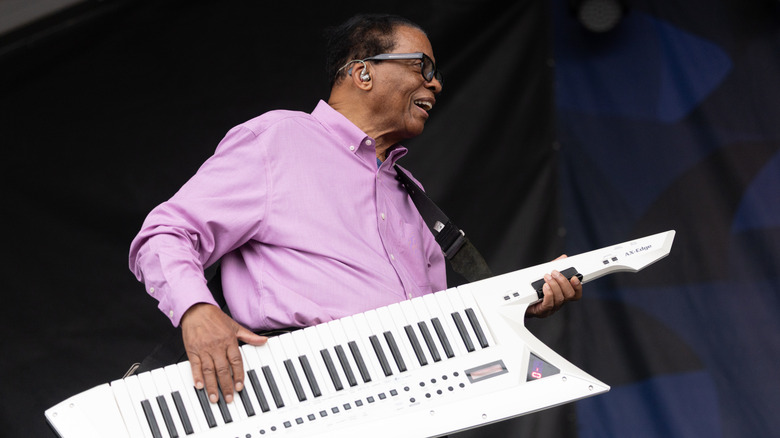
Trying to pick the greatest keyboard solo of the 1970s is like trying to pick your favorite sip of wine. The decade where jazz fusion and progressive rock dominated, the music world was rife with extraordinary keyboard solos, so many that it becomes difficult to establish a single criterion for judging their quality. There's hard rock standard bearers injecting synthetic lyricism into their work and jazz innovators probing the outer limits of fusion's harmonic potential, all while the burgeoning electronic scene was taking off.
So for this list, the greatest solos are the ones that manage to innovate and emote in equal measure. It isn't enough that we that we dig the early sound of the Moog synth's explosion in popularity — it has to touch the soul as well. Similarly, great phrasing alone won't make the cut: it's got to be from a cat that's hip to the newest technology. So here's a deep dive into some of the most notably marvelous synthetic ivory tickling the decade had to offer.
A Remark You Made — Joe Zawinul with Weather Report
"A Remark You Made" is one of those songs that straddles the gap between musical innovation and commercial viability. Though Weather Report's history will always be dominated by the extraordinary playing and tragic death of Jaco Pastorius, they were, first and foremost, a vehicle for founder Joe Zawinul's iconoclastic reimagining of what electric jazz could be. What by today's standards feels like an obvious forerunner of the smooth jazz phenomenon was the height of experimentation upon its release.
"Heavy Weather," the group's 1977 magnum opus, is rife with captivating moments for fans of fluid technique and sophisticated atmospherics, but "A Remark You Made" captures a whole other depth of feeling. It's a delicate, warmly sentimental ballad that says more with the instrumental format than many artists are able to convey lyrically. Central to that is that is the tonal depth and deft touch detail Zawinul brings to his solo and the way it interacts with the other players. He follows Wayne Shorter's sax solo and is careful to use a combination of pressure dynamics and tone wheel control to effectively match Shorter's breath-driven acoustic tone. That commitment to humanizing the electronic, coupled with the pleading phrases of a master jazz ballad soloist, makes the solo melt against the eardrums and warm the soul every time.
All My Love — John Paul Jones with Led Zeppelin
"All My Love" is something of an oddity in the wider scope of the album it appears on. 1979's "In Through the Out Door" LP finds Led Zeppelin shedding the upstart machismo of their early hard rock sound for a more elegant and mature approach. It's not quite the sort of sharp turn into adult contemporary that so many bands fall into in their later period — there's still plenty of rockstar swagger and crunchy tube amplifier distortion — but the album as a whole leans more heavily on early rock 'n' roll and honky-tonk blues than prior, more experimental efforts.
That's what makes "All My Love" such a welcome return to form: the band suddenly switches back into the sort of mystical fantasy imagery and vaguely occultic spirituality that made "Led Zeppelin IV" and "Houses of the Holy" seem less like rock records than dispatches from some heavenly realm. Central to that return is the track's quasi-symphonic synth arrangements punctuated by a hypnotic neo-classical keyboard solo courtesy of bassist John Paul Jones.
The passage follows a motif of elliptical sixteenth note phrases with a horn sound that gives the piece that endearing sword-and-sorcery quality that made earlier Zeppelin albums so intoxicating. With the rise of punk rock, new wave, and, unbeknownst to the band, the end of Led Zeppelin looming on the horizon, the solo makes for a lush but gentlemanly final nod to the band's earlier neo-classical explorations. Leave it to Led Zeppelin to throw in a good swan song.
Chameleon — Herbie Hancock
The reptilian bassline that opens "Chameleon" (and the whole of 1973's "Head Hunters" LP) is as culturally ingrained as any of the best guitar riffs of the '70s, but it's surrounded by tremendous keyboard work. By this point in his career, Herbie Hancock had scaled the heights of the jazz world, playing with everyone from Grant Green to Stan Getz, though it was his work with Miles Davis (notably "Cookin' With the Miles Davis Quintet" and "'Round About Midnight") that truly secured his legacy in the jazz world. That kind of cred might have been enough for some, but Hancock soon found his own solo material rocketing up the Billboard charts with "Head Hunters" reaching an extraordinary No. 13 on the top 200.
His opening solo on "Chameleon" comes in as a dirty, willfully abrasive distorted organ. There's a harsh belligerence that threatens to upend the infectious vibes built up by the larger ensemble up to that point. What makes it so remarkable is that the kind of wild-screeches-with-ambient-effects solo we'd normally expect to hear towards the end of a long jam where the lick vocabulary has run dry and the soloist is milking percussive jabs and noise runs.
But Hancock uses that as the basis for the solo. By the time he evolves into a properly cool electric organ solo, he's back into his melodic phrasing while still interacting closely with the percussion, almost like a hand drummer with a seven-octave line of chromatic drums in front of him. And that melodic capacity is so vast that each shift to a different keyboard or synth patch sounds like an entirely separate soloist.
Technopolis — Yellow Magic Orchestra
"Technopolis" is a stand-out track from one of the bands most responsible for the electronica boom that would soon dominate in the next decade. The late 1970s saw Devo and Kraftwerk plotting the trajectory of techno music in the United States and Europe, respectively. In the far flung reaches of Japan, three session musicians, keyboardist Ryuichi Sakamoto, keyboardist/bassist Haruomi Hosono, and drummer/keyboardist Yukihiro Takahashi, were plotting their contribution to the newly emergent art form.
With three keyboardists in the band, it's difficult to say who is tackling which solo, but the multilayered parts throughout are as musically captivating as they are technically demanding. "Technopolis," off the band's 1979 sophomore LP "Solid State Survivor," blends robotic dance floor grooves with neo-classical melodic runs. The three-part melody lines jump apart to showcase individual chops and slip right back together in a seamless manner that makes the furious intricacy go down as smoothly as a great disco hook.
In retrospect, Yellow Magic Orchestra sounds like the perfect accompaniment for visions of skyscraper-sized superheroes battling giant mechanized lizards or a snarky blue rodent zipping through a series of golden rings. Those connections are easy to make now because of the massive influence this group has had, but at the time, they were a plucky young band crafting beautifully enthusiastic futurisms. Not hard to see how they became regarded as one of the most underrated supergroups of all time.