

5 Classic Singles That Define The Monkees
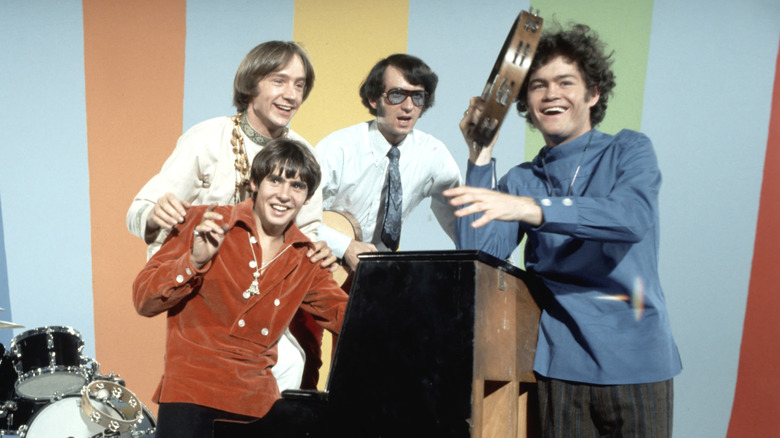
In the late '60s, the Monkees were unique and in some ways strange. But this four-pack of contrived characters created for a TV series became bona fide pop stars, and they had a serious collection of hits in their arsenal. This was largely thanks to music guru Don Kirshner, who enlisted crack songwriters to throw the band a handful of pop jewels that Davy Jones, Peter Tork, Mickey Dolenz, and Mike Nesmith made their own. The result is an archive of mid-20th-century musical brilliance that transcended the one-hit-wonder bubblegum pop label the band could have easily ended up being stuck with.
Five particular stand-out songs represent the Monkees better than any others, a packet of musical calling cards that still hold up beautifully over six decades later. Our picks are more than just the most familiar songs recorded by America's attempt to recreate the Beatles, but with broader strokes and more silliness. They're also representative of how the U.S. responded to the British Invasion: pop-rock given a burst of day-glow colors bright enough to light up radio waves.
From "Last Train to Clarksville" to "Daydream Believer," revisiting these emblematic pieces is like recapturing the pre-Vietnam War era with a whiff of the oncoming free-love spirit hanging in the air. The world seemed a little more innocent, rock 'n' roll was a bit more hopeful, and the Monkees were new teen idols with a magical touch for creating playful music.
Last Train to Clarksville
The faux-Beatles spirit shines brightly on "Last Train to Clarksville," a peppy little ditty about a romantic meet-up that introduced the world to the Monkees' sound before the TV show turned the guys into teen idols. It has the twangy, high-stepping energy that reflects an unmistakable Fab Four influence, and a lovestruck wholesomeness designed to captivate the target teeny bopper audience. The description has all the makings of a clandestine rendezvous: "Take the last train to Clarksville / And I'll meet you at the station / You can be here by 4:30 / 'Cause I've made your reservation." Delivered in an arrangement reminiscent of the Byrds and with sunny vocals by Micky Dolenz, it becomes a hopeful missive filled with mid-'60s optimism.
"Last Train to Clarksville" became the band's first No. 1 song in November 1966, launched from the No.1 debut album they released ahead of their TV show debut in 1966. In a year full of firsts for these youngsters taking the pop music scene by storm, this folksy song was a great way to get the Monkees into the public eye and became an indelible piece of their early history — one that carries its joyous spirit into the 21st century.
I'm a Believer
The Monkees made a hit out of "I'm a Believer," a song written by Neil Diamond that was originally supposed to be recorded by country singer Eddy Arnold. Once again, Don Kirschner heard a hit for the Monkees and grabbed the song for them instead. "I'm a Believer" would become the band's most successful single, climbing all the way to No. 1 on the Billboard Hot 100 in December 1966 and locking in the top spot for a sensational seven-week run. It was another tune where Mickey Dolenz took the lead, whose unpolished, pop-friendly tones became the voice that led the band into superstar status.
"I'm a Believer" is an often-covered and sampled song, appearing in more than 80 versions and works by other artists through the decades. Diamond released his own version in 1971 and took the song to No. 51 — not one of his bigger hits, and nowhere close to the success the Monkees' version achieved. An updated cover by alt-rockers Smash Mouth appeared on the "Shrek" soundtrack in 2004 and became a No. 25 hit, reminding the world of how joyous the Monkees' trademark tune could be in any era.
(I'm Not Your) Steppin' Stone
Even a troupe as whimsical as the Monkees could put walls around their hearts when the situation called for it. "(I'm Not Your) Steppin' Stone," a song that had passed through the hands of the Liverpool Five and Paul Revere & the Raiders before it reached the Monkees, took a slightly sterner tone and a minor-key construction to convey the defensive posture of a lover who knows they're being used. The difference was notable; the sound touched on the psychedelia-lite vibe loved by late-'60s rock bands with pop-star aspirations, and the edgy sentiment was a twist that showed these boys had a bit of grit.
Micky Dolenz handled lead vocals on "(I'm Not Your) Steppin' Stone," growling and howling as the tempo shifted into double time, with lyrics aimed at shaming a cultural climber looking for better prospects. "When I first met you, girl, you didn't have no shoes," Dolenz reminds her, "But now you're walkin' around like you're front page news."
This crackly single punched in at No. 20 in January 1967. While it wasn't among their highest-charting songs, it was a major success for a tune released as the B-side of "I'm a Believer." It was distinctive enough to give the Monkees an important aspect of their growing career: range. The band proved it could flex muscle among the pratfalls and send out real rock fire to balance out their sweet pop stylings.
Pleasant Valley Sunday
As yet more of the easy-going, winsome sound the Monkees had become known for, "Pleasant Valley Sunday" continued the group's streak of feel-good singles. The lyrics took an unmistakable swing at the Beatles' knack for working quirky characters into everyday situations: "See Mrs. Gray, she's proud today / Because her roses are in bloom / And Mr. Green, he's so serene / He's got a TV in every room." It didn't have the philosophical weirdness Paul McCartney and John Lennon infused their trippiest works with, but it was charming regardless. However, the mind-numbing blandness of the suburban setting eventually takes its toll, in a bridge that ends, "My thoughts all seem to stray / To places far away / I need a change of scenery." Songwriters Carole King and Gerry Goffin knew what sort of banal existence they were describing in such sharp and soul-draining detail.
For this happy-sad harmonic saga by the Monkees, the band was rewarded with a No. 3 spot on the Billboard Hot 100 in the summer of 1967. By then, the Monkees were a TV staple and had a bunch of singles bopping around all over the charts, as well as a devoted fan base.
Daydream Believer
Prior to departing the Kingston Trio, folk rocker John Stewart put pen to paper and conjured up "Daydream Believer," one of the most representative songs of the flower power era and a signature hit for the Monkees. It was another upbeat single that unfurled streams of happy energy in the face of the daily grind. The chorus "Cheer up, sleepy Jean / Oh, what can it mean / To a daydream believer / And a homecoming queen?" soared with good vibes; the tune made Stewart's songwriting a pop culture staple and became a timeless, optimistic anthem. It also put Davy Jones front and center as lead singer, which helped cement his status as the main heartthrob of the crew.
The song climbed to No. 1 in December 1967 and stuck around for four solid weeks, proving unequivocally that the Monkees were hit makers, and not just goofballs using their TV star status to sell albums. Though their run would come to an end by the time the '70s showed up, they were high in the clouds with songs such as "Daydream Believer," which was destined to become one of the classics fans know and love today.