

5 Monkees Harmonies That Still Deliver Today
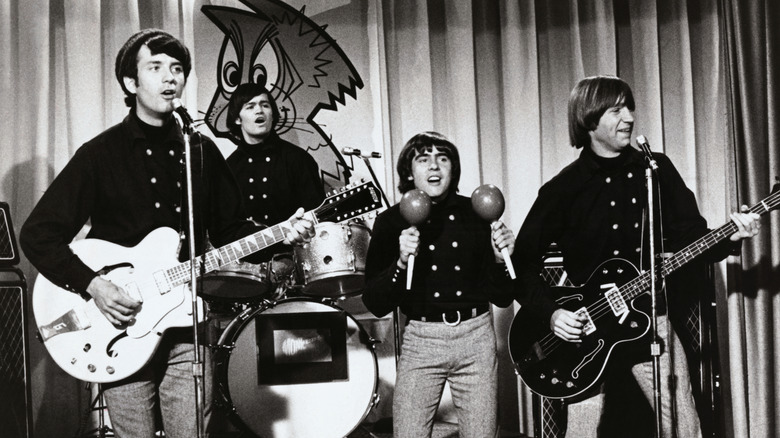
The Monkees were a cultural sensation in the 1960s, but their music still holds up, particularly the songs that show off the pop-rock band's amazing harmonies. One strange thing about the Monkees is that they didn't form organically, but were assembled by TV producers from a horde of auditioning actor-musicians. Many bubblegum pop hits weren't recorded by the bands you thought — the Monkees stepped aside in favor of studio musicians, but they really did sing on their records. It's remarkable that in a very brief period of time, four guys who were essentially strangers — Micky Dolenz, Mike Nesmith, Davy Jones, and Peter Tork — meshed their voices together in such a glorious and gorgeous manner on both their huge hits and deep cuts.
Created to be an American version of the Beatles, the Monkees scored four No. 1 albums in 1967 alone, and wound up sounding like the Beach Boys as far as harmony is concerned. That group benefitted from biology — their voices naturally blended because they were mostly related. But the Monkees almost magically melded their talents and brought some terrific vocal mixing to the '60s scene. Here are five Monkees songs with harmonies that still impress six decades later.
Valleri
Monkeemania began to die out in 1968, and the band's final Top 10 hit was the layered and musically potent love song "Valleri." Appearing on "The Birds, the Bees & the Monkees," the No. 3 hit showed that the Monkees were trying to keep pace with the times, as it incorporates the harder-edged tone of psychedelic rock as well as the prominent harmonies that were such a part of the very popular folk-rock of the time.
Unlike previous Monkees hits, which often buried a harmonizing section halfway through the running time as a showcase moment or a bridge, "Valleri" boldly kicks off with the harmony. There's very little instrumental lead-up to the singing here — the song begins with a quick riff and then a sonic blast of electric guitars, drums, and multiple Monkees just giving it all they've got right away with some deep-throated vocals. While the lower end of the scale serves as a solid base, the Monkees capable of the upper register notes get to play around a bit, warbling up and down and stretching the name of the woman who the song is about into lots of syllables. That's also the chorus, and the whole section repeats throughout the song, providing an emotional punch each time.
Pleasant Valley Sunday
Prolific married songwriting duo Carole King and Gerry Goffin moved out of New York City and into the New Jersey suburbs in the 1960s, and they found the environment so stifling and unsettling that they poured their dissatisfaction into "Pleasant Valley Sunday." The pair were associates of Monkees overseer Don Kirshner, and the band recorded the song for their 1967 album "Pisces, Aquarius, Capricorn & Jones Ltd.," which found them getting more experimental. They diffused and wryly undercut the biting lyrics with jangly guitars and similarly playful and folky vocals, including a rollicking, multi-part harmony.
Micky Dolenz takes the lead on "Pleasant Valley Sunday," a No. 3 hit, and at the end of every verse couplet, he's assisted by a higher counterpoint, with even more Monkees joining in on the chorus to bring up the low end. But then comes the memorable and impressive breakdown. The Monkees essentially scat, singing nonsense syllables with and against each other. Sometimes they create chords that hang in the air, and other times their notes collectively rise and fall in stereo.
Riu Chiu
The Monkees' skills as musicians may have been questioned — their parts were mostly played by hired session musicians early in their career, and when they were allowed to perform on later albums, they didn't sell as well — but every member was a talented and versatile vocalist. They conclusively proved as much on "The Christmas Show," a Season 2 episode of their hit sitcom from 1967. After the scripted story winds down, a scene opens on the foursome sitting around a festively decorated room as they just begin to sing "Riu Chiu," an adaptation of "Riu, Riu, Chiu," a religious Christmas song from 16th century Spain. It's rare that a fun band who starred on a silly show could be so moving, but their take on "Riu Chiu" is.
Without any instruments or apparent studio trickery, the Monkees respectfully and precisely knock out the Spanish-language tune. Their tones mix harmoniously in this arrangement for four different voices with varying ranges. Apart from a Micky Dolenz solo that visibly surprises and impresses the other singers, the Monkees are as one on "Riu Chiu," as every part adds up to a beautifully haunting singular sound.
Shades of Gray
Found on the Monkees' 1967 LP "Headquarters," "Shades of Gray" is a change of pace for the bubblegum rock group who usually recorded songs about young love and happy times. It's a sad, somber, and bittersweetly nostalgic ride comparing the carefree innocence of childhood to the chaotic and confusing existence of adulthood. Davy Jones gets first crack at lead singing duties here, the first of multiple Monkees to get a big solo verse performance, but he doesn't have to stand out there on his own for long, as the rest of the band joins in for the harmonies that populate and characterize "Shades of Gray."
Harmony breaks serve as the chorus in "Shades of Gray," and they're recorded so well that there's a double effect in play. The voices form together to create a sweet sensation amidst the glum lyrics, but remarkably each Monkee can be heard clearly and solidly. A close listen is rewarding, with each voice heard simultaneously as its own instrument while also helping to create something much bigger.
You Just May Be the One
Just before "Shades of Gray" touched Monkees fans' hearts and souls, the LP "Headquarters" delivered a much different and much sunnier track, "You Just May Be the One." Written by Monkee member and future country-rock star Mike Nesmith, it's a direct and joyful love song presented in the second person — Nesmith's narrator is in love with "you," the listener. That's a wonderful feeling and grand proclamation, and the only way to demonstrate the profundity of it all is with a choir of angels. Nesmith doesn't have real angels, of course, but he has his very capable and enthusiastic Monkees on his side to get the job done.
While the Monkees most often used harmonies as a little treat or occasional tool, in "You Just May Be the One," they completely dominate. Nesmith only sings a few lines here and there by himself. Nearly every lyric takes on a hymn-like quality because they've got four voices delivering them with proud and assertive cohesion. It's all those voices singing together, united, that creates a startling supernatural edge.