

Not Johnny Cash, Not Hank Williams: The Singer That Gave Country Music Its First Million-Seller
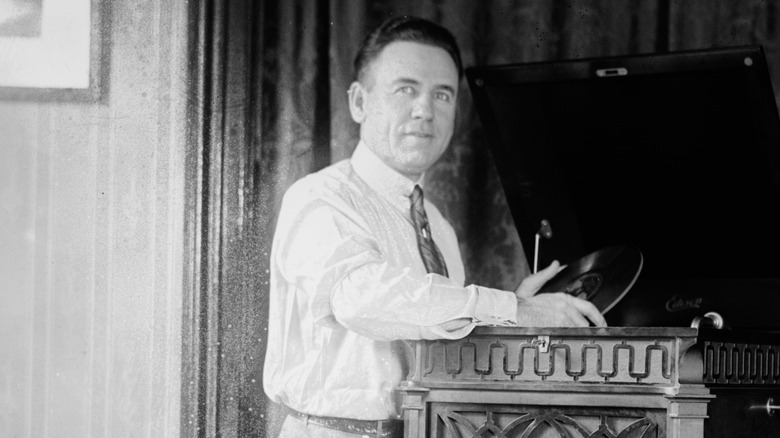
Even country music fans deeply knowledgeable of the genre's century-plus history might assume that the first artist from that world to sell a million records would be a household name or tragic figure like Johnny Cash or Hank Williams. But those performers, and many more, plied their trade after decades of pioneers carved the path and established the fundamentals of country. Among those early influences was Vernon Dalhart — the first person to ever sell a million copies of a country music record.
Dalhart's ascendance to country stardom was roundabout and indirect. Born in Texas in 1883, he was an actual cowboy, working on cattle ranches before attending the Dallas Conservatory with the ambition to become an opera singer. Indeed, by the 1910s, he'd decamped to New York and had performed in both serious operas and lighter operettas. But then he got involved with the early recording industry, putting himself up as a singer for hire willing to record almost anything, including Hawaiian tunes, old minstrel songs, and what's now called country, but which at the time was more likely to be called "hillbilly music." In 1924, the musician (whose real name was Marion Slaughter), cut the double-sided single "The Prisoner's Song" and "The Wreck of the Old '97," a milestone of a country recording.
The Prisoner's Song and The Wreck of the Old '97 was a double-sided smash
In 1924, Vernon Dalhart recorded two songs for the Victor label: "The Prisoner's Song" and "The Wreck of the Old '97." The former, a country song that would go hard as a rock cover, is a lonesome, woeful, ballad, while the latter tells a story about a train accident. Both types of tunes would be foundational to country, and Dalhart proved there was a big market for both, selling a million records with them.
That single jump-started country as a commercial force and led Dalhart to aggressively pursue the style. Over the next nine years, he recorded more than 300 different songs, sometimes repeatedly, for various labels under different names, including Jeff Fuller, Tobe Little, and Al Craver. As he did on his million-seller, Dalhart adhered to a formula, usually accompanied by a violinist and guitarist.
When the Great Depression struck in the 1930s, widespread economic suffering made it harder for Dalhart to sell a lot of records or even book a session. Between 1933 and 1939, he issued just one song, and in the 1940s he found work as a security guard and a vocal coach. While not among the country musicians in the Rock 'n' Roll Hall of Fame, he was inducted into the Country Music Hall of Fame in 1981, an honor that arrived well after the singer's death in 1948.