

5 Songs That Prove 1966 Was The Best Year Of The Yardbirds' Career
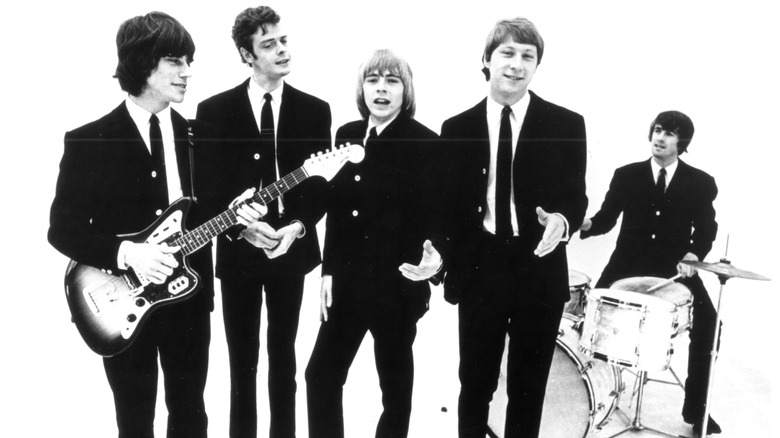
Because three of classic rock's most iconic, history-making guitarists cycled through the Yardbirds, the band's own contributions often get overlooked. To view the band as "just" a launchpad for Eric Clapton, Jeff Beck, and Jimmy Page (and Led Zeppelin) is to sell them way short. Between 1963 and 1968, few groups were as inventive and exciting, and even fewer took British blues, R&B, and rock further. But while they produced classic cuts throughout their run — and with apologies to Clapton, who left in 1965 — the band undoubtedly peaked in 1966. On songs released by the Yardbirds that year, you hear a band come into their own: one able to tap into their zeitgeist, while creating music that's ageless.
Part of our justification for picking our entries is that 1966 was largely Beck's time on lead guitar, and he breathed new life into the Yardbirds. On tracks like "Shapes of Things" and "Over Under Sideways Down," their new axman put his stamp on the band's evolving sound, pushing them into psychedelic territory. And we couldn't ignore "Happenings Ten Years Time Ago," which captures the mind-blowing power of the band's short-lived lineup with Page on second lead guitar.
1966 was a watershed year for British music, with the Beatles' "Revolver," the Rolling Stones' "Aftermath," and the Kinks' "Sunny Afternoon," and this was just as defining a time for the Yardbirds. As these songs prove, it was the year when the legendary blues rockers found their wings and took flight.
Shapes of Things
Where Eric Clapton's lead guitar work masterfully balances precision with soul, Jeff Beck's playing is fiery and more unrestrained. Anticipating masters like Jimi Hendrix, the Yardbirds' second lead guitarist harnessed distortion, pushing his Vox AC30 amp to growl and scream. On the solo and breakdown of "Shapes of Things," this effect creates a spacey, sitar-like sound that soars against squeals of feedback. It's a gorgeous piece of '60s psychedelia that sounds miles away from the band's British blues and garage rock roots.
Written by Yardbirds singer Keith Relf, drummer Jim McCarty, and bassist Paul Samwell-Smith, "Shapes of Things" captures the undercurrent of youth revolt that began to bubble over in the '60s; to crib from Bob Dylan, the times were a changin'. "Come tomorrow, will I be older? / Come tomorrow, may be a soldier," goes the bridge. "Come tomorrow, may I be bolder than today?" Seeing cycles of war and environmental decay around him, the narrator pleads with his parents' generation (and perhaps his own): "Please don't destroy these lands / Don't make them desert sands." With trenchant lyrics, groundbreaking guitar work, and an undeniable groove, it's a 1966 rock song that sounds even cooler today.
The single release of "Shapes of Things" added to the Yardbirds' successful run on the charts. It hit No. 3 on the U.K. singles chart in March 1966, and just missed the Top 10 in the U.S. two months later, peaking at No. 11 on the Billboard Hot 100. Psychedelic rock was making a mark.
Stroll On
With its driving backbeat and gritty guitar, you can hear why Italian film director Michelangelo Antonioni wanted the Yardbirds' "Train Kept A-Rollin'," an R&B tune by Tiny Bradshaw on the band's 1965 album, "Having a Rave Up with the Yardbirds," for his 1966 project "Blow-Up." Though perfect for a thriller set in swinging London, Antonioni couldn't get the rights, so the band reworked and re-recorded the song, calling it "Stroll On." One of only a few tracks with Jimmy Page joining Jeff Beck on guitar, it showcases the sheer power of this short-term lineup.
That version of the Yardbirds features in one of the most iconic scenes in "Blow-Up." The protagonist, played by David Hemmings, stumbles into a crowded nightclub with the band bashing through "Stroll On." In the scene, Beck loses his temper at a malfunctioning amp, smashing his guitar and triggering a riot. Though the lyrics are far from incendiary, including heartbroken lines such as "You made me cry / By tellin' me / You didn't see / The future bore / Our love no more," the performance is furious and unforgettable.
Happenings Ten Years Time Ago
With groundbreaking albums such as the Jimi Hendrix Experience's "Are You Experienced," 1967 was the decade's best year for psychedelic rock. However, the Yardbirds beat these artists to the punch with 1966's "Happenings Ten Years Time Ago," blowing minds as it laid the groundwork for the genre's coming explosion. Another track that features the Jeff Beck and Jimmy Page lineup, the song splices together blasts of furious guitar and experimental additions such as a monologue and revving engines. Driving and heavy, it's far out.
But it's Keith Relf and drummer Jim McCarty's lyrics that make "Happenings Ten Years Time Ago" a psychedelic gem. Obliquely and abstractly, they evoke the ways we may be consciously and subconsciously connected to past lives. "Happenings 10 years time ago / Situations we really know / But the knowing is in the mind," goes the chorus, before cutting to the core of the matter with "Sinking deep into the well of time." Tapping into Buddhist concepts like reincarnation and the ephemerality of existence, the Yardbirds anticipated the shift in sound and subject matter that would take late '60s rock 'n' roll by storm.
But Page's furious riffing on "Happenings Ten Years Time Ago" also laid the groundwork for the band that the Yardbirds would spawn: Led Zeppelin. The latter's John Paul Jones played bass on the track, and after Relf and McCarty left the Yardbirds in 1968, he'd join the band's final lineup and Led Zeppelin's first: The New Yardbirds with Robert Plant and John Bonham. After fulfilling a string of dates, they rebranded as Led Zeppelin, forever changing the face of rock history.
Over Under Sideways Down
"Over Under Sideways Down" showcases the wave of innovation the Yardbirds rode in 1966. The title track of the 1966 U.S. release of their fourth album — later dubbed "Roger the Engineer" and appearing on a slightly modified U.K. version called "Yardbirds" — it's a significant step away from the band's blues roots. Guided by Jeff Beck's guitar work, the band veered toward experimentation, pushing at the boundaries of what they could do. Thus, the song jerks back and forth between boogie-woogie verses and Middle Eastern-sounding psychedelic breakdowns.
It's that blend of old and new that makes "Over Under Sideways Down" so inventive. "We got the idea from listening to Mike Raven, who used to play lots of old rock 'n' roll on his radio program," McCarty explains in his 1983 book "Yardbirds" (via American Songwriter). "We were in the studio and thought, 'Let's do a "Rock Around the Clock"-type boogie.'" On top of that framework, Beck's guitar gains room to pop and soar, adding sonic textures.
"It was very much like a microcosm of a life, really," drummer Jim McCarty recalled in his 2018 book, "Nobody Told Me: My Life with the Yardbirds, Renaissance, and Other Stories" (via American Songwriter). "... Suddenly we were going to sunny California where things were happening and things were rich and there were lovely girls and cars and everything." Yet the bridge, with haunting repetitions of "When will it end?," underscores the exhaustion and frayed nerves that come with that lifestyle and would eventually consume the Yardbirds.
The Nazz Are Blue
Midway through the guitar solo on "The Nazz Are Blue," Jeff Beck hits and holds a long, quavering note. It rings and reverberates, bending and then fading as the band trundles on with a furious, frenetic groove. Sometimes all it takes is one moment in a song to make it iconic, and this soaring and mournful wail is exactly that — an exclamation mark. As much as the Yardbirds' sound evolved in 1966, they always remained a well-oiled blues machine, and that's what's on display on this song off that year's LP, "Over Under Sideways Down."
The only Yardbirds track to feature Beck on lead vocals, "The Nazz Are Blue" gives voice to a lonely man looking for a lover. Across three verses, the tension builds as desperation mounts and longing grows: "Now all I gotta find is you / And if the Nazz don't help me baby / You better forget about me too." As to what "the Nazz" is, there's some debate. In the '60s, it was slang for "the coolest" or "greatest," so the song may be a hipster lament; even tastemakers get burned by love. But it also could refer to the narrator's "blue car" in the second verse. Whatever the definition, the tune smolders with desire.
Released in 1966 as the B-side to the "Happenings Ten Years Time Ago" single, "The Nazz Are Blue" reminds us that the Yardbirds could never stray too far from the blues that made them. Yet it also captured a band who were unafraid to push at the boundaries of the genre, and in so doing, made music and sounds that still resonate, reverberate, squeal, and roar.