

The '70s Singer With One Of Yacht Rock's Most Beautiful Voices You Probably Don't Know
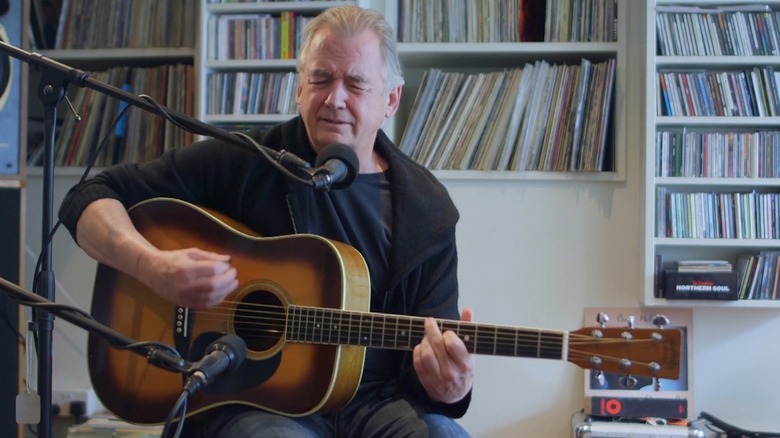
Some artists just aren't appreciated by their home country, which seems to be the case for Ned Doheny, the singer-songwriter from Beverly Hills, California. Boasting a beautiful voice and a strong knack for songwriting, Doheny worked alongside artists from the Laurel Canyon scene, including Glenn Frey, Don Henley, and Linda Ronstadt, crafting polished, easy-to-listen-to pop rock records. His second album, 1976's "Hard Candy," is a masterclass in white soul, yacht rock, and fusion that failed commercially in the United States but found a remarkably receptive audience in Japan, kickstarting his career overseas and, in the 2020s, earning him the respect of younger generations.
"The Japanese were the first to connect with what I was doing," Doheny said in an interview with Red Bull Music Academy. "I think a lot of it had to do with rhythm — they can't understand anything I'm saying, so it has nothing to do with the lyrics." After CBS Records dropped him following the commercial failure of "Hard Candy," Doheny released his third album, "Prone," exclusively in Japan in 1979. He continued to perform and tour in Japan, and in 1990 was hired as the host of a radio show in Yokohama, "Postcards from Hollywood," until 1993.
Doheny's popularity in Japan coincided with the rise of city pop, a Japanese genre shaped in part by American pop, jazz, and soul. His blend of sophisticated arrangements, polished production, and catchy melodies shared the sound and sensibility of city pop. As the genre enjoys a global resurgence in the 2020s, Doheny's music, especially "Hard Candy," is finding new audiences.
Ned Doheny's connection with city pop
Featuring glossy production and meticulously crafted arrangements, city pop is defined by its electronically inspired twists on funk, disco, and soul. Many of these elements built upon American influences, combining the culture of the postwar Japanese economic boom with California's West Coast aesthetic. At the same time, white American artists such as Ned Doheny were exploring similar musical ideas through what became known as "plastic soul," a term that describes soul music made by white artists drawing on Black influences such as George Benson, Isaac Hayes, and Curtis Mayfield. Often overlapping with yacht rock, plastic soul was made popular by artists like David Bowie on "Young Americans," Doheny on "Hard Candy," and another one of the most beautiful voices in yacht rock history, Boz Scaggs, on "Silk Degrees." Doheny's sound made him a natural fit for city pop fans.
That sound isn't just defined by rhythm and grooves, but by Doheny's beautiful voice. Inspired by singers like Levon Helm, Luther Vandross, and Billie Holiday, Doheny's voice is smooth like velvet, sliding up and down the scale with the grace of a dolphin in the surf. In his upper register, the timbre of his voice is akin to fellow soft rocker Michael McDonald of the Doobie Brothers, but in his lower register he has the rhythm and sass of Japanese city pop singer Yoshino Fujimal. In 2014, fellow Laurel Canyon resident Jackson Browne wrote for Rolling Stone, "[Doheny is] a producer-arranger whose grasp of rhythm and harmony is on a footing with the great record makers of the last 30 years. His singing too has developed steadily, and in a wonderful way. He sings higher and stronger than just about anybody."
The U.K. club scene and album reissues
Because Ned Doheny's albums mostly circulated in Japan, many of them became sought-after hits in the U.K.'s underground DJ scene, where they were prized for their rarity. In an interview with Ban Ban Ton Ton, Doheny credited the DJ community with helping revive his career in the late '90s. "The music business was in shambles at that point, and I was unsure of how to make my presence known," he said. "Little did I know that with considerable help from the DJ community, my music would eventually be discovered by another generation."
The renewed interest spurred by the club scene and the beginnings of the city pop resurgence led to a new market for Doheny's records. In 2014, the Numero Group released a collection of remixed and remastered material from his '70s period, featuring bonus tracks and unreleased audio. The release was met with positive reviews from critics. Doheny believed the release was connected to the growing interest in his music among DJ community. "[Numero's] interest seemed to coincide with a growing awareness of my work within the DJ community. A new door has opened, and with it a new life."