

The 3 Best Girl Groups Of The '70s
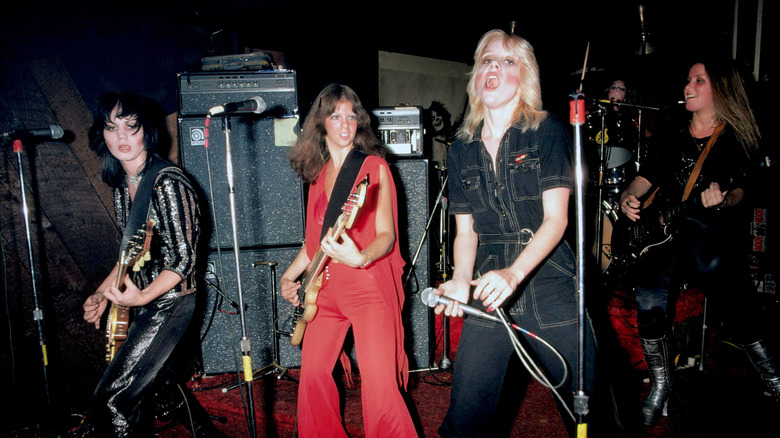
The very concept of a "girl group" calls to mind visions of identically dressed divas and choreographed microphone routines. That was definitely the case with the best girl groups of the '50s and the predecessors in previous decades, but by the 1970s the format was expanding in all directions. Whether it was a group of sisters from Philadelphia getting us on the dance floor, or the pioneering ladies of the first major teen girl hard rock act, the 1970s were a time when traditional formats were evolving.
To that end, we wanted to showcase the groups that were breaking free of the mold (although there's going to be some echoes of that polished uniformity along the way.) These are the artists who realized that the concept of a "girl group" could use a few additional adjectives, be they modifiers to the genre, the aesthetic, or the instrumentation.
Fanny
Fanny reminds us why it's always refreshing to exceed expectations. The very term "girl group" calls to mind images of vacuous teen-idol pop vocalists more adept at posing for magazine layouts than executing solid musicianship. But amidst the ongoing generational sea of Spice Girls, there emerge, nevertheless, groups whose technical capacity shines through. In the case of Fanny, it's more than just a token gesture towards virtuosity: their instrumental skills placed them easily and undeniably among the most adept upper ranks of the hard rock boys' club.
Where some girl groups are derided for loping along instrumentally (The Runaways, legendary as they are, do come to mind), Fanny is awash in stunningly skillful performances. Their cover of the Beatles' "Hey Bulldog" goes hard with infectious precision drumming courtesy of Alice de Buhr and the steadily aggressive assuredness of guitarist June Millington's guitar work. That's just one window into the technical mastery this group shows — mastery that, it should be pointed out, is notable irrespective of the gender of the players.
There were lineup changes through the years — de Buhr and Millington left following 1973's "Mother's Pride — but the musical evolution continued unabated, and by their final album, 1974's "Rock And Roll Survivors," there's an extraordinarily accomplished veteran band backing up the powerful but always silky-sweet female vocals, and we're left to marvel at the fact that both facets are coming from the same players.
Fanny split up shortly after "Rock And Roll Survivors," even though it contained "Butter Boy," their biggest hit at No. 29 on the Billboard Hot 100. It's a royal shame considering that by that point in their careers they sounded poised to be the female Steely Dan.
Sister Sledge
Occupying a more traditional girl group image (the orchestrated fashions and a focus on multi-part ensemble vocals) and reminding us all that we are family, the titular Sledge sisters (Debbi, Joni, Kim, and Kathy) served as a sort of all-girl answer to the Jackson 5, bringing the R&B/Soul stylings of yesteryear into the disco age.
Originally formed as the teenage vocal ensemble Mrs. Williams' Grandchildren in Philadelphia, Pennsylvania, the then teenage singers benefitted from the tutelage of said grandmother, Viola Williams. A trained opera singer, Williams coached the girls extensively on proper vocal technique and began booking performances at their church and local events. It was an effective and proactive but ultimately constricting start to their careers, and the girls soon formed their own project as they entered adulthood.
The newly minted Sister Sledge released two LPs, 1975's "Circle of Love" and 1977's "Together," to minor success before teaming up with Chic masterminds Nile Rodgers and Bernard Edwards for 1979's "We Are Family." The title track would go on to become the quartet's signature smash while "He's the Greatest Dancer" would become a hit in its own right. Sister Sledge had always showcased sophisticated arrangements and tight, crystal-clear vocal harmonies, but "We Are Family" was the album that refined their disco sensibilities into a well-oiled hit machine. Disco may have been about to hit a hard decline in popularity, but Sister Sledge laid down an album-length summation of the genre's peak years.
The Runaways
The Runaways have an undeniably detailed and tragic story but it yielded an important milestone group in female rock music. Founded in 1975 as the brainchild of eccentric and controversial producer Kim Fowley, the band was initially intended as a marketing gimmick built around the novelty of an all-girl hard rock outfit. That superficial starting point yielded cult-status in the United States, two major solo careers, and an enduring rock legacy.
Though initially derided by critics for their juvenile musicality and over-reliance on image, the group was able to transcend their barely-there Billboard chart presence with a series of hugely successful international tours. Their signature song, "Cherry Bomb," succeeded in becoming a chart-topping hit in Japan, making it one of those classic rock hits that was way bigger outside the U.S. Arena concerts throughout the country soon followed.
The Runaways finally seemed poised to attain the spoils of rock stardom that had been so elusive in the United States, but a combination of infighting, managerial disputes, and personal issues led the group to disband in 1979 after just four short years. That modest success proved to be fruitful ground, however, as guitarists Lita Ford and Joan Jett went on to major solo careers throughout the 1980s. Vocalist Cherie Currie would go on to find success outside of music as a sculptor of chainsaw art.