

5 Guitarists Who Helped Invent The Defining Sound Of Modern Rock
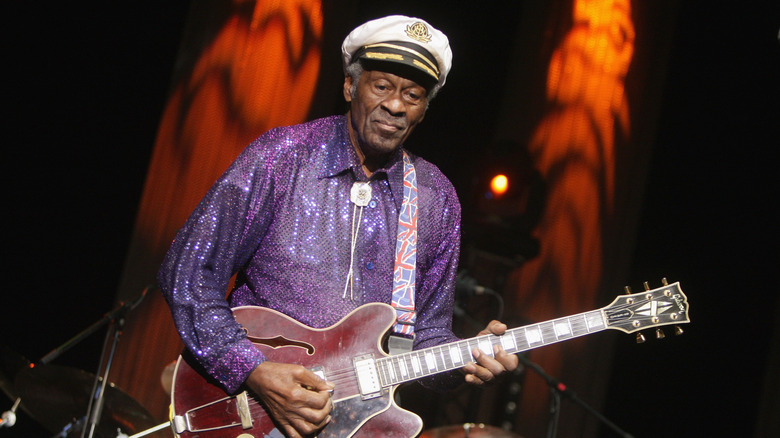
Guitar music is recognizably different across genres and eras, but in modern rock, it has a distinct style that's a huge part of the overall sound. Since rock came into its own through the '50s and '60s, that sound has changed, thanks in part to guitarists who were truly ahead of their time, playing and innovating the instrument in ways that would make rock what it is today.
Whether through skill, creativity, or invention, some guitarists have impacted rock music so heavily that they fundamentally changed its flow. The '50s kickstarted rock 'n' roll from jazz and blues, the '60s saw the British Invasion and the start of a branching rock genre, and with the '70s, arena rock and multiple subgenres emerged, and rock continued to evolve. Riffs got heavier, the clean sound of early rock icons was replaced by overdrive and distortion, and solos became more than a short way to bridge song segments. Rock became a beast with many heads, and that evolution took the hands of several skilled guitarists.
Every guitarist on this list has been recognized for their contributions to music, and they're each inductees into the Rock & Roll Hall of Fame. But unless you're a musical history enthusiast, you might not know how their individual playing styles left a lasting mark on rock music. So, let's take a look.
Chuck Berry is the godfather of rock
The "Godfather of Rock" is none other than the legendary guitarist Chuck Berry. If it wasn't for his music in the '50s, the guitar may have never become the popular rock instrument that it is today. Berry mixed together other popular musical styles of the era, creating a sound that would later be attributed as the blueprint for popular rock music. He didn't invent the entire genre or the guitar style on his own — that came from generations of musical influences — but he distilled it into one of its first commercial origins.
In Berry's hands, a foundation of blues, a helping of jazz, and a touch of country morphed through a chrysalis of performances to create something entirely new. Using the distortion common in the electric style of Chicago blues, Berry's guitar rang with a sound that became synonymous with rock music, and he was one of the first to take the guitar from background rhythm to the focal point of an ensemble. He even entertained the crowd like a rock star, playing his guitar behind his head in much the same way Jimi Hendrix would decades later.
Sister Rosetta Tharpe is the godmother of rock
Where Chuck Berry is rock 'n' roll's godfather, Sister Rosetta Tharpe is the undisputed "Godmother of Rock." Indeed, Berry's style wasn't entirely his own invention, even if he helped usher rock into existence. Much of what he did was simply an imitation of Tharpe, a slightly earlier and lesser-known gospel musician. Tharpe once said, "Can't no man play like me," and she wasn't lying. Her critics once claimed her highly skilled guitar playing and high energy weren't appropriate for a woman, but there's a good chance they actually felt threatened by her abilities.
Tharpe drew from blues and jazz genres and made masterful work of scales on the fretboard, and her riffs and licks actively drove her songs forward, rather than simply remaining buried in the overall melody. Her style and guitar playing directly inspired the first generation of rock 'n' roll musicians — Elvis Presley, Johnny Cash, Jerry Lee Lewis, you name it. Listening to her music, the guitar sounds just like what you'd expect from artists in the '50s and '60s, yet she was doing so a decade or two before they were — the definition of "ahead of their time."
While Tharpe was well known in those early days, she's largely forgotten in the modern era, outside of music history enthusiasts. She played the famous Cotton Club with Cab Calloway in 1938, but these days, Tharpe draws fewer than 100,000 listeners per month on Spotify, far less than she deserves.
Link Wray popularized a chord that changed rock music forever
Rock 'n' roll guitar legend Link Wray first reached fame in 1958 when he released "Rumble." This was a time when rock guitar was clean and crisp, ringing with the electrical sound of steel strings and nothing more. Wray took that style of guitar, flipped it on its head, and threw it to the dogs, becoming one of the first major commercial successes to use the distortion and attitude that would define rock through the modern era.
Wray didn't have access to distortion effect pedals and stompboxes like the rock guitarists of today. Instead, he created the sound by punching holes into the cone of the speaker of his relatively primitive tube amp. Such a simple act made his brand of rock something grittier than the rock music of his contemporaries.
Not only did Wray sound like the hard rock and metal of generations to come, but he's also credited with inventing the power chord, though it's more likely that he just popularized its use in rock 'n' roll. Regardless, this simplistic guitar chord structure has become the basis of many rock songs — particularly in metal, hard rock, and punk rock music — and much of that is thanks to Wray. His music directly influenced guitarists like Pete Townshend of The Who and Jimmy Page of Led Zeppelin and the Yardbirds fame. He continued to play and experiment with guitar sounds well into the '60s, and is credited with being one of the inventors of the Americana genre.
Eddie Van Halen fundamentally changed everything from guitar solos to equipment
Everyone knows that Eddie Van Halen was one of the best self-taught guitarists in rock history. He could riff and solo like it was nobody's business, but being good doesn't mean you helped invent the sound of modern rock. Van Halen is on our list because he fundamentally changed rock guitar and solos by incorporating certain styles of playing, as well as possessing a level of skill that would set a precedent for future musicians.
Van Halen wasn't the first to use the two-hand tapping technique on the frets, but he certainly popularized it in the rock world. This allowed him to play the guitar in much the same way a pianist would play the keys, being able to go faster and produce a more varied sound. But it wasn't just the tapping that made Van Halen's guitar revolutionary. His sheer skill showed the world that a new era of guitar-driven rock was on the horizon, with a new sound and level of technical skill that future guitarists would have to live up to.
Beyond playing, this masterful guitarist is responsible for several pieces of guitar gear that are still in use today, including a guitar assist support and a tuning device. Most notably, his self-made "Frankenstrat" guitar led to the creation of the Superstrat, which became one of the most popular electric guitars,
Jimi Hendrix showed the world how the modern rock guitar is played
Before Eddie Van Halen changed rock guitar, helping to usher in the modern-day sound of rock 'n' roll was Jimi Hendrix. He was so good that he absolutely stunned Eric Clapton the first time Clapton heard him play. And it was this skill — his technical ability and his showmanship — that made a massive impact on the rock music we hear today.
Skill doesn't necessarily equal influence, but Hendrix is an exception to the rule. He played the guitar in a way that no one before him ever could, and it changed how rock music sounded. His soloing style became the root of hard rock and heavy metal solos – if you couldn't climb a scale with Hendrix's energy, you were just playing rhythm with your amp turned up. Even simple moves like playing the low string with your thumb from the top of the fretboard became commonplace after Hendrix used them on stage.
Hendrix's playing inspired countless rock musicians from his heyday through today, but he also brought a stage presence and entertainer energy that rock needed to match if it wanted to stay relevant. As a guitarist, you couldn't sit back on your heels and let the rest of the band pick up the slack when it came to boosting the crowd. You were either a central figure in the showcase or you seemed out of place, and that's exactly how rock guitar is used today, largely thanks to Hendrix.