

The 5 Most Beautiful Female Voices Of The '70s
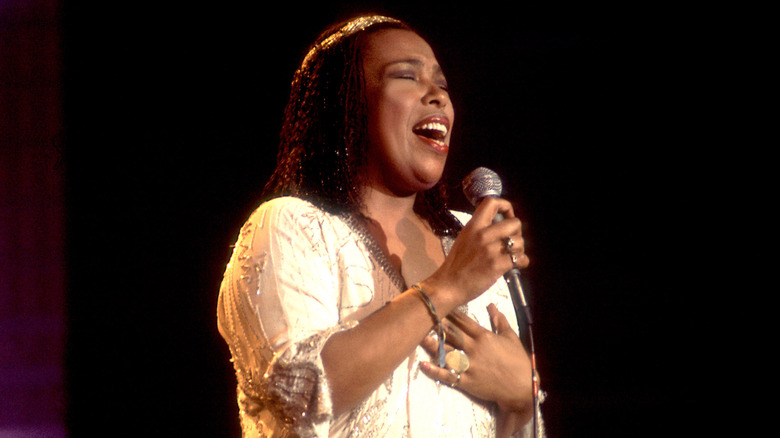
The 1970s was truly an eventful decade for music, as the rock, disco, punk, soul, and funk scenes were in full bloom. The decade wasn't short on amazing singers either, which made it hard for a vocalist to stand out from the rest. So we've chosen five singers who separated themselves so far from the pack that they can be considered the most beautiful voices of the '70s.
All of the artists that we selected are celebrated for their singing ability more than their fame and many accomplishments, which speaks to how much their voices have touched people. Their vocal performances are also the best part of any song that they deliver, from the ethereal yet mighty voice of Olivia Newton-John to the supreme ability of Barbra Streisand to tailor her voice to match the emotion of a song, like she's playing a character when singing. Put simply, all of these singers are constantly celebrated for how their voices have affected the music industry and the entire world.
Minnie Riperton
If you're able to hear operatic stylings in Minnie Riperton's voice, it's for good reason, because she was taught to sing opera at The Abraham Lincoln Center in Chicago at an early age, as well as Chicago's Junior Lyric Opera, studying for almost 10 years. The gifted singer eventually became known for her five-octave vocal span, which allowed her to take notes to heights rarely achieved.
However, more than incredible range is needed for a singer to reach someone emotionally, and Riperton achieved that by combining her unique register with sincere feeling, something that is showcased on ballads like 1975's "Inside My Love" and "Lovin' You," a No. 1 hit in 1975 that defined pop history. But the sweetness of Riperton's vocals can also be felt in her more up-tempo songs, like "Adventures In Paradise," which is just one example of her versatility.
However, as many wonderful singers know, talent often doesn't guarantee commercial success, and it eluded Riperton after her first album, "Come to My Garden." But that changed in 1974 with the release of her sophomore LP, "Perfect Angel," a project that climbed to No. 4 on the Billboard 200 and made her a global star.
Linda Ronstadt
Linda Ronstadt has five consecutive platinum albums under her belt, 10 Top 10 singles, 11 Grammys, and she was the first female artist to fill arenas in rock star fashion, yet none of those achievements are mentioned as much as her voice. One of Ronstadt's vocal gifts was her ability to give exactly what a song needs, from a confident swagger in 1974's "You're No Good" to vulnerability in 1970's "Long, Long Time," and a balance of power and tenderness in 1977's "Blue Bayou."
Ronstadt talked about her singing technique with San Francisco Classical Voice and explained how she learned to have so much control. "Those early years on the road, there weren't good sound systems, so I just screamed as loud as I could," she recalled. "It was when I learned to sing softly that I really got control of my voice, I could sing way better with half the energy, half the pushing."
The native Arizonan retired from her singing career in 2011 due to health issues, yet she's released enough stunning material to forever tide the world over, whether it's songs from The Stone Poneys, her work with Dolly Parton and Emmylou Harris as Trio, her solo work, or her many other collaborations.
Roberta Flack
Roberta Flack could break your heart into a million pieces with the soft sincerity of her voice, then put it back together with the sheer joy it elicits. Securing a music scholarship to Washington, D.C.'s Howard University before she was 16, Flack tapped into her talents early on before being discovered by jazz pianist Les McCann in her 30s, who set her up with an Atlantic Records audition after hearing her sing live.
"Her voice touched, tapped, trapped, and kicked every emotion I've ever known. I laughed, cried, and screamed for more ... she alone had the voice," McCann wrote in the liner notes of "First Take" (via Britannica), Flack's inaugural release. Donny Hathaway, who released a long list of gorgeous tunes with Flack, such as 1977's "The Closer I Get to You" and 1972's "Where Is the Love," was also deeply touched by her voice, once telling Blues & Soul magazine (via Oxford American) that he never stopped being taken with her singing chops.
In a 1980 interview with The Christian Science Monitor, Flack talked about the importance of not just relying on the technical aspects of singing to touch someone, but knowing how to step inside of a song to interpret its feeling. "A musician is a person who is challenged by the very mystery the music holds ... to try to unfathom it and find some meaning in it for yourself and then to transfer that meaning in a vocal or instrumental way to other people so they can hear it."
Barbra Streisand
Even though Barbra Streisand's voice has been analyzed and dissected through the years, she first had her sights set on acting, not singing. But those acting chops have helped her singing tremendously, because she's able to act within a song, and step into the part of its protagonist with the greatest of ease.
Streisand brings the theater into the recording booth and uses her three-octave vocal range to sing conversationally, as if she's having a heart-to-heart chat with you in her living room. That unique style can be heard on a slew of '70s hits such as "Evergreen," "You Don't Bring Me Flowers," and "The Way We Were." Streisand is also able to translate that intimacy into her stage performances, yet never in the exact same way.
"I want to play with it, play with the music, you know, rephrase it depending on how I felt that night," she explained in an interview with NPR. "That's what I think keeps a performance honest. You can't just copy what you did from the night before." But it just isn't Streisand's enunciation and communicative singing style that make her voice one of the best; it's the extreme control she exhibits, as well as her ability to transition seamlessly between higher and lower registers.
Olivia Newton-John
Visualizing Olivia Newton-John's voice may conjure up an image of gentle sunrays shooting through clouds and landing in a field of flowers. Indeed, her voice contained a warmth that floated effortlessly through songs like a bird in midflight. Her 1974 single "I Honestly Love You" is a prime example, where she sings just above a whisper and brings a feeling of affection to the song.
Even on up-tempo cuts like "Have You Never Been Mellow," Newton-John's soft delivery brings a level of intimacy to the lyrics, as if it's a ballad, but her ultra-light voice was far from fragile. That quality helped make songs from the musical "Grease" timeless classics, — and proof that 1978 was a stand-out year for movie soundtracks — whether it's her mighty delivery on "You're the One That I Want" or "Hopelessly Devoted to You."
"I first fell in love with Olivia's voice when I was a little girl and heard 'I Honestly Love You.' Songs like 'Magic,' 'Suddenly,' and 'Have You Never Been Mellow' showcased her beautiful airy tone and signature sound," Mariah Carey posted on X after Newton-John died in 2022. "And THEN there was GREASE. I was obsessed."