

Country Rock Bands That Defined The '70s
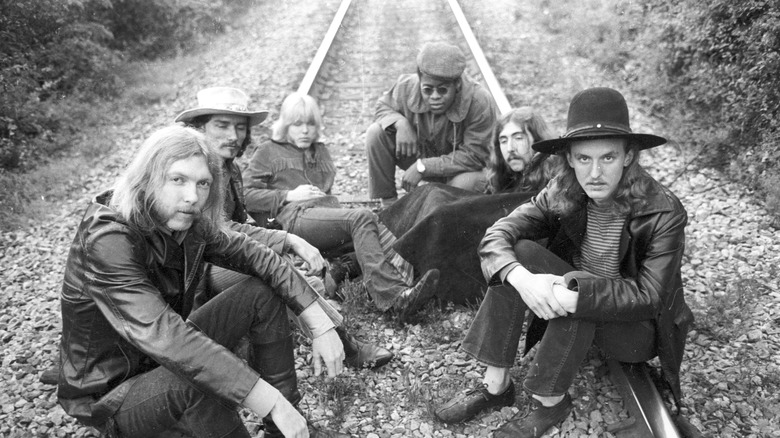
One of the most influential sounds to arise from the post-folk and rock movement of the '60s was country rock. The fusion of twang and crackle was the perfect fit for musicians who couldn't choose between the two. The sound provided a backbone for adult contemporary artists who softened the edges, and more devoted rockers who sharpened them instead. What resulted was a handful of country rock bands whose sounds helped define '70s music and forge the framework for Americana artists yet to be.
Every band that helped solidify the rootsy sounds of country rock are familiar units with catalogs that became contemporary musical canon; the Eagles, the Band, Pure Prairie League and more showed the world that country tones could hang over rock bones, and vice-versa. Whether they rode the line and dipped songs gingerly into both sounds or favored one mode more than the other, the country rock bands that defined '70s music are a rowdy bunch of innovative writers and players who made their own rules.
The Eagles
Arguably the biggest country rock band to ever take ownership of '70s airwaves, the Eagles gave the California sound an intoxicating shot of country swagger. They were helped along in part by drummer-vocalist Don Henley, a Texas native who carried many of the band's songs with his husky, Southern-tinged vocals. With the Southwestern desert providing a dusty backdrop that merged with SoCal grunginess and a penchant for country-heavy guitar work, the Eagles stitched together a patchwork personality that felt both unique and familiar.
Memorable hits like "Tequila Sunrise," "Already Gone," and "Take It Easy" made the most of the country elements of the Eagles' quintessential formula. But it went even deeper than that early on. The band's second album, 1973's concept album "Desperado," cast the band as Old West cowboys, right down to the photographic reenactments that became the album art. The title song became the band's unofficial anthem and one of the finest country rock ballads in the history of modern music, though it wasn't released as a single. Nonetheless, the Eagles hold the distinction of being one of rock's highest-selling acts, proving that '70s country rock could move money from the get-go.
The Allman Brothers Band
Known for hits like "Ramblin' Man" and "Midnight Rider," the Allman Brothers Band were like a band of musical outlaws with a talent for melody and mood. Actual Allman Brothers, Duane and Gregg, who came up through the music scene of the South as young players building out their sound, depended on a shifting lineup of bandmates throughout their career. The early '70s lineup included legendary guitarist Dickie Betts as well as pianist Chuck Leavell and drummer Butch Trucks, with others coming and going, including founder Duane Allman, who died in a motorcycle crash in 1971.
Gregg Allman kept on trucking with the band, churning out historic country rock with a smoky husk in his voice and a playful sense of down-home spirit that never dulled the rock edges of the music he made, both with his ever-changing band line-up and as a solo artist. His pioneering vision that merged soulful elements with a gritty rock set the gold standard for a sound that may evolve, but never loses its '70s era call-backs — hallmarks that made Gregg Allman a Southern rock icon before his death in 2017 and turned the Allman Brothers Band into one of country rock's most venerated ancestors.
Pure Prairie League
How country rock was Pure Prairie League when they hit their peak in the early '70s? Country enough for lead singer Vince Gill (who joined in 1979) to spin off a full-fledged country career and become a Nashville superstar after leaving the band. Hits like "Two Lane Highway," "Amie" and "Let Me Love You Tonight" made it clear the band was an adult contemporary favorite; a string of albums starting in 1972 put the League in a league of their own.
Many members came and went from the band after its original 1970 line-up shifted, including Country Music Hall of Famer Gill and fellow inductee Gary Burr; cameos by folk and country royalty like Emmylou Harris and ex-Eagle Don Felder helped expand the band's sound. Unlike other country rock acts that burned brightly before disbanding, Pure Prairie League is still in action more than 50 years after their inception. Their newer music may not circulate on the airwaves these days, but the tracks they laid down in the '70s set country rock music on the path it's still following today.
The Marshall Tucker Band
Hailing from Spartanburg, South Carolina, the Marshall Tucker Band had the bona fides to cause a country rock sensation when they came into their own in 1972. The following year, these down home players had contributed the swampy, Southern soul of "Can't You See?" to the growing collection of country rock songs on contemporary radio. They were the opening act for fellow country rockers, the Allman Brothers Band, asserting their own sensibilities while sharing the jangly sounds with their well-known road mates.
With its bold choice of a flute passage among the standard country rock instruments, "Heard It in a Love Song" presented a classic country scenario about a music man not letting love tie him down. Lines like "Wish you could come, but I don't need no woman tagging along" and "Always something greener on the other side of that hill / I was born a wrangler and a rounder" blended cowboy life with touring musician vibes in a way that rock bands like Bon Jovi and their stab at country rock "Wanted Dead or Alive" would echo years later. Not only did the Marshall Tucker Band leave a country rock mark in the '70s, but they helped inform the works of country rockers down the line as well. They're still a perfect introduction to country rock and one of the more intriguing '70s bands young music fans should dig into.
The Band
Back before the country rock label evolved into Americana and roots rock, Canadian-American unit the Band was blending soulful Southern influences into a folk-rock tapestry that presented the best of all possible elements. Their masterpiece "The Weight" is practically an anthem for Southern rockers who dig a country-fied version of their bluesy tuneage. You may not recognize the title, but you surely know the "Take a load off, Fannie" chorus. And "The Night They Drove Ol' Dixie Down" has all the Cajun influence of a Louisiana stomper, complete with a mournful, horn-heavy brass band flavor to add country melancholy of a slightly different flavor.
Key players in the Band included guitarist- songwriter Robbie Robertson, drummer and multi-instrumentalist Levon Helm, and bassist-vocalist Rick Danko. Having begun their country rock sojourn around 1960 as the Hawks, a backing band for blues singer Ronnie Hawkins, the members later became Bob Dylan's band in 1965, but The Band began writing their own songs and recording under that name in 1967.
Their journey came to a far-too-soon end in 1976, captured in a Martin Scorsese-directed documentary called "The Last Waltz" that many music fans consider a quintessential concert film. There was a limited reunion without Robertson in 1983, resulting in three more albums; Robertson went on to create a robust solo career as well as experimenting with acting. Listening to Americana and folk-country bands today, it's easy to hear strains of this Rock & Roll Hall of Fame band and their genre-defining works resounding through the decades.