

5 Songs That Prove 1967 Was The Best Year Of The Monkees' Career
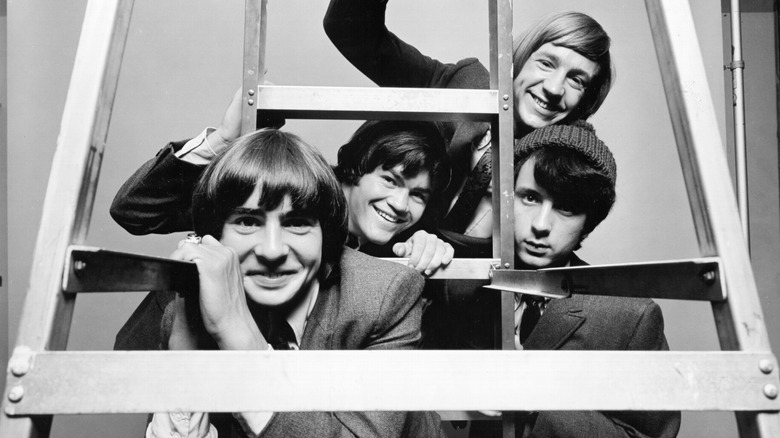
From cynically crafted fake TV show band to legit creative musical outfit, the Monkees quickly proved they weren't monkeying around (contrary to what they sang in their show's theme song). The Monkees swarmed the pop culture landscape in a flash in 1965, released their first album in 1966, and by 1970 they were done. Amidst such a flurry of success, 1967 was undoubtedly their finest year.
The Monkees had three albums reach No. 1 on the Billboard 200 in the same year, 1967: "Pisces, Aquarius, Capricorn & Jones Ltd.," "More of the Monkees," and "Headquarters." Their debut, "The Monkees," reached No. 1 the year prior. This absolutely unprecedented streak of success also produced three No. 1 songs, "Daydream Believer," "I'm a Believer" (lots of believing going on), and "Last Train to Clarksville." This pretty much sells our case for 1967 being their best year with their best songs, no matter that "Daydream Believer" and "I'm a Believer" were released as singles in 1966 prior to their albums releases (we're counting years based on album releases).
On the whole, our choices for their five best songs from '67 best convey the Monkees' enthusiastic energy, hooky melodicism, and infectious charm. No matter that the Monkees never even remotely approached the musical merits of the band they were constructed to emulate, the Beatles, they caught on for a reason, and their best songs portray that reason. So let's swing through the Monkees' discography and see what made them so great, including more depth than you might expect.
I'm a Believer
No matter how familiar and hard to hear with fresh ears, and no matter that the Monkees have plenty of other worthy songs in their catalogue, there's no way that "I'm a Believer" doesn't sit on the throne of songs that prove 1967 was their best year. Coming from 1967's "More of the Monkees," it was their biggest hit, reached No. 1 in December 1966 and stayed there for seven weeks, has gotten covered over 250 times (Smash Mouth and "Shrek," we're looking at you), and brims with the precise kind of youthful verve and vibrancy that made folks love the Monkees. Thanks be to Neil Diamond for writing the song, a move that he wasn't upset about because he considered himself a songwriter, first, not a performer.
It's really not hard to see why "I'm a Believer" worked so well for the Monkees. Innocent as a teenager's first love, but charmingly bold, the song's chorus states its resolute conclusion again and again: "Then I saw her face, now I'm a believer / Not a trace, of doubt in my mind." What other outlook would work for a band first recruited through an ad that called for "4 insane boys, age 17-21" for a new TV show, as Biography cites? So it was that four goofy, loveable kids getting caught up in antics proved the perfect vehicle for a whimsical, explosive earworm about romantic derring-do.
Musically, "I'm a Believer's" little organ motif in the chorus does the lion's share of expressing the song's irrepressible quirkiness. But the song wouldn't have worked so well if performed by another group. It really is enough to make even the most hardened cynic a believer.
Shades of Gray
Quite a bit more musically and emotionally mature than "I'm a Believer," "Shades of Gray" from 1967's "Headquarters" almost acts like a post-break-up follow-up to the Monkees' biggest hit: "When the world and I were young / Just yesterday / Life was such a simple game / A child could play." The Eleanor Rigby-sounding song, with its beautiful piano and string opening, goes far in demonstrating that the Monkees weren't mere network clowns who didn't understand music. "Headquarters" was essentially the first of their albums under their own creative control.
It took some work for the Monkees to wrest themselves and their musical fate away from publisher Don Kirshner, the force behind the quartet's rise to fame. Decades later in 1993, Kirshner called himself a talentless person who couldn't read or write music, but who had an uncanny gift for knowing what sounded good (per The Guardian). Be that as it may, the Monkees wanted to work on their own without him looming over things, and had to fight for creative freedom with the help of the show's producers. Without such efforts, we would have never gotten an album like "Headquarters," nor a song like "Shades of Gray" that very poignantly demonstrates the depth of the musicians hiding behind made-for-TV smiles.
Granted, the Monkees didn't write "Shades of Gray." That honor goes to Barry Mann and Cynthia Weil, a Grammy-winning husband-and-wife songwriting duo who penned the Righteous Brothers' legendary "You've Lost That Lovin' Feelin'." That's quite the pedigree. It took a big leap for the silly-seeming Monkees to tackle "Shades of Gray," but they pulled it off in spades.
Words
"Words" marks a final departure for the Monkees from the bubblegum sound that granted them popularity. It comes from "Pisces, Aquarius, Capricorn & Jones Ltd.," the last of the Monkees' three 1967 albums and thereby the most different from those albums under the control of publisher Don Kirshner. It's surreal, a bit unsettling, and is written in an eerie minor key that mirrors the song's heartbroken, semi-obsessive narrator ("Now I'm standing here / Strange, strange voices in my ears / I feel the tears / But all I can hear are those"). The shimmering guitar and prominent, descending bassline most closely resemble the strutting cowboy sound of Jefferson Airplane's "White Rabbit" from the same year.
"Words" comes from the pens of regular Monkees songwriters Tommy Boyce and Bobby Hart, who were responsible for 12 Monkees songs, including fan favorites like "Last Train to Clarksville," "She," and even the theme song from the Monkees' TV show. But by all accounts, they wrote it for the Leaves in 1966, a very short-lived garage band that put out two albums from 1966 to 1967. For whatever reason, perhaps because of Boyce's and Hart's ongoing collaboration with the Monkees, the Monkees covered it the next year.
But honestly, the Monkees' version of "Words" is so vastly different that the two might as well be different songs. The Leaves' version is exceedingly simple to the point of being crude and pushes a clean guitar to the forefront of the mix, going back and forth between two chords for the verse. The Monkees' took this template and added loads of instrumental nuance, variety, and interesting vocal layers. "Words" reached No. 11 on the Billboard Hot 100 as a B-Side to "Pleasant Valley Sunday."
The Kind of Girl I Could Love
In comparison to songs like "Words" or "Shades of Gray," "The Kind of Girl I Could Love" from 1967's "More of The Monkees" is something of a throwback, a ruckus celebration of one of the Monkees' central lyrical themes: love. We're choosing this song because it presages later Monkees' musical maturity, especially because guitarist and vocalist Michael Nesmith gets partial songwriting credit on this song. He was by far the most prolific songwriter out of the four Monkees, with 52 songwriting credits under his belt mostly across the Monkees and his own band, Michael Nesmith & The First National Band, who released their first album the year after the Monkees broke up in 1970.
Indeed, "The Kind of Girl I Could Love" is something of a Nesmith solo affair. He does lead vocals, backing vocals, steel guitar, and production on a hi-tempo song full of bombastic percussion, shining lead lines, a memorable steel guitar solo, and interwoven harmonic layers that all last less than two minutes, but still feels full. And, because Nesmith's voice is deeper, broader, and less nasal than Micky Dolenz's (the Monkees' drummer who sings on "I'm a Believer"), the whole song sounds less naive and immature than it might otherwise. "The Kind of Girl I Could Love" hints at the Monkees' full potential but still retains the band's innocence and early career gloss, including lines like, "Girl, you look mighty good to me / And I know that you've got to be / The kind of girl that I could love."
(I'm Not Your) Steppin' Stone
It should take less than one listen to "(I'm Not Your) Steppin' Stone" from 1967's "More Of The Monkees" to know why we're including it in this article. It's easily the most aggressive and sneering song out of the Monkees' entire catalogue, more like a proto-punk song than anything else. And wouldn't you know it? The Sex Pistols even covered it on 1979's "The Great Rock 'N' Roll Swindle," the soundtrack to the 1980 movie of the same name.
Once again, songwriters Tommy Boyce and Bobby Hart rear their songwriting heads on "(I'm Not Your) Steppin' Stone." And once again, like with "Words," they actually wrote it for another band: Paul Revere & the Raiders, who rocked the Billboard Hot 100 in the late '60s with five Top 10 hits and one No. 1 hit. None of those songs were "(I'm Not Your) Steppin' Stone," however, no matter that Paul Revere's version from 1966 is very similar to the Monkees' version. But Paul Revere's version has even harsher vocals and overdriven guitars.
Maybe the Monkees' slightly janglier, twangier version worked in their favor, as "(I'm Not Your) Steppin' Stone" is most closely associated with the Monkees than any other band. No matter how we cut it, the song is the Monkees at their most gutsy and garage-like — practically head-bangingly so. Take its driving energy, what sounds like power chords on the guitar, some characteristically Monkees organ lines, plus a bit of rockin' drumwork, and you've got a song that adds another dimension to the Monkees' entire output.