

5 Country Rock Albums That Helped Change The Sound Of The '70s
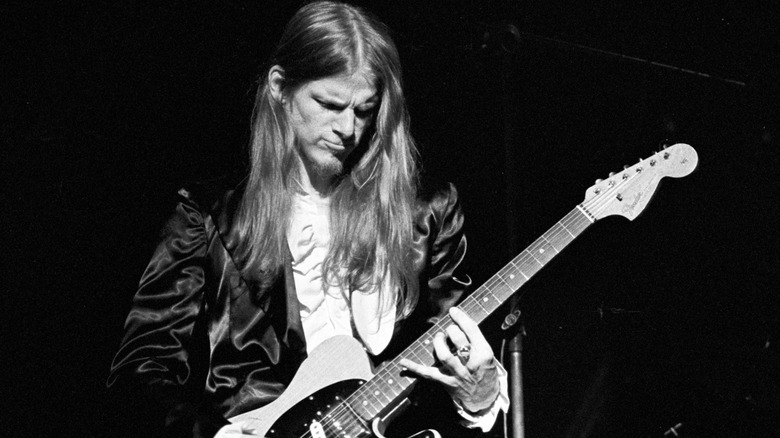
The 1970s were a time of rapid expansion in all rock idioms, and the wild world of country (aka Southern) rock was no exception. While it might seem like old hat by today's standards, the concept of infusing the blue-collar pastiche of country with the hard-driving, distorted guitars of rock 'n' roll wasn't always a foregone conclusion. With that in mind, we wanted to look at the albums whose rip-roaring contributions to country rock defined one of the most beloved and enduring rock subgenres.
For the purposes of this list, merely being country rock isn't enough — plenty of bands were jumping on board with the hybrid concept and making bank. We've chosen the exemplary '70s albums from artists who played crucial roles in evolving the sound. Whether it's a former Frank Zappa sideman taking all he'd learned from that legendary gig into the Southern idiom, or jazz fusion pioneers taking on a country twang, there's some fascinating Southern-fried innovation to discover.
Little Feat — Feats Don't Fail Me Now
A former member of Frank Zappa's Mothers of Invention band, guitarist Lowell George formed Little Feat when Zappa encouraged him to become a bandleader in his own right. That influence goes a long way to explain the sound of 1974's "Feats Don't Fail Me Now," an album that wears the country rock banner proudly but loosely.
Tracks like "Oh Atlanta" have the Southern phrasing and honky-tonk instrumentation inherent to the style, but the album sees those accouterments becoming set pieces for open, unhurried jam sessions and a steady influx of additional stylistic information. Album opener "Rock and Roll Doctor" is a slow-burning, funky meditation showcasing the unavoidable influence of Frank Zappa as a bandleader and arranger. Indeed, such proto-jam band groove worship and driving, boogie beats were a staple of the Mothers of Invention in all its eras, and Lowell, effortlessly fluent in that language, uses it to tell his own stories.
At the heart of that appeal is the always percolating dialogue between drummer Richie Hayward, percussionist Sam Clayton, and bassist Kenny Gradney. The deeply integrated, danceable meditation that results makes the whole album into one long, continuous bed of cowboy funk grooves, while song hooks fluidly drift in and out. It's a sonic space where the guitar work of Lowell George and Paul Barrére can wail and accent without pulling focus, and lush backing vocals (from no less than Bonnie Raitt and Emmylou Harris) cascade across a groovy landscape.
Thus, Little Feat's evolution can be seen as playing a central role in the evolving jam band sound. "Feats Don't Fail Me Now" picks up where the Grateful Dead left off and helped preserve the format until later acts were ready to pick up the slack in subsequent decades.
The Eagles — Hotel California
Arguably the ultimate '70s country rock experience, 1976's "Hotel California" finds the Eagles at their creative and commercial peak. The compositional and instrumental interplay between Don Henley, Don Felder, and Joe Walsh moves into the foreground, filling the gap left by the outgoing Bernie Leadon. As a result, a newfound attention to rockstar swagger moved front and center, and that unique '70s era of country rock fusion was fully defined.
That fruitful collaboration yielded "Life in the Fast Lane," one of those famous songs that started out as warm-up exercises. The track is particularly important because it demonstrates the Eagles' penchant for fully embracing the guttural guitar distortion and arrogant snarl of hard rock, but without abandoning the underlying country harmonies and lead phrasing. That genre-blending confidence is also heard on "Victim of Love," a pounding arena rocker that borders on sounding like a Southern Judas Priest.
Such attention-grabbing hard rock infusions serve to make ballads like "Wasted Time" and "The Last Resort," which lean more into the rhinestone-infused country pop stylings of Glenn Campbell, seem all the more poignant. Henley and the boys use those mellow moments to remind us that they are country balladeers first and foremost.
That earnest dynamic range is enough to justify the record's critical adulation and inclusion on our list, but the legendary title track deserves special commendation. The group's all-time biggest hit, its Latin-infused acoustic guitars and slow-burning hard rock undercurrents surround an ominous tale of demonic intrigue that has captivated listeners for decades, leading to widespread speculation about the hidden meaning of the song "Hotel California."
The Dixie Dregs — Free Fall
While other country rock artists dominated the charts, the Dixie Dregs were crucial in the musical evolution of the 1970s. Just as rock 'n' roll gave way to the sprawling exploits of progressive rock, so too did traditional notions of jazz rapidly evolve into the rock- and funk-infused realms of jazz fusion. That's where the Dixie Dregs play an important role: Their crackerjack musicianship encompassed the dirt-kicking aura of Southern rock, and also brought it into the sophisticated world of jazz theory and intricately structured improvisation. The band's first official LP, 1977's "Free Fall," finds an already mature band navigating their hybrid world as though the Allman Brothers Band had come to jam with Return to Forever.
Guitarist Steve Morse and violinist Allen Sloan carry off cheerful, respectfully aggressive solos that focus on accenting the chord changes, while using the usual Southern rock vocabulary more as textural color than a primary stylistic focus. But there's more at play than just the unique merging of Southern rock and jazz chord structures. By the late 1970s, jazz fusion was quickly evolving into smooth jazz, and the Dixie Dregs show subtle glimmers of a burgeoning style that would eventually be dominated by Kenny G, the Rippingtons, and Spyro Gyra.
Dixie Dregs albums such as "Free Fall" earned the respect of musicians, but the individual members thrived as hired guns: Steve Morse went on to work with Kansas and Deep Purple, while drummer Rod Morgenstein found rock radio success with Winger and eventually a professorship at the Berklee College of Music.
The Allman Brothers Band — At the Fillmore East
The Allman Brothers Band's tragic real-life story is the stuff of rock 'n' roll legend, but their impact on country rock and the 1970s as a whole cannot be overstated. Much of that initial influence is down to their seminal 1971 live album "At the Fillmore East," in which Duane Allman and Dicky Betts showcase guitar playing that would become the instrument's stylistic bedrock for the country rock genre going forward.
While Allman and Betts' axe work showcased on the album might seem pedestrian by today's standards, it's only because it's become one of the most influential sounds in the history of the electric guitar. The duo's precisely phrased harmony leads, delicate volume swells, and searing vibrato take the gauntlet thrown down by Jimi Hendrix and give it a fresh polish. Songs like "In Memory of Elizabeth Reed" and "Whipping Post" see both unleashing white-hot leads that never lose their bluesy flair, yet step outside of traditional pentatonic shapes with jazz inflections and unexpected exoticisms. Thus, it is an album with some epic long songs that sound even cooler today.
Duane Allman died in October of 1971, shortly after "At the Fillmore East" was certified gold. The unexpected loss led the group to restructure internally and complete their subsequent studio album, 1972's "Eat a Peach," as a five-piece band. That regrouping would come with an increased emphasis on songcraft and memorable hooks over extended jamming and instrumental virtuosity. Nevertheless, the impact of "At the Fillmore East" would endure.
The Atlanta Rhythm Section — Champagne Jam
The Atlanta Rhythm Section's most commercially successful album, 1978's "Champagne Jam," feels like a grand summation of a decade of country rock. What began as a genre full of gritty, snarling, blues-based menace evolved mid-decade – by way of the Eagles – into a commercial juggernaut that balanced instrumental dirt with contemporary pop prestige. With the majority of the era in the rearview mirror, the Atlanta Rhythm Section finishes polishing off a decade of stylistic refinement in grand fashion.
The band's name was derived from working as the house band at Studio One in a suburb of Atlanta, Georgia, and their tight session-player chops and ultra-slick production values quickly separated them from their more visceral and less refined country rock colleagues. The Atlanta Rhythm Section would spend the better part of the decade trying to drum up commercial interest, until "So Into You" from 1976's "A Rock and Roll Alternative" gave them their first hit.
Faced, as so many bands are, with label pressure to move away from long jams and displays of mammoth chops and into hit-single territory, the band released "Champagne Jam" and with it two successful singles: "I'm Not Gonna Let It Bother Me Tonight" and "Imaginary Lover." Throughout the tracks, the group's polish and sophistication can be traced largely to keyboardist Dean Daughtry, whose extended voicings and regal aura channel Ray Charles, Curtis Mayfield, and the Black gospel tradition.
For all its sterling accomplishments, the success of "Champagne Jam" was short-lived, with 1979's LP "Underdog" beginning a downhill slide in commercial viability. Eventually resigned to the legacy band circuit, the Atlanta Rhythm Section would reunite in various lineups throughout the subsequent decades.