

5 Classic Albums That Define The Sound Of '80s New Wave
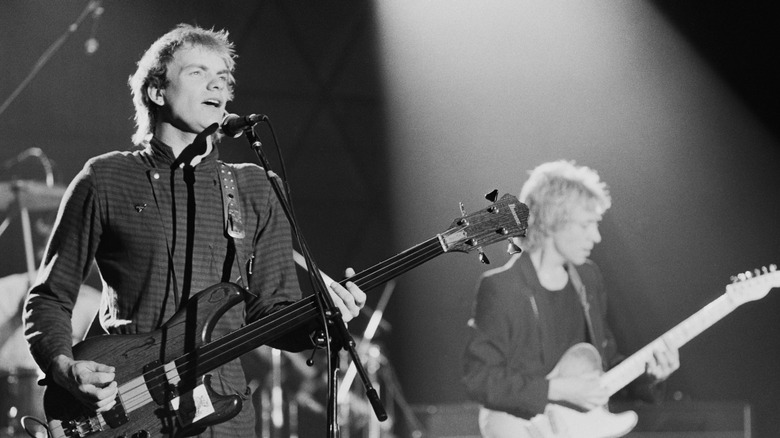
The albums that define '80s new wave are a diverse and playful lot. A term used to describe a wide array of newly emergent styles in the late '70s and early '80s, the new wave genre encapsulates a period when new artists embraced the everyman DIY ethos of punk rock while rejecting its frequently unpolished, unlistenable output. The result was a style of radio-friendly art pop that experimented as much as it moved units.
Whether you're talking about the influx of African percussion, reggae drum patterns, or literate, jazz-influenced guitar work, there's plenty of great new wave musicianship to explore, even if we were too busy spinning the records to notice it the first time around. With that in mind, we wanted to take a look at some of the albums by new wave bands and artists whose work exemplifies that punk-meets-polish world of upbeat sonic exploration. Whether it's a trio of notoriously clashing personalities or a lone solo artist struck down in his prime, there was ample music to make the whole shack shimmy.
Duran Duran — Rio
"Rio," which blasted all the way to No. 6 on the Billboard 200 in 1983, is Duran Duran's magnum opus and, arguably, the definitive encapsulation of new wave as a genre. It fully embraces the synth-pop undercurrents of the new decade with a healthy infusion of funk virtuosity, cementing new wave's newly emergent presence as up-tempo, dancefloor-ready adult contemporary.
The album finds a young and hungry band just entering its first days of veteran professionalism. Vocalist Simon Le Bon makes the spotlight shine with his signature power baritone, but there's a fascinating auditory world unfolding behind him. Bassist John Taylor and guitarist Andy Taylor (no relation) dance nimbly over the muscular, workhorse drumming of Roger Taylor with rapid-fire arpeggiated invective from keyboardist Nick Rhodes. It's a sound that wholly detaches from the Bee Gees-inspired disco flair of the previous decade and sets a new era of dance pop on its course.
For all its enduring legacy, "Rio" never sounds like a faded relic of a bygone era. While so many of their contemporaries have fallen under the uncomfortable banner of "dad rock," Duran Duran transports us back in time to an era when their music was as vital, fresh, and, like, totally '80s.
"Rio" (and its follow-up, 1983's "Seven and the Ragged Tiger") proved so successful that the Taylors would be forced to launch the Power Station, one of the best funk supergroups of all time, just to give themselves a vacation from it all. That group proved to be a one-off, and Duran Duran have been satiating wild canine appetites ever since.
Tears for Fears — Songs From the Big Chair
1985's "Songs From the Big Chair," Tears for Fears' sophomore release, was the MTV breakout success that founders and creative core Roland Orzabal and Curt Smith had been hinting at with the more modest success of 1983's "The Hurting." Though that record had been well received (and contained "Mad World," famously remade by Gary Jules for the Donnie Darko soundtrack), there is still a stiffness to the album — a kind of overly fresh, unthawed quality that befalls even the most sophisticated of first albums.
"Songs From the Big Chair" finds the duo fully comfortable in their own skin. Songs like "The Working Hour," with its protracted instrumental intro and searing saxophone lines courtesy of Mel Collins, capture a newfound sense of conceptual and compositional maturity that lands somewhere between Vangelis, Enya, and Kenny G.
It's a smoldering mix, and that maturity prevails even on the album's more up-tempo radio fare, giving angsty anthems like "Shout" (an ode to primal scream therapy) and the chipper "Everybody Wants to Rule the World" a sophisticated assuredness that makes new wave's punk rock origins vanish completely. It's like if Leonard Cohen covered Depeche Mode.
"Songs From the Big Chair" quickly caught on as an international hit, with "Shout" and "Everybody Wants to Rule the World" joined by "Head Over Heels." The former two works hit No. 1 on the Billboard Hot 100, the latter reached a respectable No. 3, and the album itself spent five weeks at No. 1 on the Billboard 200. The success paved the way to longevity for Tears for Fears, who remain one of the longest-running rock duos of all time.
Talking Heads — Remain in Light
You may find yourself listening to the Talking Heads' seminal 1980 masterpiece "Remain in Light" with its intricate percussion and funk cadences. And you may ask yourself, "How did they get here?" Good question. The album's captivating sound is borne out of producer Brian Eno's penchant for indigenous African music, combined with guitarist/vocalist David Byrne's neck-snapping precision guitar playing. It's a natural — though dramatic — development of the post-punk sound they'd been developing across multiple albums since their days at New York's legendary CBGB's venue.
That multilayered sound is complemented by additional percussionists as well as King Crimson, David Bowie, and Frank Zappa guitarist Adrian Belew, adding the final layer of polish to a band that had been forging their way to upper-crust status without fully abandoning their punk undercurrents. The result is an album that echoes the jazz fusion stylings of Miles Davis as much as the slick '80s sophisticate pop it was quickly coming to define.
"Remain in Light" would clock a respectable No. 19 on the Billboard 200, although the single "Once in a Lifetime" would only scrape the Hot 100 at No. 91. Those are modest numbers compared to the group's later success, but it demonstrates why the album is regarded so highly: like so many pivotal new wave albums, it showcases a band that has all the scrappy energy of the punk scene melded with the high-brow sensibilities that would come to define the 1980s. It was an era when Wall Street tycoons and mohawked punks hung out at the same clubs, and the Talking Heads were happy to bridge the divide.
Snakefinger's Vestal Virgins — Night of Desirable Objects
Sometimes a genre-defining album still slips under the radar. Guitarist Philip Charles "Snakefinger" Lithman would go down in history as a longtime collaborator of the avant-garde music and media collective known as the Residents, but his solo albums manage to blend that band's experimental surrealism with remarkably mature, adult-oriented pop stylings. 1986's "Night of Desirable Objects," from Snakefinger's Vestal Virgins, his final solo LP, sees him emerge as a solid new wave songwriter and, as always, a captivating guitar soloist.
Songs like "There's No Justice in Life" and "Bless Me For I Have Sinned" have the up-tempo, ska-inflected manic energy and sarcastic humor associated with Oingo Boingo and Devo, while the laid-back, synth-heavy funk of "The Golden King" captures the elegant Marc Jordan/Bruce Cockburn end of the new wave spectrum. But between those polarities are wild left turns into unexpected territory: Snakefinger turns in an a capella gospel track with "Jesus Gave Me Water," and "Move" is a straight-ahead performance of Miles Davis' bebop standard. The album works to satisfy the new wave mainstream and fans of outlandish art rock in equal measure.
Though always a hit with the critics, Snakefinger never enjoyed mainstream success in his lifetime and would always be more remembered for his work with the Residents. The guitarist died on July 1, 1987, while touring in Europe with his band. It was, ironically, the same day that "There's No Justice in Life" was released as a single.
The Police — Synchronicity
There can be little wonder as to the real reason the Police broke up. The band were so famously at odds with one another that an album title like "Synchronicity" sounds witheringly ironic. Nevertheless, it stands as the Police's definitive — and final — statement as a band. Released in 1983, the album caps off a massively successful late '70s/early '80s run for a band who had become one of the foremost innovators of the new wave genre.
With a sound that could almost be described as "frantic reggae," the Police only barely nodded at new wave's punk roots before launching off in their own unique direction. Beginning with the success of "Roxanne" (a song whose plaintive wail has been sung to every woman with that name), the band launched into a series of iconic albums and supporting singles, with "Synchronicity" yielding their most successful hit in the form of "Every Breath You Take." The song would spend eight weeks at No. 1 on the Billboard Hot 100, and become a classic love song in the minds of everyone who never bothered to think about the lyrics.
But as with so many classic new wave artists, there's a wellspring of extraordinary musicianship to be found amidst all the pop panache. Though attention naturally falls to bassist/vocalist Sting's magnetic presence, it is drummer Stewart Copeland whose jazz vocabulary and polyrhythmic phrasing shine through, becoming hypnotic and fascinating to listen to while never forgetting to rock. That percussive intricacy forms the basis of the Police's off-kilter energy. Guitarist Andy Summers sits comfortably amidst it all, filling in the gaps between the two. It all makes for a sound that manages to summarize new wave while still being wholly its own thing.