

One-Hit Wonders Whose Songs Survived Longer Than Their Brief Fame
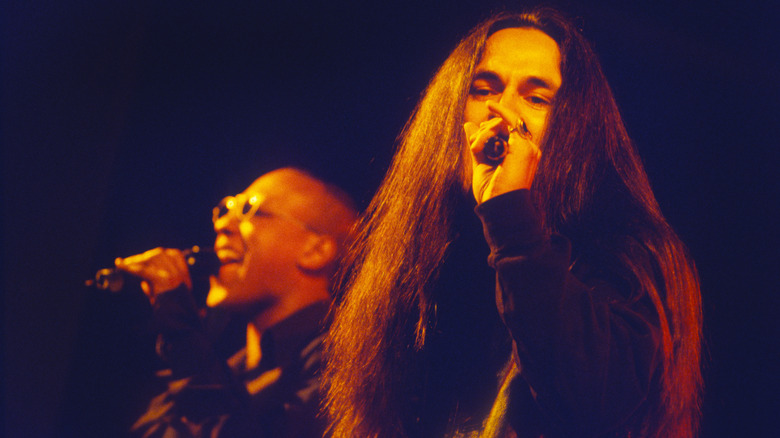
When it comes to one-hit wonders, many musicians ride the wave of their success for years and turn nostalgia into money. Haddaway and Lou Bega, for example, continue to perform even if they're mostly known for "What Is Love" and "Mambo No. 5," respectively. Yet there are other artists who vanished after their breakouts.
These one-hit wonders possess songs that still electrify audiences for various reasons, but they didn't stick around to experience it. Sure, those royalty checks (if they signed good deals) should remind them of their music's impact, but it's strange to think how they're nothing more than wrinkles in time in the music industry.
From Charlies & Eddie to Wild Cherry, let's swing by Memory Lane, turn left into Nostalgia Drive, knock on a few doors, and check out what happened to beloved one-hit wonders who might have deserved more than their 15 minutes of fame. Having said that, it's only mandatory that you play these songs while reading this.
Wild Cherry
In 1970, the funk 'n' roll sound of Wild Cherry was born. The group experienced turbulence and a revolving door of band members, but they only released their self-titled debut album in 1976. The record hit No. 5 on the Billboard 200 and generated the groovy single "Play That Funky Music," which hit No. 1 on the Billboard Hot 100 and stayed on the chart for 25 hip-shaking weeks.
Even though it was released in 1976, and it's a classic single that defined '70s funk, this hasn't stopped the track from being spun in clubs in the modern era. Wild Cherry understood the assignment and created an unmistakable song that gets any party started with its earth-shattering beat and bass-heavy boogie. "Play That Funky Music" also remains a favorite go-to song for Hollywood productions, appearing in everything from "The Office" to "The Nice Guys" and "The Big Bang Theory."
For Wild Cherry, though, they would peak as a band with this song. They received a Grammy nomination for best new artist of the year, and they released a few more albums afterward (including a sequel track titled "Keep On Playin' That Funky Music"), but nothing touched the seismic success of "Play That Funky Music," which vocalist/guitarist Rob Parissi claimed was written in five minutes. By 1979, Wild Cherry stopped playing that funky music altogether.
Ram Jam
"Black Betty" is one of rock's most famous one-hit wonders with no known author; however, it was popularized by Ram Jam in 1977. No matter how wild and raucous a crowd is, the moment that "Black Betty" blazes through the speakers, everybody can't help but clap along and belt out the catchy lyrics.
"Black Betty" peaked at No. 18 on the Billboard Hot 100 and hung around on the charts for 17 weeks, which isn't too far off from Ram Jam's actual lifespan as a band — if you blinked, you would have missed it. Vocalist and guitarist Bill Bartlett had recorded "Black Betty" with his former band Starstruck, but the track was repurposed as a single and appeared on Ram Jam's 1977 self-titled debut album, which peaked at No. 34 on the Billboard 200. Ram Jam released their next album "Portrait of the Artist as a Young Ram" the following year, but after it failed to chart or spawn a single, the band said, "See ya later, kid."
Decades after its release, Ram Jam's version of "Black Betty" remains immensely popular, having been used in a Super Bowl ad and continuously popping up in big TV shows like "The Hunting Party," "Friday Night Lights," and "Family Guy." A look at the comments section under the music video on YouTube shows how people still dig it to this day, with one commentator saying, "If your band is going to be known for only one song, make it a banger like this one."
Charles & Eddie
In 1992, the soul-tastic Charles & Eddie — consisting of Charles Pettigrew and Eddie Chacon — stormed the charts with "Would I Lie to You?" –- which was off their debut album "Duophonic." The song's vocal hooks sink their melody into you, making it impossible to shake off as soon as the line "look into my eyes, can't you see they're open wide?" rings.
"Would I Lie to You?" went to No. 1 in 18 countries. It debuted at No. 83 on the Billboard Hot 100, but it clawed its way up to No. 13. The ascension more than epitomizes how the song forged its way into pop culture — not only becoming a radio darling over the years but also appearing in TV shows like "The Rookie" and "The Challengers: All Star." As testament to its legacy, David Guetta, Cedric Gervais, and Chris Willis released a dance cover version of the song that burned its way into the No. 32 position on the Billboard Hot Dance/Electronic Song chart in 2016.
But what happened to Charles & Eddie after their big hit? Well, they released a second album, "Chocolate Milk," in 1995, then called it quits in 1997 after their record label ghosted them. "I was pretty lost," Chacon told The New York Times. "I had a real identity crisis after it was over. I questioned my own validity as an artist." Pettigrew passed away in 2001, while Chacon eventually released his own music.
Baltimora
Maybe not everybody knows the name Baltimora, but they certainly know the timeless tune of "Tarzan Boy." Sounding like a more musically refined version of Tarzan's yell through the filter of disco, this song just makes you want to join in the jungle jolly and wave your hands in the air.
Formed in 1984, Baltimora was a dance group that started out in Italy. They struck lightning with their first single "Tarzan Boy," which came off their 1985 debut album "Living in the Background." The song beat its chest all the way to No. 13 on the Billboard Hot 100 in 1986 and No. 3 on the U.K. charts. Peaking so early turned out to be a blessing and curse for Baltimora as the heat was on for them to top "Tarzan Boy." The title track off "Living in the Background" charted on the Billboard Hot 100, but it only managed to reach No. 87 and never had the lasting power of its predecessor. Baltimora would release their second album, "Survivor in Love," in 1987, but it struggled to have the impact of what came before it, so the group broke up.
In terms of "Tarzan Boy," this one-hit wonder still swings around in pop culture, appearing in movies like "Teenage Mutant Ninja Turtles III" and "Beverly Hills Ninja" as well as shows like "Stranger Things" and "Pluribus." The song has also been the theme song of AEW wrestler "Jungle" Jack Perry, who is the son of actor Luke Perry.