

5 Songs That Prove 1989 Was The Best Year Of The B-52s' Career
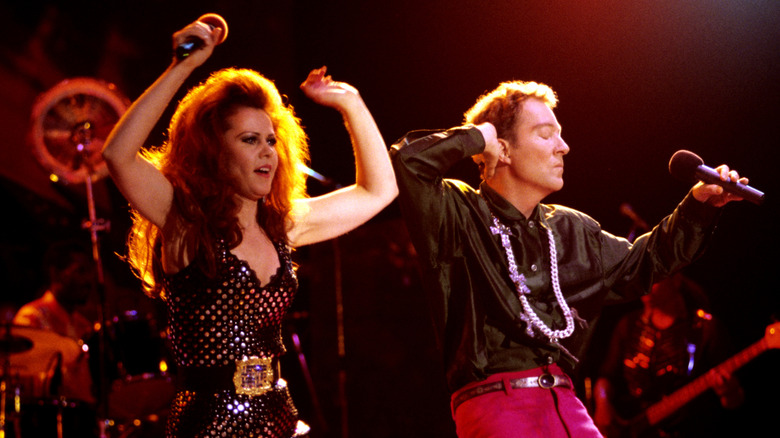
The B-52s started in the late '70s, but their pinnacle came a decade later. Their origin story is appropriately kitsch: five friends in Athens, Georgia, go out to Chinese food where they share a tiki drink called a Flaming Volcano. With the rum gone to their heads, they make their way to a friend's house for a jam session, discovering how much fun they could have playing music together. These friends — Fred Schneider, Kate Pierson, Keith Strickland, and siblings Ricky and Cindy Wilson — played their first concert at a house party on Valentine's Day 1977. Two years later, they released their self-titled debut LP, kicking off five decades of fun, love, and making people dance, and by 1989, the B-52s reached the height of their unique success story.
The B-52s recorded now-classic new wave tunes like "Rock Lobster," "Private Idaho," and "Song for a Future Generation." They were also LGBTQ+ icons, with Ricky, Schneider, and Strickland as gay men, and Pierson now married to a woman. Fifty years after their big coming out, the B-52s are getting their flowers, including having their stars added to the Hollywood Walk of Fame in October 2026.
But these flowers sprouted through hardship. Ricky Wilson died of AIDS/HIV-related complications in 1985. The loss of a brother, dear friend, and the man credited with shaping the band's sound was too much. The B-52s went on hiatus, and the party might have been over for good — had they not rebounded with "Cosmic Thing. It's an album with five songs that prove why 1989 was the best year of their career.
Cosmic Thing
The B-52's fifth album opens up with the title track. "Cosmic Thing" is a classic B-52s song, with the band's trademark vim and vigor. Schneider delivers the lyrics with his unmistakable cadence, recounting, "I was havin' this out-of-body experience / Saw these cosmic beings / Everywhere I went up there, they were shakin' their cosmic things." While some might interpret this "out-of-body" moment as a different kind of trip, apparently, the B-52s had a close encounter during the recording process.
"I remember one night up at the studio, we had a UFO sighting," Cindy Wilson told Billboard. "Fred and I were standing in the front yard and saw this light in the sky that was shaking and twirling around and around, kind of like in a unity pattern and jumping all around. We could not figure out what it was, but it stuck around for a little while and then left."
"Cosmic Thing" was included in the soundtrack to the 1988 sci-fi romantic comedy, "Earth Girls Are Easy," starring Geena Davis, Jeff Goldblum, and Jim Carrey. But since that film was a flop, odds are good that fans first heard "Cosmic Thing" when they bought the album. And what they found was reassurance: for a group wracked with grief over the loss of a pivotal member, the song told longtime fans that things were going to be okay. The B-52s weren't grounded by their sorrow. They were, in fact, reaching new heights of creativity and success.
Channel Z
Saying the B-52s weren't political is a mistake: being openly gay in the '70s and '80s was a political statement. However, the group never let that cross over into their music, as they always focused on being "the world's greatest party band." Yet, "Channel Z" showed that they weren't completely oblivious to what was going on in the world. The track is rife with environmentalist themes, with Schneider singing, "Space junk, laser bombs, ozone holes / Better put up my umbrella," on the first chorus. Pierson and Wilson soon chime in, singing how they know "we've got to change what's happening / something good could happen."
"I think what we do best is, do whatever music we feel passionate about, and we talk about the political stuff in interviews and do benefits and things like that," said Schneider (via Bandcamp). "We don't want to write songs where we hit somebody over the head with a message. 'Channel Z' is very direct, but it also just isn't a downer."
"Channel Z" marked the B-52s' growth as a band, so much that Warner Bros. Records held a marketing meeting to discuss "Cosmic Thing," four of the label's vice-presidents argued over which should be the album's first single (via Rolling Stone). They ultimately decided on "Channel Z" before pushing it out to college radio. "Channel Z" didn't make it to the Billboard Hot 100, but found its way to the top of the Alternative Airplay charts, spending three weeks at No. 1.
Deadbeat Club
1989 was when the B-52s rediscovered themselves. After the death of Ricky Wilson, Keith Strickland shifted from drums to guitars and keyboards, having written songs with those instruments after losing his dear friend. "Writing the music which became 'Deadbeat Club,' I was thinking about Ricky a lot," Strickland told CBS Sunday Morning in 2022, "and that was one of the songs where I was imagining him sitting beside me playing."
"Deadbeat Club" shows off Kate Pierson and Cindy Wilson's vocals (with Fred Schneider chiming in on the chorus). It's an autobiographical song, harkening back to the band's earlier days when they were broke and spent their time drinking coffee. "Friends of ours would say, 'Oh, you're such deadbeats.' So we'd joke about ourselves being the deadbeat club," Strickland told Spin in 1990. The song is full of references to Athens, including Allen's burger spot ("Going down to Allen's for / a twenty-five cent beer") and the Normaltown neighborhood.
As the fifth and final single from "Cosmic Thing," "Deadbeat Club" enjoyed some of the success from the previously released track: it peaked at No. 30 on the Billboard Hot 100. For the B-52s, the song's success couldn't be measured in numbers. "'Cosmic Thing' was really written to heal ourselves, but magically it healed a lot of other people who heard it," Pierson told CBS Sunday Morning. "Being outsiders or gay or whatever, they felt different, and I guess our message was, it's always, it's okay to be different."
Roam
If "Cosmic Thing" was the B-52s finding themselves, they first had to get lost: in the case of Keith Strickland, it was getting out of New York City in the late '80s and heading north to the country. After studying Buddhism and attending events at the Karma Triyana Dharmachakra Monastery in Woodstock, New York, Strickland relocated to the town, calling the location "idyllic and very healing" (via Billboard). It was there when he began working on the music for "Cosmic Thing," creating the music that would guide his friends back from grief.
Kate Pierson herself would also move to Woodstock. The band would even cut four songs for the album with producer Don Was at Dreamland Studios in nearby West Hurley. "Being in the country while working on 'Cosmic Thing' gave us the easygoing, porch swing life we had in Athens that we needed to make these songs," she told Billboard. Ironically, "Roam" was recorded not in Woodstock, but back in New York City with Nile Rodgers of Chic producing. A gorgeous composition built on Pierson and Wilson's harmonies, "Roam" crescendoes in that irresistible chorus: "Roam if you want to, roam around the world / Roam if you want to, without wings, without wheels."
"It was really fun music to make, about freeing our fortunes," Wilson told Classic Pop. "'Roam' has many meanings, but it's a beautiful song about death. It's about when your spirit leaves your body and you can just roam."
Love Shack
The greatest evidence that 1989 was the B-52's best year can be found in a funky little shack — "Love Shack," a global party anthem that has since become the band's signature track. "Love Shack" reached No. 3 on the Billboard Hot 100 in November 1989 (the band's first Top 40 hit); the RIAA has since certified it 3X-Platinum, and chances are, you're already singing the chorus.
The song was inspired by an actual place: the Hawaiian-themed Ha-Le, an Athens club that resembled a shack. "You wouldn't expect it to be what it was, and when you opened the door, it was a wild band playing," said Schneider (via Rolling Stone). With a now-iconic video (featuring longtime friend of the band, RuPaul), "Love Shack" became synonymous with partying, helping to revitalize the B-52's career while carving their niche in pop culture history.
As for the meaning behind the line "Tin roof rusted," there isn't one. While recording the song, Wilson sang "tin roof" as an ode to the shack's actual tin roof, thinking that the music would still play. But it didn't, leading her to utter "rusted" in that lower volume. Pierson told the AV Club that the term has taken on "all sorts of interpretations," with the most common idea being it means pregnant. "I have no idea how people got that idea," she said. "I've never heard that particular expression, and I don't even know how it came up, but I hear it all the time now!"