

5 Blues Legends You Didn't Know Changed Rock History
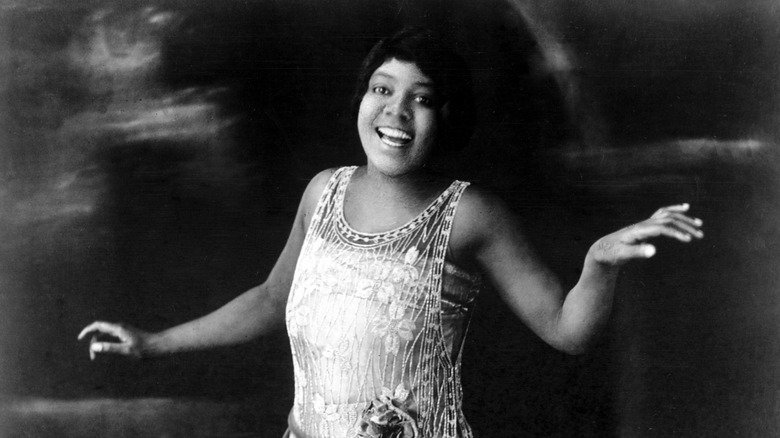
Rock 'n' roll pulled from many genres of music that came before it, but perhaps none more than the blues. Originating in rural areas of the Southern United States, blues music was itself inspired by genres like folk, ragtime, and Black spirituals. While you could argue that dozens of blues singers influenced rock music, a few had an outsized impact on the performers who came after them.
The blues was created, shaped, and disseminated by Black musicians, most of them Southern, who played and sang songs full of emotion and stories about real life. Once the genre became popular in the mid-1910s, white musicians also started recording blues songs. But Black artists, many of whom came from extremely hard backgrounds, sang with the weight of experience that would carry through the ages and inspire an entirely different genre of music. Here are five blues legends you didn't know changed rock history.
Lead Belly
Born Huddie William Ledbetter in 1889, the man who would become Lead Belly came from extremely humble beginnings. Before he became famous, Lead Belly spent several stretches in prison for assault, murder, and attempted murder. But his musical genius was evident: he could write songs instantaneously, and also had an encyclopedic memory for folk songs. His talents eventually got him to New York, where he performed, recorded, and influenced a sprawling group of musicians. He died in 1949, not long after performing in Europe.
According to Smithsonian Magazine, author John Reynolds has claimed that George Harrison once said, "If there was no Lead Belly, there would have been no Lonnie Donegan; no Lonnie Donegan, no Beatles. Therefore, no Lead Belly, no Beatles." Van Morrison and Ronnie Wood went further, with the former crediting Lead Belly with influencing the entire British music scene of the 1960s, a sentiment the Rolling Stone guitarist seconded.
It wasn't just the Brits, either. Janis Joplin credited the bluesman with making her care about music. And in his Nobel Lecture after winning the Nobel Prize for Literature, Bob Dylan remembered how listening to a Lead Belly album changed his life: "It was like an explosion went off. Like I'd been walking in darkness and all of the sudden the darkness was illuminated. ... I wanted to know all about it and play that kind of music." Lead Belly was inducted into the Rock & Roll Hall of Fame in 1988.
Bessie Smith
Elizabeth "Bessie" Smith was born sometime around 1895 in Tennessee. By 1906, both of her parents were dead, and she and her siblings were taken in by an aunt but lived in poverty. Smith started singing on the streets with her brother, and by 14, she was performing in theaters and getting rave reviews. In 1923, she signed with Columbia Records and quickly became the highest-paid Black performer, known as the "Empress of the Blues." Unfortunately, her career took a downturn after the Great Depression hit, and she died in a car accident in 1937. An estimated 7,000 mourners came to her funeral.
Smith's rough style and lyrics about living and loving hard influenced rock 'n' roll — and eventually rap — in many ways. Rolling Stone ranked her No. 33 on its list of the 200 Best Singers of All Time. Her recording of "Downhearted Blues" was included in the Rock & Roll Hall of Fame's unranked list of 500 Songs that Shaped Rock 'n' Roll. In 1989, Smith was inducted into the Hall herself.
Perhaps the rocker who was most famously influenced by Smith was Janis Joplin. "[Bessie Smith] showed me the air and taught me how to fill it," Joplin once said. "She's the reason I started singing, really" (via "Blues Music in the Sixties: A Story in Black and White"). After Smith's tragic death, her grave remained unmarked for decades. Then in 1970, Juanita Green, President of the North Philadelphia NAACP, and Janis Joplin bought a headstone for Bessie Smith. It reads, "The Greatest Blues Singer in the World Will Never Stop Singing."
Muddy Waters
Born McKinley Morganfield in 1913, the man who would become Delta blues legend Muddy Waters spent his childhood learning the folk songs of Mississippi and listening to every phonograph record he could get his hands on. He bought his first guitar at 17 and would find success after moving to Chicago.
When he realized his music was drowned out by the noisy patrons in the clubs he played, he bought an electric guitar and started singing in a manner closer to shouting, as well as putting together backing bands. The changes worked. He got the attention he wanted and went on to a stellar career.
He died in 1983, four years before he was inducted into the Rock & Roll Hall of Fame. The Hall credits him with forming the first real rock band in those Chicago clubs, and his influence on rock music was almost unmatched. The legendary guitarist scared Jimi Hendrix to "death" the first time he listened to his music. Hendrix told Rolling Stone, "I heard one of Muddy Waters' old records when I was a little boy and it scared me to death, because I heard all of those sounds. Wow, what is that all about?" Almost unbelievably, both Rolling Stone Magazine and the Rolling Stones are said to have taken their names from the Waters tune "Rollin' Stone."
Ma Rainey
Ma Rainey was born Gertrude Pridgett in Georgia in 1886. She would go on to create the classic blues style, and there is even a good argument that she was the first blues artist, period. She sang the blues in her vaudeville act at the turn of the century, spreading the sound outside of the South for the first time. Known as the Queen of the Blues, she is also credited as being the Mother of the Blues.
At a time when even the most iconic blues singers didn't write their own material, Rainey wrote roughly a third of the songs she recorded. Some of those were later covered by artists including Elvis Presley, Ray Charles, and Janis Joplin (who credited Rainey as one of her biggest influences). Her lyrics were unapologetic, covering controversial subjects including sex, bad relationships, and female anger. She didn't just sing; she gave full performances, drawing on her vaudeville experience. According to Mother of the Blues: A Study of Ma Rainey (via Time), her dance moves were described as uninhibited and provocative, words that immediately call to mind the complaints about Elvis' dancing decades later.
Rainey died in 1939. She was inducted into the Rock & Roll Hall of Fame in 1990 in the Musical Influence category, giving her credit for shaping not one but two genres of music.
Sister Rosetta Tharpe
There is no question about the influence of gospel and blues musician Sister Rosetta Tharpe, who's known as "The Godmother of Rock 'n' Roll." Tharpe started performing at age 4 and would initially become famous as a gospel singer, although her music — especially her iconic guitar playing — was unmistakably blues music, and many of the religious songs she played were written by a former blues artist.
It was Tharpe's use of an electric guitar, and the way she made it as much of an important part of her sound as her voice was, that defined her performances and made her a direct precursor to rock music. Jerry Lee Lewis remembered hearing her for the first time: "I said, 'Say man, there's a woman who can sing some rock and roll.' I mean, she's singing religious music, but she is singing rock and roll. ... She's hitting that guitar, playing that guitar, and she is singing." (via "Devil's Music, Holy Rollers and Hillbillies"). Some believe the distinctive playing style Lewis became famous for was him trying to recreate how Tharpe played the electric guitar on his piano. Pete Townshend essentially copied the windmill motion she made when playing. Little Richard said she was his favorite singer.
Unfortunately, Tharpe's credit for shaping rock 'n' roll was a long time coming. When rock music took off in the 1950s, young white men took center stage. Her influence was forgotten by the time she died in 1973. Tharpe was finally inducted into the Rock & Roll Hall of Fame in 2018.