

The Best Girl Groups Of The '90s You've Never Heard Of
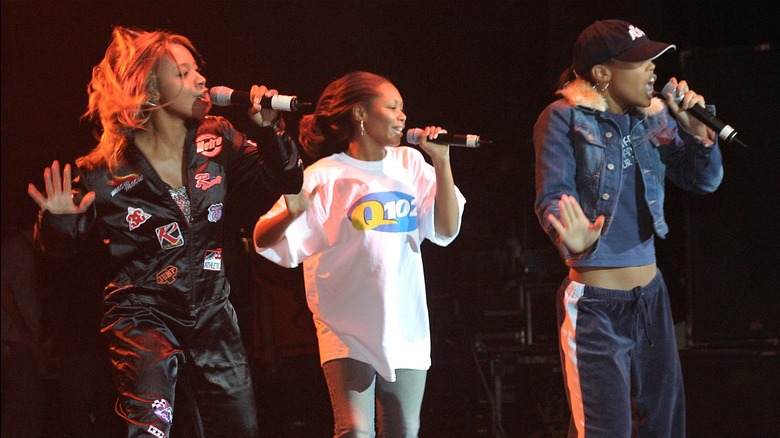
If you grew up listening to music in the 1990s, chances are you remember the decade's biggest girl groups. From TLC's infectious blend of hip-hop and R&B to the Spice Girls' unstoppable brand of pop, girl groups filled radio playlists, dominated music television, and provided the soundtracks to countless teenage romances and heartbreaks. But for every group that achieved lasting superstardom, there were many others whose careers followed considerably different trajectories. Some showed they had enough talent to rival the decade's biggest names yet never quite achieved the same recognition; others enjoyed enormous hits before seemingly disappearing overnight. (The latter shouldn't really be surprising, though; after all, throughout music history, some of the best girl groups had only one major hit.)
Interestingly, several of these now-overlooked girl groups were anything but obscure during their heyday. One group snagged a contract with a music legend's recording label, while another enjoyed considerable success before the members became embroiled in a dispute over their group name. Another created an anthem that remains instantly recognizable to '90s R&B fans. And there's a group that produced a future international superstar, albeit one who reached new heights of success as part of a different ensemble.
For this list, we're looking at five U.S. girl groups that made their mark during the 1990s but somehow faded into obscurity, becoming unfamiliar to today's listeners. We based our choices on factors such as (but not limited to) chart performance, record sales, critical reception, and distinctive musical contributions. Perhaps more importantly, we also looked into the circumstances that ultimately led to their decline in visibility.
Wild Orchid
Long before Stacy "Fergie" Ferguson became a worldwide musical sensation alongside the Black Eyed Peas, she was a member of Wild Orchid. The trio, which also included Renée Sands and Stefanie Ridel, formed in 1990, initially performing as NRG (New Rhythm Energy). Leaning toward an accessible combination of pop, dance music, and R&B, they eventually signed with RCA Records. The group's self-titled debut came out in 1997; their single "Talk to Me" peaked at No. 48 on the Billboard Hot 100.
Despite going on tour alongside successful boy bands and even being nominated at the Billboard Music Awards, Wild Orchid never really attained the kind of commercial breakthrough that could have skyrocketed them to superstardom. A year after their debut, their second album, "Oxygen," was released, but was sadly a commercial failure. Subsequently, their third album, "Fire," never saw release. In the midst of a growing fog of dissatisfaction within the group and because of her personal issues, Ferguson quit Wild Orchid in 2001; Sands and Ridel continued working together, releasing "Hypnotic," Wild Orchid's fourth and final album, under Yellow Brick Records in 2003.
Ferguson joined the Black Eyed Peas a year after she left Wild Orchid — and the rest, as they say, is music history. While Wild Orchid may not have had a happy ending, the three maintained their friendship throughout the years, with Ridel even writing two songs for Ferguson's 2005 solo album.
Brownstone
For a group whose debut album sold more than a million copies, Brownstone receives surprisingly little attention nowadays. Formed in 1993, the original trio consisted of Nichole "Nicci" Gilbert, Charmayne "Maxee" Maxwell, and Monica "Mimi" Doby. When Michael Jackson signed the LA-based group to his MJJ Music label, they became one of the first acts associated with the venture. Brownstone's first album, "From the Bottom Up," arrived in 1995 and quickly established the singers as serious contenders in an already-crowded field of female vocal groups. The single "If You Love Me" climbed to No. 8 on the Billboard Hot 100 chart and even earned the group a Grammy nomination for best R&B performance by a duo or group with vocal in 1996.
It's important to stress that their success wasn't simply a matter of having a famous recording executive behind them: Gilbert contributed extensively to the debut album's songwriting and production, giving "From the Bottom Up" a level of personal involvement and relatability that helped it stand out from other cookie-cutter girl group offerings at the time. However, Doby's sudden departure necessitated a replacement in the form of singer Kina Cosper. The revised Brownstone released their next album, "Still Climbing," in 1997, but it didn't match the success of their debut.
Brownstone's story took a tragic turn in 2015 when Maxwell died following an accident. Nevertheless, the group has continued to evolve rather than disappear entirely. In 2022, Brownstone — which now features Gilbert alongside Teisha Brown and Arin Jackson — announced a third studio album titled "Back Again."
Jade
Imagine enjoying a string of commercially successful albums and singles within the first five years of your musical career, only to become better known decades later for a legal dispute involving your band's name. That's pretty much what happened to Jade, the girl group made up of R&B enthusiast Joi Marshall, jazz lover Tonya Kelly, and gospel singer Di Reed.
Formed in 1991, Jade released their debut album, "Jade to the Max," a year later, achieving RIAA platinum certification by selling over a million copies. It also generated several hits, including "Don't Walk Away," which climbed to No. 4 on the Billboard Hot 100 in 1993. Jade's next release, 1994's "Mind, Body & Song," wasn't able to reproduce their debut's commercial success but still sold more than enough units to become a certified gold album. The second single off the album, "Every Day of the Week," peaked at No. 20 on the Billboard Hot 100. Despite these achievements, Marshall, Kelly, and Reed decided to go their separate ways in 1995.
Sadly, efforts to revive Jade eventually produced an unexpected complication. The trio discussed a reunion and jointly registered the group's name as a trademark, but those plans did not come to fruition. However, Marshall and Kelly, joined by singer Myracle Holloway, performed as Jade at a few concerts in 2021, prompting Reed to file a lawsuit over the use of the name. (To be fair, it's a far cry from some of the most petty lawsuits bandmates filed against each other.) Four years later, a federal appeals court ruled against Reed's trademark claims.
702
Before the trio of Kameelah "Meelah" Williams and sisters Irish and LeMisha Grinstead became 702, they (along with a third Grinstead sister, Orish) were part of a musical act called Sweeter Than Sugar. After showcasing their talents at a competition in Atlanta in the early '90s, the group got the attention of Michael Bivins, a founding member of R&B group New Edition. Under Bivins' guidance, the group changed its name to 702 (after Las Vegas' area code). Orish soon left the group, and the Williams-Grinstead-Grinstead trio became the final lineup. In 1996, 702 released their first album, "No Doubt," which included the single "Get It Together" (peaking at No. 10 on the Billboard Hot 100 chart).
"Where My Girls At?" (from their self-titled second album in 1999) was undoubtedly the group's breakthrough song, peaking at No. 4 on the Hot 100 and becoming one of the year's best-selling (and inescapable) singles. However, 702's third album, 2003's "Star," didn't quite reach the same commercial heights. Due to internal management-related struggles and the group members' individual career plans, 702 disbanded in 2003, but not without periodically reuniting for occasional performances.
Tragically, Orish passed away in 2008 due to kidney failure, while Irish died in 2023 following a period of severe health problems. Williams and LeMisha have since continued performing together and commemorating their former bandmates. In 2026, the surviving duo returned to Las Vegas for a concert celebrating three decades since their debut album.
Blaque
Considering that Blaque enjoyed two major pop hits and had the backing of a member of legendary girl group TLC, their relatively short stay in the mainstream spotlight feels rather unfortunate. Formed in Atlanta in 1996 by Lisa "Left Eye" Lopes, the trio consisted of Shamari Fears, Brandi Williams, and Natina Reed. Blaque released its self-titled debut album in 1999. The record achieved platinum certification, while its single "Bring It All to Me" peaked at No. 5 on the Billboard Hot 100.
Blaque's popularity subsequently extended beyond the recording studio, with the group appearing in the 2000 cheerleading comedy film "Bring It On" and the 2003 dance drama film "Honey." However, difficulties with subsequent album releases hindered the trio from building on their promising debut. Their sophomore album, "Blaque Out," took nearly a decade before being properly accessible on digital platforms, while their third, "Torch," remained unreleased for years. The tragic death of Lopes in 2002 was another tremendous setback, with Williams telling The Guardian in 2019 that the loss was a terrible turning point in Blaque's career.
Sadly, tragedy struck once more in October 2012 when Reed died after being hit by a vehicle. Despite losing their bandmate, Fears, now known as Shamari DeVoe, and Williams eventually resumed performing together as Blaque. The duo also released the previously shelved "Torch" in 2019. In 2024, the group's story received renewed attention through an episode of TV One's "Unsung."